Ancient Engineering · Homestead, Florida, USA

Coral Castle, Florida

A modern megalithic garden carved single-handed by a five-foot Latvian immigrant — and the go-to case for anyone claiming ancient stone-moving needs no mystery.

Mainstream: Built 1923–1951 AD (by Edward Leedskalnin)Alternative: Date not disputed — the argument is over the method, cited as living proof one man could move megaliths with 'lost' knowledge25.50°, -80.44°

At a glance

Coral Castle, Florida
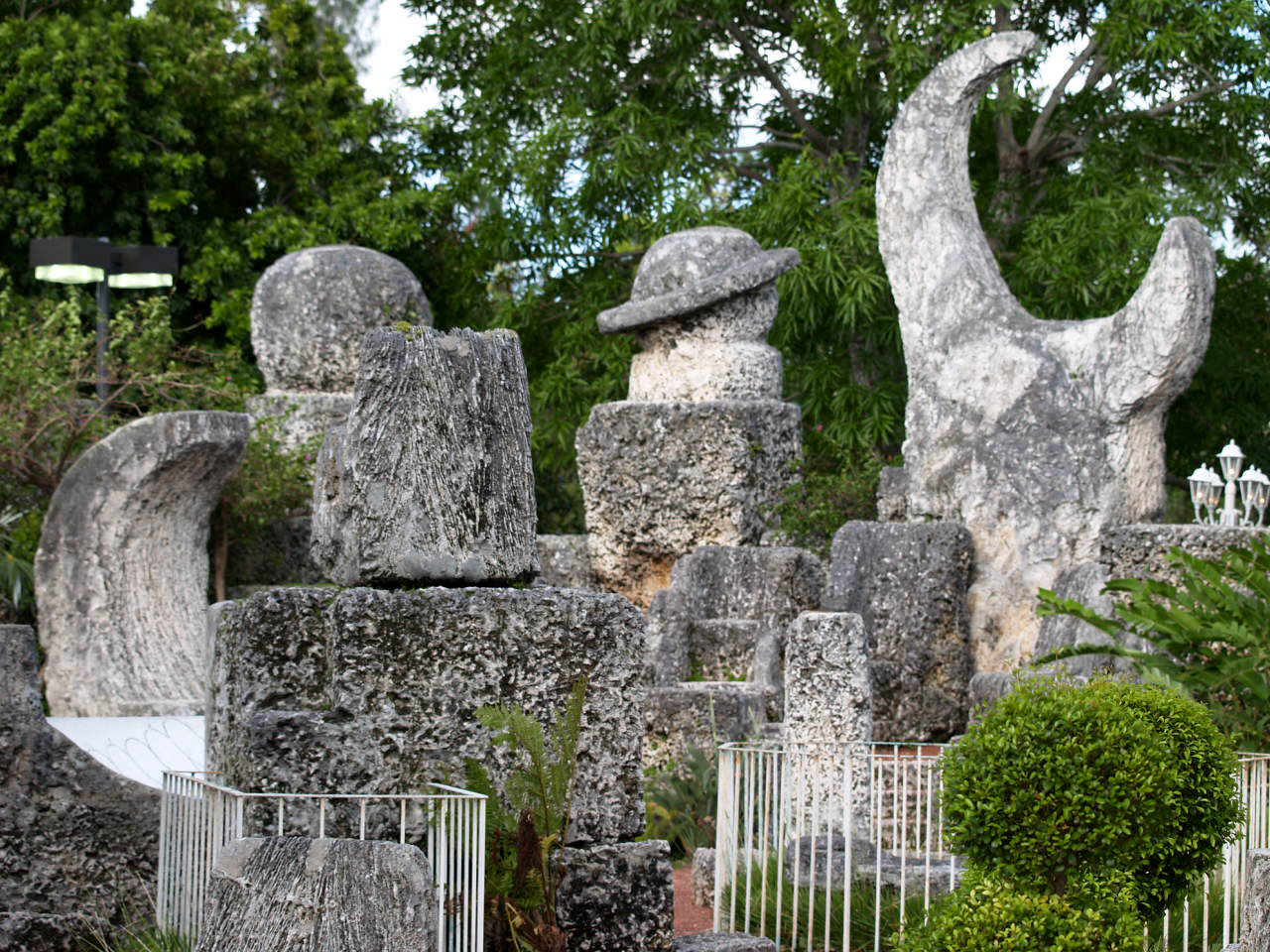
Photo: Christina Rutz (paparutzi) · CC BY 2.0

Coral Castle is a sculpture garden of oolitic limestone (locally called coral rock) built by Edward Leedskalnin, a Latvian immigrant, between 1923 and 1951, first at Florida City and then relocated to its present site near Homestead. It contains an estimated 1,100 tonnes of stone worked into walls, a nine-tonne swinging gate, tables, chairs, a sundial, a Polaris telescope, and rocking blocks weighing many tonnes each — some individual pieces heavier than the largest blocks in the Great Pyramid's outer casing. Leedskalnin worked almost entirely alone, mostly at night, and was famously secretive, telling curious visitors only that he 'understood the laws of weight and leverage' and had discovered 'the secrets of the pyramids'. Because it is a fully documented modern site, Coral Castle occupies a unique place in the ancient-mysteries debate: it is repeatedly cited as living proof that a single determined person, with simple tools, can raise megaliths — while also generating its own crop of legends about magnetism and anti-gravity.

See it on the globe →
The mainstream view

What archaeology says

To engineers and historians there is little genuine mystery about how Coral Castle was built, because the tools survive and eyewitnesses recorded the process. Leedskalnin used hand tools improvised from scrapped car and truck parts, block-and-tackle pulley systems, chain hoists, and — crucially — sturdy timber tripods made from telephone poles, from which he suspended chain falls to lift and swing blocks a few centimetres at a time. Photographs taken during his lifetime and after his 1951 death show exactly this equipment in place. The local limestone is soft enough to saw and quarry with hand tools when freshly cut, hardening on exposure, which explains how one man could shape it.

The decisive piece of evidence came in 1986, when his celebrated nine-tonne 'perfectly balanced' gate finally seized up and was dismantled for repair. Engineers found it was not floating on any mysterious force: it turned on a salvaged truck bearing set into a hole Leedskalnin had drilled precisely through the block's centre of gravity, which is why a child could once push it open. His methods were ordinary physics applied with extraordinary patience and an intuitive grasp of the fulcrum. His friend and building contractor Orval Irwin, who watched him work, wrote a 1996 book explicitly rejecting the paranormal readings as an insult, insisting it was leverage and 'the sweat of the brow'. Modern experimental demonstrations, including televised recreations, have shown small teams and even individuals moving multi-tonne blocks with the same tripod-and-lever kit.

Key evidence cited
  • Surviving timber tripods, chain hoists and block-and-tackle rigs photographed at the site
  • The 1986 gate repair revealing an ordinary truck bearing through the block's centre of mass
  • Soft, freshly-quarried oolitic limestone that hand tools can saw and shape
  • Eyewitness accounts, notably contractor Orval Irwin's 1996 leverage-based explanation
  • Modern recreations moving multi-tonne blocks with the same simple tripod-and-lever kit
The alternative view

What the skeptics propose

Coral Castle became legendary partly because Leedskalnin fed the legend himself. He wrote and self-published pamphlets on magnetism and 'Magnetic Current', claimed mainstream science misunderstood the nature of magnets, and dropped tantalising hints that he had rediscovered how the Egyptians and Peruvians moved great stones. Neighbours reported he worked at night with the site screened off, and no one ever quite saw the heaviest lifts happen — a vacuum that decades of speculation have filled. Popular writers and television programmes have proposed that he tapped Earth's magnetic field, used sound or vibration to reduce weight, or applied a lost anti-gravity principle, sometimes linking the site to ley lines and the '35th parallel' geometry.

Within the alternative-history community the more measured and more influential use of Coral Castle is as an argument by analogy. If one small, untrained man could move and place 1,100 tonnes of stone — including blocks heavier than most ancient megaliths — using only pulleys, tripods and time, then the standard objection that sites like Baalbek or Sacsayhuamán 'could not' have been built without advanced technology is undercut from the sceptics' own side. Some proponents press the point further, noting that Leedskalnin left no written method and that his productivity still seems remarkable, and use this to argue that simple ancient methods may likewise have been more capable than mainstream reconstructions allow. The magnetism and anti-gravity claims, by contrast, rest almost entirely on his showmanship rather than on any measured anomaly at the site.

Key evidence cited
  • Leedskalnin's own pamphlets on 'Magnetic Current' hinting he knew the pyramid builders' secret
  • His secrecy — working alone, at night, behind screens, with no one witnessing the biggest lifts
  • The sheer output of one untrained man moving ~1,100 tonnes single-handed
  • Blocks heavier than the Great Pyramid's casing stones raised without a construction crew
  • The site cited as proof simple methods could raise ancient megaliths thought to 'require' lost tech

Genuinely open questions

  1. Why did Leedskalnin cultivate the magnetism and 'secret' mythology rather than simply document his methods?
  2. How much faster or cleverer than a standard tripod-and-lever workflow was he really, given the pace of his output?
  3. Does Coral Castle strengthen or weaken the 'ancient megaliths need lost technology' argument overall?

Worth knowing

Leedskalnin is said to have built the whole place to win back a fiancée sixteen years his junior who jilted him the day before their wedding — he called her 'Sweet Sixteen' and reportedly kept working on his stone monument to her for nearly three decades.