What archaeology says
The standard account, followed by the Turkish Department of Culture, credits the Phrygians with the first excavations in the 8th to 7th centuries BC, taking advantage of tuff so soft it can be worked with hand tools. The complex was then enlarged over many centuries. Xenophon's Anabasis, written around 370 BC, describes Anatolian villagers living in excavated underground houses with their livestock, showing the tradition was well established by the Classical period.
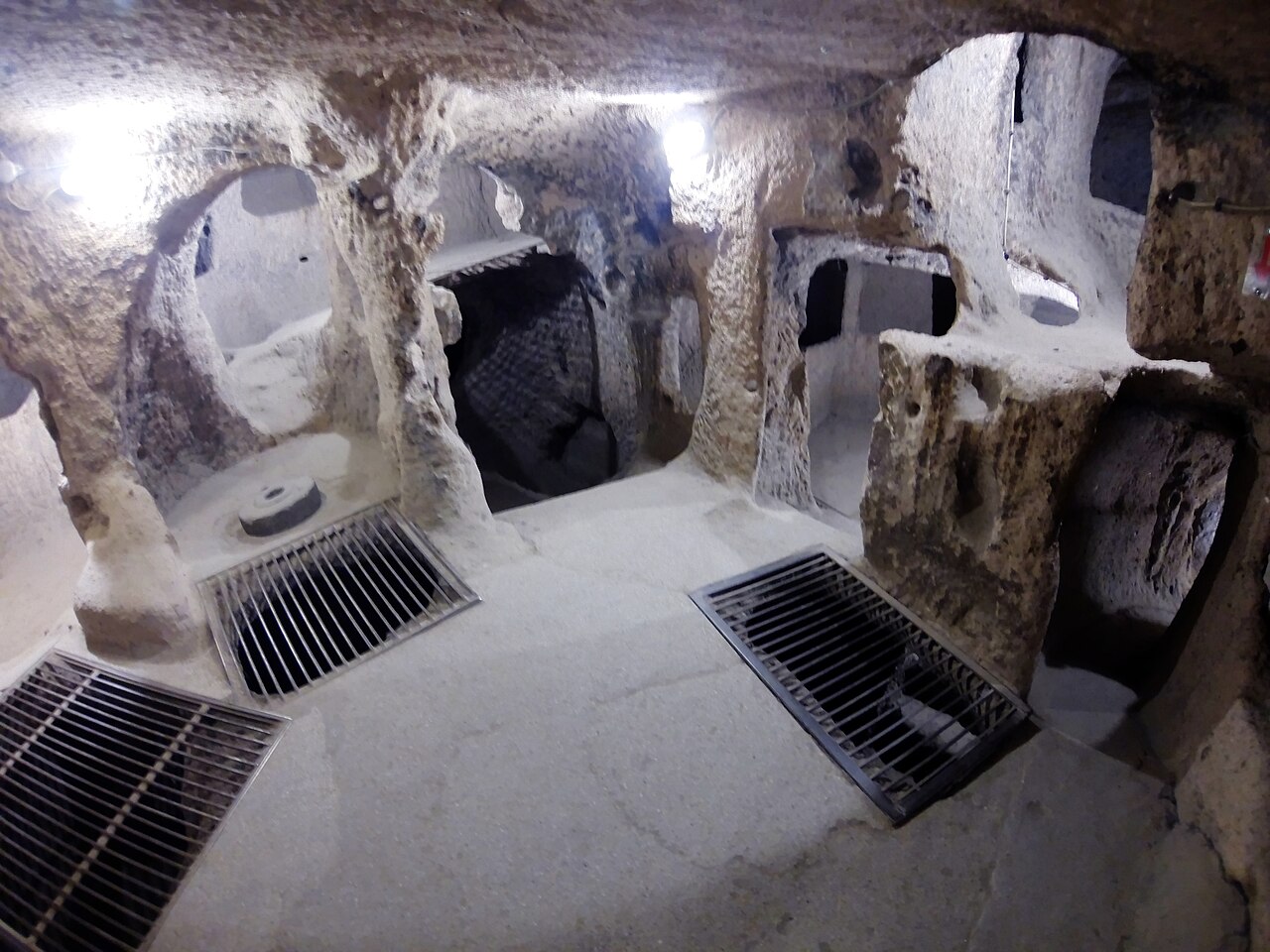
The city as visitors see it today is overwhelmingly a Byzantine creation. During the Arab-Byzantine wars of the 7th to 10th centuries AD, Christian communities deepened and fortified the complex, adding chapels, ventilation shafts and the great circular millstone doors that could seal each level from the inside. Population estimates for Kaymaklı at its height commonly run to around 3,500 people, with some scholars arguing the vast storage capacity implies considerably more.
Some archaeologists accept that the earliest chambers could be older than the Phrygians, possibly Hittite work of the 2nd millennium BC, noting Hittite-era artefacts found in the region and the strategic pressures of the Bronze Age collapse. But no excavated layer has yet proven occupation earlier than the Iron Age, and dating rock-cut voids, which contain no datable material of their own, remains notoriously difficult.
- Eight identified levels reaching roughly 80 metres down, with four open to the public since 1964
- Byzantine-era chapels, crosses and millstone blocking doors consistent with 7th–10th century AD refuge use during Arab raids
- Xenophon's Anabasis (c. 370 BC) independently describes underground dwellings in Anatolia
- Turkish Department of Culture attributes the first excavation to the Phrygians, 8th–7th century BC
- Extensive storage rooms, wineries and stables indicating planned refuge for thousands of people and livestock
- No excavated artefact layer at Kaymaklı predates the Iron Age