What archaeology says
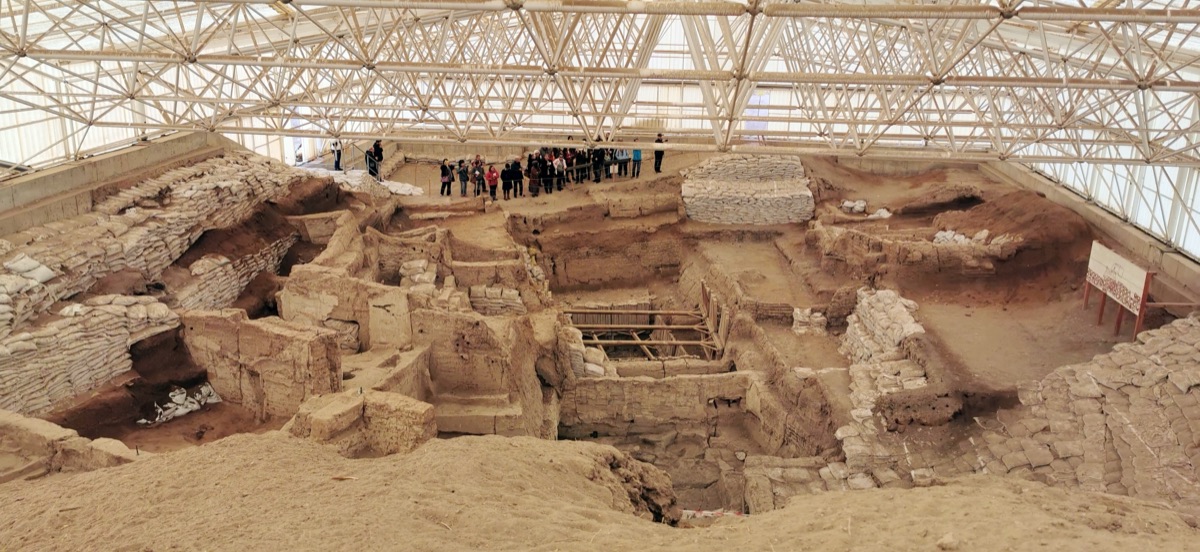
Mainstream archaeology sees Çatalhöyük as an egalitarian farming community — one of the world's first large permanent settlements. Radiocarbon dating, refined by Bayesian modelling under the Hodder project, brackets the East Mound between roughly 7100 and 5950 BC. Residents grew wheat, barley and lentils, herded sheep and goats, and continued hunting aurochs. Analysis of skeletons, house sizes and grave goods shows remarkably little social or gender inequality: men and women ate similar diets, did similar work, and received similar burials. Houses, not temples or palaces, were the unit of society; Hodder found no central authority, no elite quarter and no public buildings, describing the settlement as 'radically egalitarian'.
The famous imagery — leopard reliefs, vultures over headless bodies, the corpulent 'Seated Woman' flanked by felines — is interpreted by the Hodder project not as proof of a Mother Goddess cult (Mellaart's view) but as part of a symbolic world concerned with ancestors, wild animals, and the drama of death and memory. Figurine studies showed most figurines are animals, and many 'goddess' figures may represent mature, high-status women or ancestors rather than deities. Skulls were sometimes removed, plastered and recirculated among the living — an ancestor practice shared across the Near Eastern Neolithic.
A 2014 study of the celebrated 'map mural' — long claimed as the world's oldest map, showing the town beneath an erupting volcano — found that Hasan Dağ did erupt around 6900 BC, within the mural's era, though sceptical researchers note the 'map' may equally be a geometric pattern and a leopard skin.
- Extensive radiocarbon series with Bayesian modelling dates occupation to c. 7100–5950 BC
- Bioarchaeology shows near-equal diets, workloads and burials for men and women — but no evidence of matriarchy
- Most figurines are animals; 'goddess' figures are rare and often found in rubbish deposits, not shrines
- No temples, palaces, elite residences or central storage — an egalitarian, house-based society
- 25 years of meticulous excavation with full digital recording, among the best-documented digs ever