What archaeology says
Classical archaeologists attribute the entire sanctuary, podium included, to Roman engineering. Construction of the Jupiter temple began under Augustus and continued in phases for over two centuries, with the great courtyard and propylaea added through the reigns of Nero, Trajan and beyond. Architectural studies by Daniel Lohmann of the German Archaeological Institute traced a coherent Roman construction sequence: the Trilithon course belongs to a Julio-Claudian enlargement of the podium, bonded into the Roman design, sitting atop a foundation course of smaller (though still enormous) blocks, and left visibly unfinished when the megalithic outer casing project was abandoned mid-build. The blocks carry Roman-style tooling and drafting identical to that on the quarry stones.
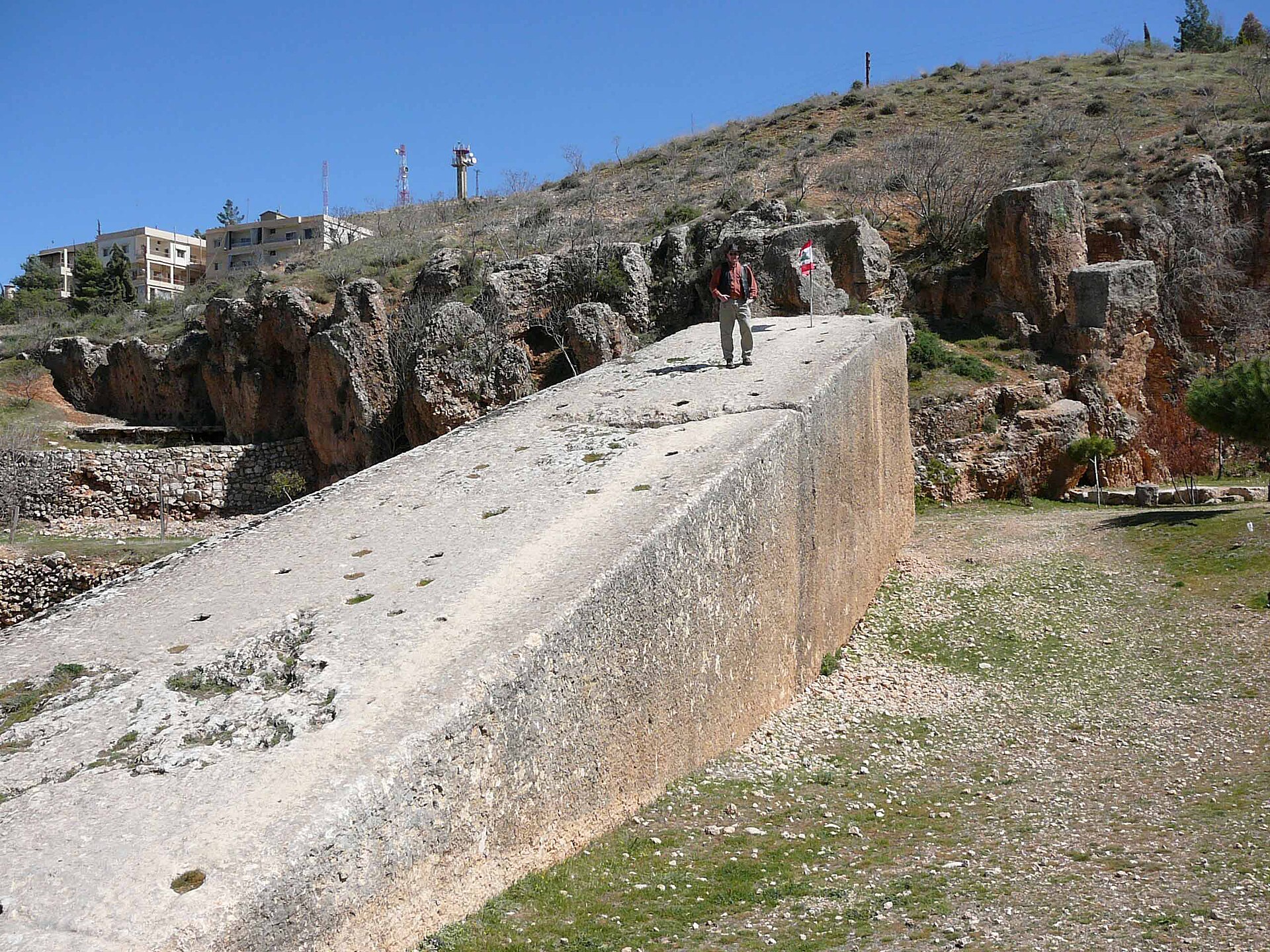
The logistics, while extreme, are considered within Roman capability. The quarry lies about 800–900 metres away and slightly uphill of the temple, so the blocks could be moved on rollers or sledges down a gentle gradient without lifting. Jean-Pierre Adam's 1977 engineering study calculated that a few hundred men using capstans, rollers and prepared trackways could shift an 800-tonne block — slow, expensive, but feasible. The abandoned quarry stones are read as evidence of ambition outrunning practicality: the Romans cut blocks even they could not economically move, and simply left them.
Excavation of Tell Baalbek beneath the courtyard shows settlement reaching back to the Pre-Pottery Neolithic around 8000 BC, but nothing suggesting monumental pre-Roman megalithic construction — the earlier layers are villages and a modest Bronze and Iron Age sanctuary.
- Daniel Lohmann's architectural analysis showing the Trilithon course bonded into the Julio-Claudian podium design
- Identical Roman tooling and drafting margins on the Trilithon and the abandoned quarry monoliths
- The quarry sits slightly uphill only 800–900 metres away, allowing transport without lifting
- Jean-Pierre Adam's engineering study showing capstans and rollers could move 800-tonne blocks
- Tell Baalbek excavations show only villages and a modest sanctuary before the Roman era