What archaeology says
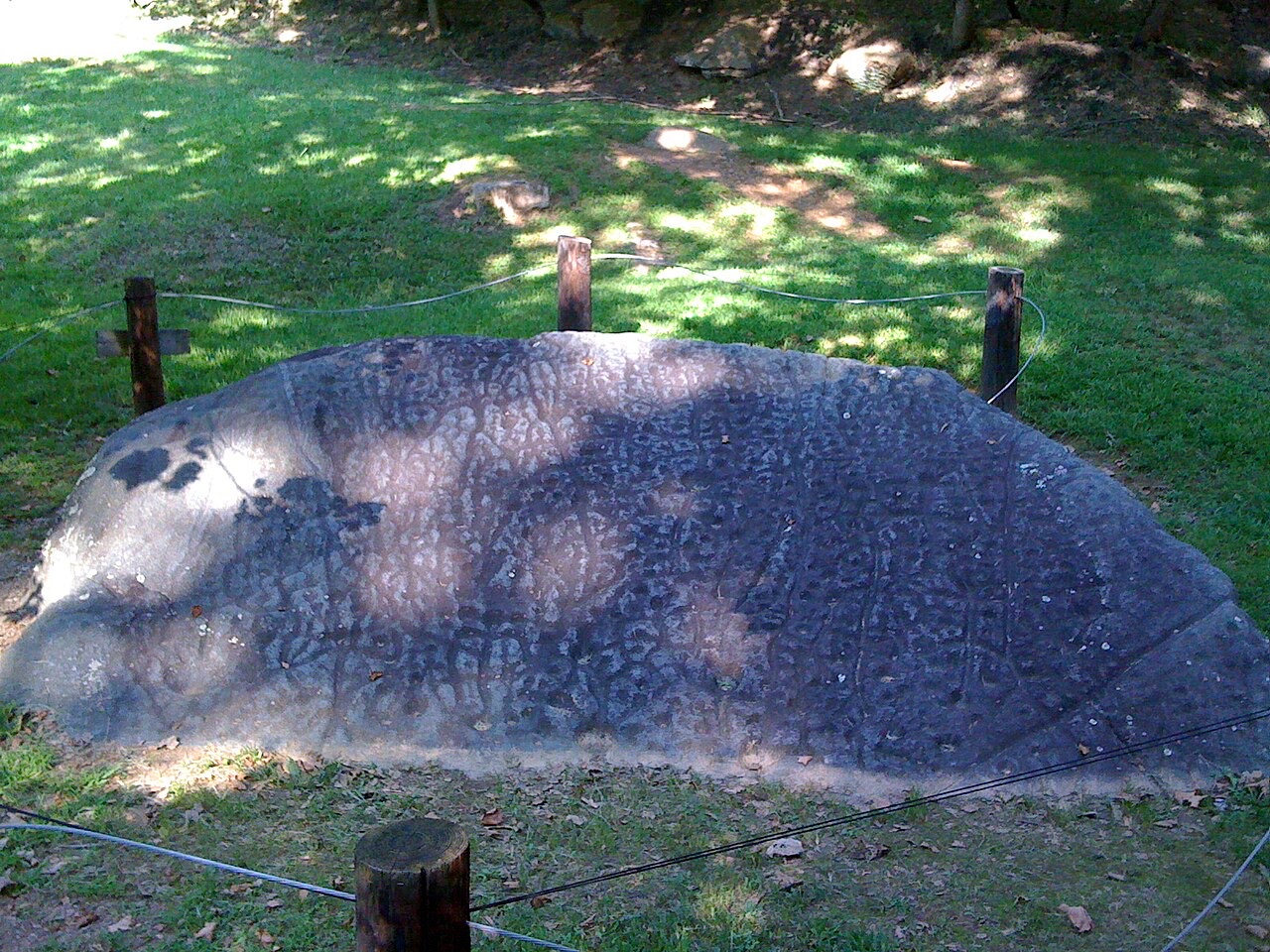
Archaeologists read Judaculla Rock as a palimpsest with at least two deeply separated chapters. The first is industrial: soapstone (steatite) is soft, heat-resistant and was prized across the Late Archaic Southeast for carving cooking bowls, and the boulder preserves clear bowl-extraction scars and quarrying debris dated by excavation of the surrounding deposits to roughly 2000-1000 BC. The second chapter is symbolic: the cupules, nested rings, cross-in-circle motifs and stylised figures were pecked over and around the quarry scars, and researchers such as Scott Ashcraft, working with Western Carolina University and Cherokee partners, place most of this activity between the Woodland and Mississippian periods — roughly AD 500 to 1700 — with some marks possibly as late as the early historic era. Cross-in-circle designs, for instance, belong to a well-known Mississippian symbolic repertoire.
What the glyphs say is genuinely unknown, and mainstream scholars are candid about it. Proposals include a boundary or treaty marker, a map of the surrounding valleys and hunting grounds, tallies, clan or ceremony records, and accumulated marks from generations of ritual visits — perhaps connected to the documented Cherokee use of the nearby Judaculla old fields as a sacred place. No proposal has produced a decipherment, and most specialists doubt the marks constitute writing in the linguistic sense at all.
Crucially, mainstream practice now treats Cherokee tradition as evidence rather than folklore garnish. The Eastern Band of Cherokee Indians regards the rock as a living sacred site, participates in its stewardship with Jackson County, and Mooney's 1900 recording of the Tsul'kalu narratives is used to understand the boulder's role as a threshold to the Master of Game's domain — a place where hunters once fasted and sought permission before the hunt.
- Approximately 1,548 recorded motifs make it the densest carved boulder east of the Mississippi, documented by modern survey and 3D scanning
- Bowl-extraction scars and excavated quarry debris date soapstone working at the boulder to the Late Archaic, c. 2000-1000 BC
- Motifs such as cross-in-circle designs belong to known Woodland-Mississippian symbolic repertoires of the Southeast
- James Mooney's 1900 Myths of the Cherokee records the Tsul'kalu tradition in detail, tying the rock to a documented sacred landscape
- The Eastern Band of Cherokee Indians' continuing relationship with the site supports interpretation as a long-used ceremonial place
- No verified Old World script elements have been identified despite repeated epigraphic claims