What archaeology says
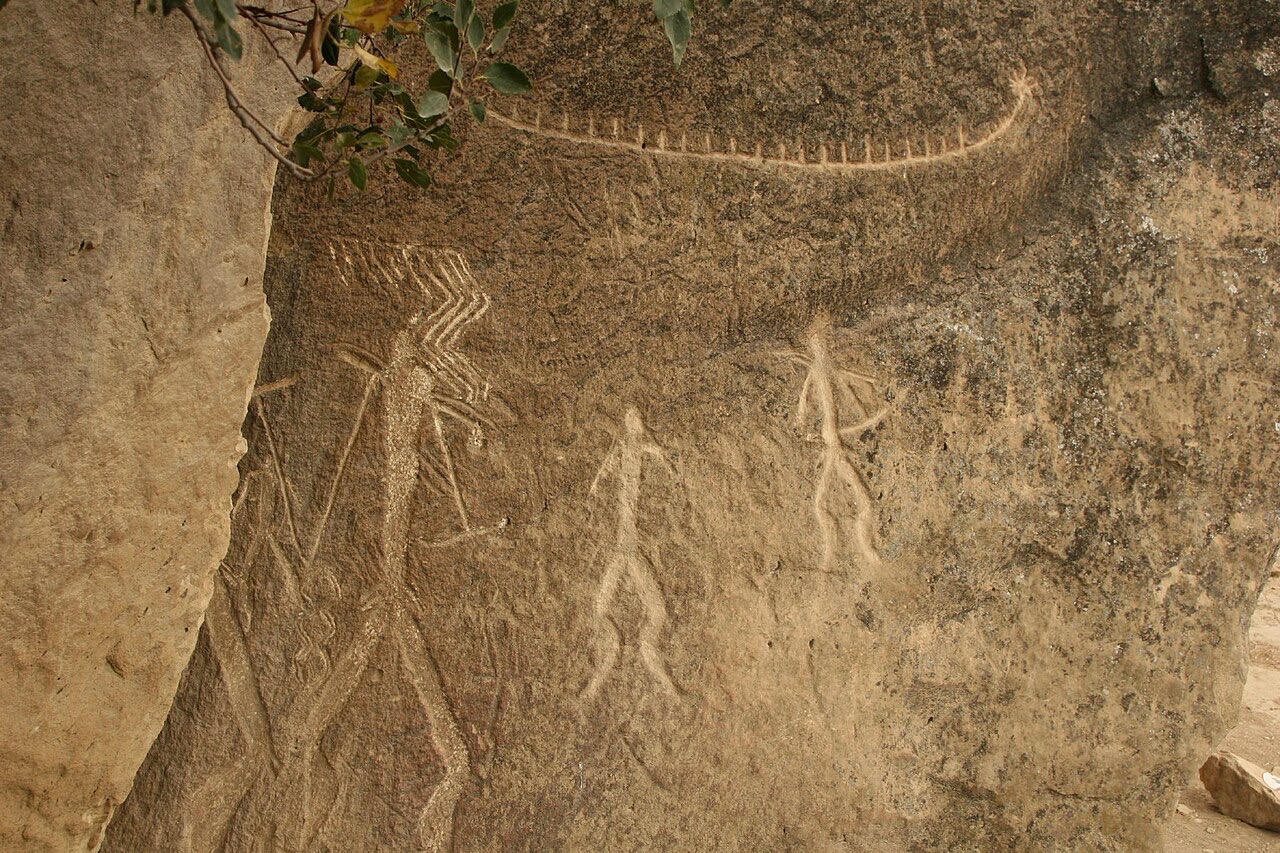
Mainstream archaeology treats Gobustan as an exceptional but thoroughly local record of life on the Caspian shore from the end of the Ice Age onward. The earliest engravings — large naturalistic aurochs and full-figured human forms — are attributed to Upper Palaeolithic and Mesolithic hunter-fisher communities, with later phases adding domesticated animals, collective dances, camel caravans and eventually medieval inscriptions. Excavated shelters at the site yielded tens of thousands of stone tools and occupation deposits that anchor this long chronology. The boats, generally placed in the Neolithic to Bronze Age, fit a shoreline community that fished and travelled the Caspian, whose waters then lapped much closer to the hills; some boats carry sun symbols, a motif common across prehistoric Eurasia.
Heyerdahl's Odin hypothesis receives short shrift from professional archaeologists and historians. His argument chained together the Gobustan boat carvings' resemblance to Scandinavian petroglyphs, the thirteenth-century Ynglinga Saga's tale of Odin migrating from a land of the Aesir east of the Black Sea, and the phonetic similarity between Aesir and Azerbaijan/Azeri. Norwegian academics — who publicly debated Heyerdahl and the co-authored Jakten på Odin (The Search for Odin, 2001) — showed that Snorri Sturluson's saga is medieval learned myth-making, not migration history; that the name resemblance is coincidence; and that boat imagery with crews and sun symbols arose independently in many waterside cultures. The similarity is real; the genealogical link is not demonstrable.
None of this diminishes the site's standing. UNESCO's 2007 inscription cites the outstanding testimony the engravings give to hunting, fauna, flora and lifeways across millennia of climatic change, and Gobustan remains the cornerstone of Azerbaijani prehistory — no Vikings required.
- Excavated occupation deposits and tens of thousands of stone tools tie the engravings to continuous local habitation from the late Ice Age onward
- The engraving sequence (aurochs and hunters, then herders, then camel caravans and inscriptions) tracks known regional cultural development
- Boat images with crews and sun symbols occur independently in many prehistoric waterside cultures, weakening any unique Scandinavian link
- Snorri Sturluson's Ynglinga Saga is thirteenth-century learned euhemerism, written two millennia after the boats were carved
- Philologists reject the Aesir-Azerbaijan name equation as coincidental sound-alikeness
- A first-century AD inscription of Rome's Legio XII Fulminata at Gobustan shows the site's later visitors are documented when they really came