What archaeology says
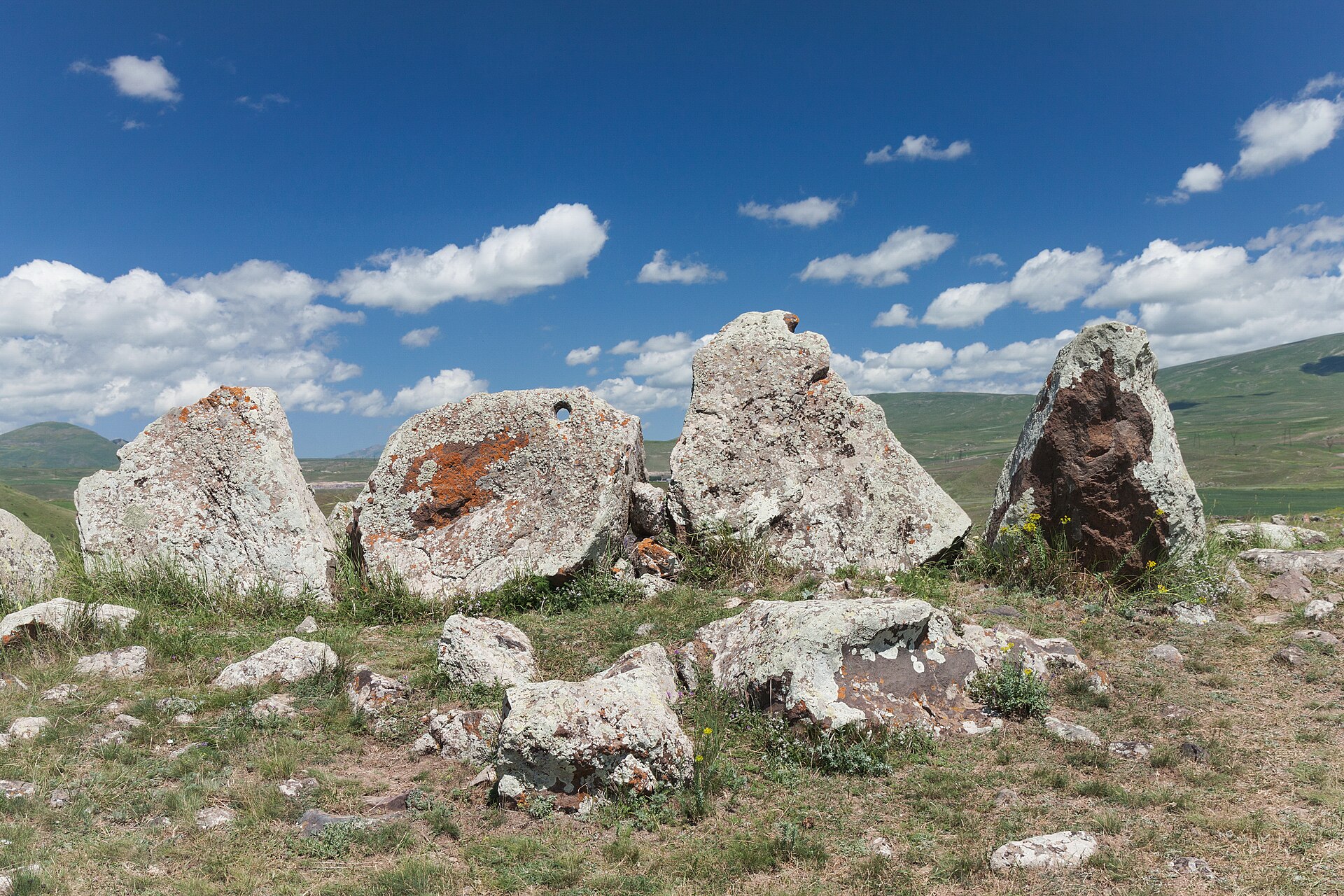
Archaeological attention began after Onnik Khnkikyan, an Armenian archaeologist, first described the stones in 1984, but the key fieldwork came in 2000, when a team from the Institute for Ancient Near Eastern Studies at the University of Munich, working with Armenian colleagues under Stephan Kroll, surveyed and test-excavated the site. Their conclusion was straightforward: Zorats Karer is principally a necropolis of the Middle Bronze Age to Iron Age, containing substantial stone cist tombs of those periods, and the line of standing stones may later have served as reinforcement for a defensive wall, possibly Hellenistic, around a hilltop settlement. Grave goods and construction parallels tie the site comfortably into the megalithic and burial traditions of the South Caucasus in the second and first millennia BC. Nothing excavated at the site dates anywhere near 5500 BC.
The astronomical claims received a formal hearing in the archaeoastronomical literature. A. César González-García's 2014 assessment for the Handbook of Archaeoastronomy and Ethnoastronomy accepted that a few solar alignments at the site are plausible — hardly surprising for any arrangement of over two hundred stones — but found the strong claims untenable: the famous holes are short, rough and weathered, giving fields of view of several degrees, far too wide for the precision observations claimed. Herouni's own solution was to postulate narrow sighting tubes once inserted into the holes, for which no archaeological evidence whatsoever exists. Clive Ruggles of the University of Leicester, the doyen of the field, has likewise described the observatory interpretation and the Stonehenge comparison as unwarranted. For mainstream science, the holes more likely relate to hauling the stones, ritual, or something not yet understood — a real puzzle, but not a telescope.
- 2000 Munich–Armenian excavations identifying Middle Bronze Age to Iron Age tombs at the heart of the site
- Grave architecture and finds paralleling known South Caucasus burial traditions of c. 2000–300 BC
- González-García's 2014 analysis showing the holes' fields of view are far too wide for precision astronomy
- No archaeological trace of the sighting tubes Herouni's observatory model requires
- Nothing excavated at the site dating remotely close to the claimed 5500 BC