Origins of Civilisation · Tell Abu Shahrain, Dhi Qar, Iraq

Eridu

The city the Sumerians themselves called first — where kingship 'descended from heaven' before the flood.

Mainstream: c. 5400 BC (earliest Ubaid settlement) to c. 600 BCAlternative: Hundreds of thousands of years of 'kingship' before the flood, if the Sumerian King List's antediluvian reigns are read literally30.82°, 46.00°

At a glance

Eridu
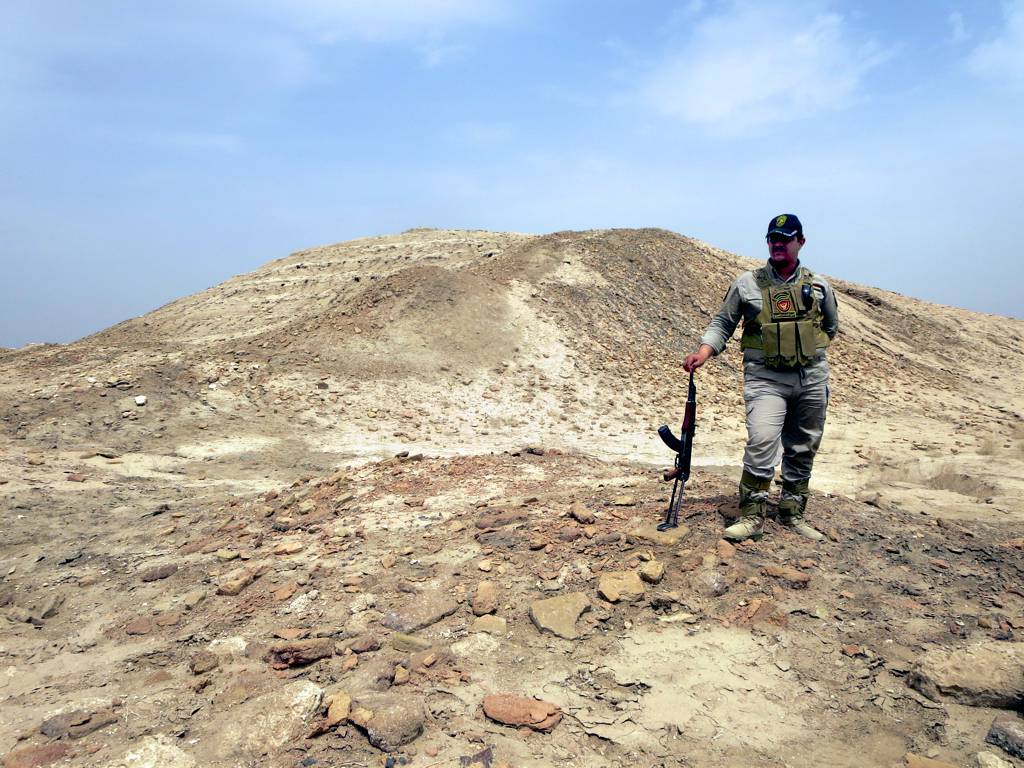
Photo: David Stanley · CC BY 2.0

Eridu, today the desert mound of Tell Abu Shahrain in southern Iraq, was regarded by the Sumerians as the oldest city in the world — the place where kingship first 'descended from heaven' according to the Sumerian King List, and the seat of Enki, god of fresh water, wisdom and magic. Archaeology broadly agrees with the legend's thrust: settlement began around 5400 BC in the Ubaid period, and beneath the ruined ziggurat excavators found an unbroken sequence of eighteen superimposed temples spanning some two thousand years, each built upon the ruins of the last. The city declined as the rivers shifted and the soil salted, and was largely abandoned by around 600 BC — yet its memory as the primeval city persisted in Mesopotamian literature to the end.

See it on the globe →
The mainstream view

What archaeology says

The defining excavations were led by Fuad Safar with Seton Lloyd for Iraq's Directorate General of Antiquities between 1946 and 1949. Cutting beneath the unfinished Ur III ziggurat of king Ur-Nammu (c. 2100 BC), they uncovered a sequence of mud-brick temples reaching down to a small single-roomed shrine of the earliest Ubaid period — a continuous architectural pedigree for Enki's sanctuary stretching back more than two millennia before the ziggurat itself. Thick deposits of fish bones among the offerings fit Enki's watery character with almost uncanny neatness. The earliest pottery defines the 'Eridu phase' (c. 5400–4700 BC) of the Ubaid culture, and the sequence runs on through the Uruk period into historic times. After decades of interruption, fieldwork resumed in 2019 with a joint Iraqi, Sapienza University of Rome and University of Strasbourg project focused on the Ubaid cemetery and settlement.

On the Sumerian King List, mainstream Assyriology reads the document as ideology rather than chronicle: composed and copied mainly in the late third and early second millennium BC, it projects a theory of legitimate kingship rotating between cities, and its earliest known manuscript lacks the antediluvian section entirely — the eight pre-flood kings reigning a combined 241,200 years appear to be a later literary addition using schematic sexagesimal numbers. As for the flood itself, Leonard Woolley announced in 1929 that a three-metre silt layer at Ur was Noah's flood, but subsequent work showed the flood deposits at Ur, Kish and Shuruppak date to different centuries and none covers a whole city — evidence of repeated, devastating but local river floods on a flat alluvial plain, plausibly the seedbed of the flood tradition rather than a single global event.

Key evidence cited
  • Eighteen superimposed temples beneath the ziggurat, from a simple Ubaid shrine to monumental platforms
  • The 'Eridu phase' pottery sequence anchoring settlement to c. 5400 BC
  • Fish-offering deposits matching Enki's cult continuously across millennia
  • Flood layers at Ur, Kish and Shuruppak dating to different centuries — local river floods, not one deluge
  • The earliest King List manuscript lacking the antediluvian kings, marking them as a later literary addition
The alternative view

What the skeptics propose

For alternative historians, Eridu is where the paper trail of a forgotten epoch begins. Zecharia Sitchin, in The 12th Planet (1976) and its sequels, read E.RI.DU as 'home in the faraway' — in his telling, the first settlement of the Anunnaki, extraterrestrials from the planet Nibiru, and the reason the King List's antediluvian reigns run to tens of thousands of years each: he took the numbers literally, as 'shars', orbital periods of Nibiru. Sumerologists respond that Sitchin's translations are simply wrong — the Anunnaki are gods, not astronauts; there is no Sumerian planet Nibiru beyond Neptune; and the numbers follow known sexagesimal conventions — and his system has been rejected in its entirety by Assyriologists, though his books still sell in the millions.

A softer and more widespread alternative reading treats the King List's pre-flood section, the Eridu Genesis flood story and the city's 'first city' status as garbled memories of a real civilisation destroyed by post-glacial flooding at the end of the Ice Age. Graham Hancock and others note that the Persian Gulf was dry land until rising seas flooded it between roughly 12,000 and 6000 BC, and that Eridu sits precisely where refugees from a drowned Gulf landscape would settle — a hypothesis given a serious academic airing by archaeologist Jeffrey Rose's 'Gulf Oasis' work, though Rose himself makes no claims about lost civilisations. Mainstream scholars accept the drowned-Gulf geography and even the possibility that Gulf populations moved into Mesopotamia, but point out that everything actually excavated at Eridu — pottery, architecture, burials — belongs to a modest village culture that grew slowly into urbanism, with no trace of an advanced antecedent. The debate, at its best, is about how much real history a myth can carry.

Key evidence cited
  • The Sumerians' own insistence that Eridu was the first city, where kingship descended from heaven
  • The King List's 241,200 years of pre-flood reigns, read literally by Sitchin as Anunnaki 'shars'
  • Multiple independent Mesopotamian flood traditions (Ziusudra, Atrahasis, Gilgamesh) centred on this region
  • The post-glacial drowning of the Persian Gulf, which would have submerged any earlier coastal settlements
  • Eridu's position at the head of the Gulf, exactly where survivors of a flooded landscape would regroup

Genuinely open questions

  1. Does the Persian Gulf floor conceal pre-Ubaid settlements drowned by post-glacial sea-level rise?
  2. How much historical memory, if any, underlies the antediluvian section of the Sumerian King List?
  3. Why did the Sumerians single out Eridu — a relatively small city — as the primeval seat of kingship?

Worth knowing

Eridu's patron god Enki was said to have saved humanity from the flood by whispering the divine plan to a reed wall — technically keeping his oath not to tell any human directly.