Ancient Engineering · Diquís Delta, Costa Rica

Diquís Stone Spheres

Hundreds of stone spheres, some almost geometrically perfect — abandoned in a river delta with no written explanation.

Mainstream: c. AD 300–1550 (most spheres after c. AD 600)Alternative: Thousands of years earlier if read as relics of Atlantean navigators (Zapp & Erikson) — sceptics otherwise question how near-perfect spheres were achieved, not when8.91°, -83.48°

At a glance

Diquís Stone Spheres
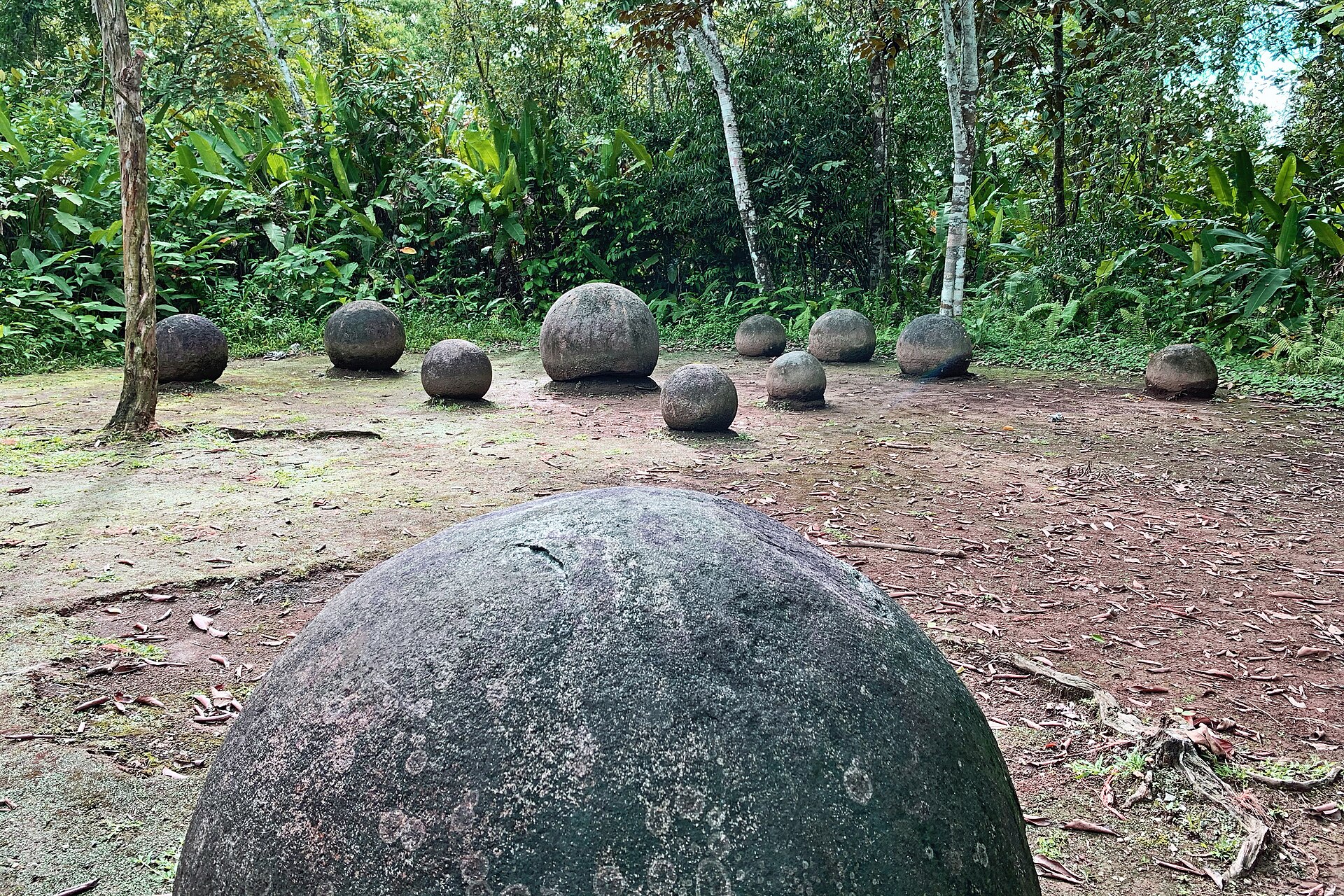
Photo: Diego Padilla Durán & Mario Roberto Durán Ortiz · CC BY-SA 4.0

Scattered across the Diquís Delta of southern Costa Rica are more than 300 stone spheres, ranging from a few centimetres to 2.66 metres in diameter and up to about 15 tonnes. Most are shaped from gabbro or granodiorite, hard igneous rocks, and the best examples deviate from a perfect sphere by only a few centimetres. They came to light in the 1930s and 1940s when the United Fruit Company cleared the delta for banana plantations, and bulldozers, looters and dynamite scattered or destroyed many before scientists could record them. A handful remain in their original positions at sites such as Finca 6 near Palmar Sur, where spheres were set in alignments beside earthen mounds. In 2014 four sphere sites were inscribed as Costa Rica's Precolumbian Chiefdom Settlements UNESCO World Heritage listing.

See it on the globe →
The mainstream view

What archaeology says

The first scientific study was published by Doris Stone in 1943, followed by Samuel Lothrop of Harvard's Peabody Museum, whose 1963 monograph documented around 186 spheres, their sizes and their arrangements. Modern understanding rests on the work of Ifigenia Quintanilla's Sierpe-Térraba project in the 1990s and, since 2002, sustained excavation by Francisco Corrales and Adrián Badilla of the National Museum of Costa Rica. At Finca 6, spheres sit in situ on alignments associated with mounds, ramps and residential areas of the Aguas Buenas (c. AD 300–800) and Chiriquí (c. AD 800–1550) periods. Because stone cannot be radiocarbon-dated directly, ages come from stratigraphy and associated pottery — which is why estimates have shifted over the decades and why displaced spheres are so hard to date at all.

As for manufacture, archaeologists reconstruct a patient, entirely human process: selecting naturally rounded boulders of gabbro or granodiorite, roughing them out by pecking and hammering with harder stones (possibly aided by alternate heating and rapid cooling to spall the surface), then grinding and polishing with sand and leather. The raw stone outcrops lie in the Cordillera Costeña, several kilometres from many find-spots, so the delta's chiefdoms also moved multi-tonne boulders across rivers and swamps. The spheres are strongly associated with high-status settlements and are generally read as markers of chiefly rank, ceremonial space or social identity; their makers left no writing, and researcher John Hoopes of the University of Kansas — the leading academic voice on the spheres — is frank that nobody knows precisely why they were made. Crucially, measurement shows they are very good but not perfect spheres, and unfinished or broken examples fit the hand-working sequence.

Key evidence cited
  • Spheres found in situ at Finca 6 in direct association with dated Aguas Buenas and Chiriquí period settlements
  • A plausible manufacturing sequence of pecking, grinding and sand-polishing consistent with tool marks and local technology
  • Source outcrops of gabbro and granodiorite identified in the nearby Cordillera Costeña
  • Measured deviations from sphericity of centimetres, not the claimed hundredths of an inch
  • Continuous archaeological research by the National Museum of Costa Rica since 2002, culminating in UNESCO listing in 2014
The alternative view

What the skeptics propose

The spheres' roundness has long attracted grander explanations. The most developed alternative case is Ivar Zapp and George Erikson's 1998 book Atlantis in America: Navigators of the Ancient World, which argued the spheres were teaching instruments of a lost seafaring culture — an 'Atlantean' navigation school whose sphere alignments encoded sightlines to distant sacred sites including Easter Island, Stonehenge and Giza. Zapp, a former University of Costa Rica design professor, held that the spheres' claimed perfection (equal diameter from any measuring point to within hundredths of an inch) was beyond simple hand-working and pointed to a sophisticated civilisation lost to rising seas at the end of the Ice Age. Erich von Däniken and later ancient-aliens media have folded the spheres into their catalogues of 'impossible' artefacts, and local legend long held that the spheres contained hidden gold — which is why so many were split with dynamite.

Archaeologists have answered point by point. The 'perfect sphere' claim traces back to a misreading of Lothrop, who — as his own field notes and his wife's account confirm — measured many large spheres with a plumb line and tape without excavating them fully, and never claimed machine precision; modern measurement finds deviations of centimetres, and erosion makes many spheres impossible to measure meaningfully at all. The alignment argument fails because most spheres were bulldozed from their original positions before being recorded, so sightlines drawn through them today are sightlines through banana-plantation landscaping. John Hoopes has publicly dismantled the Atlantis, ley-line and extraterrestrial claims, noting the spheres belong to a well-documented sequence of local chiefdom cultures. Even so, the alternative writers are right about one thing: the finest spheres are extraordinary objects, and the absence of any indigenous account of their meaning leaves a genuine void that speculation rushes to fill.

Key evidence cited
  • The near-perfect geometry of the best spheres, which Zapp and Erikson argue exceeds hand-working
  • Zapp's claimed long-distance sightlines from sphere alignments to Easter Island, Stonehenge and Giza
  • The sheer labour of shaping and moving 15-tonne igneous boulders across a river delta
  • The absence of unfinished spheres at some sites, read as evidence the makers' methods are not represented
  • No surviving indigenous tradition explaining the spheres' purpose — an interpretive vacuum

Genuinely open questions

  1. What did the spheres actually mean to the Diquís chiefdoms — rank, cosmology, territory, or something else entirely?
  2. How were multi-tonne boulders transported from mountain outcrops across the wet delta landscape?
  3. Can the few spheres still in their original alignments be shown to reference astronomy, or are the arrangements social?

Worth knowing

So many locals believed the spheres held gold at their centres that dozens were blown apart with dynamite — every single one proved to be solid stone all the way through.