Myth & Memory · Lake Guatavita, Colombia

El Dorado & Lake Guatavita

The most famous treasure legend on Earth began not as a city but as a man — a chieftain covered in gold dust on a sacred Andean lake.

Mainstream: Muisca gilded-man ritual practised c. AD 800–1500; legend first recorded in the 1530sAlternative: A literal golden city ('Manoa') sought from 1541 into the 20th century4.98°, -73.78°

At a glance

El Dorado & Lake Guatavita
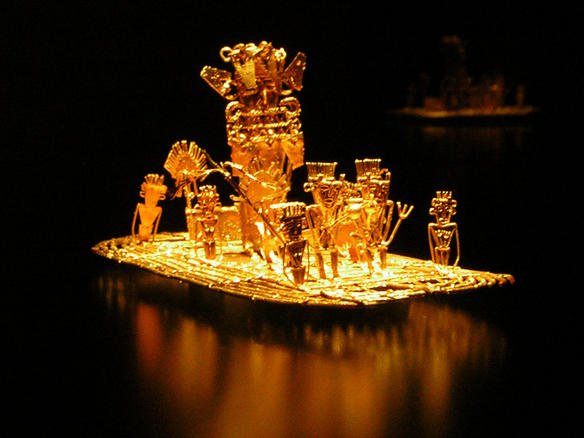
Photo: Andrew Bertram · CC BY-SA 1.0

El Dorado — 'the golden one' — is the legend that launched a hundred expeditions and consumed thousands of lives. Its seed was real: at Lake Guatavita, a small circular crater lake high in the Colombian Andes about 57 kilometres north-east of Bogotá, the Muisca people invested a new ruler in a ceremony in which he was coated in powdered gold and floated to the centre of the lake on a raft, casting gold and emeralds into the water as offerings. Spanish imagination transformed the gilded man into a golden city, then a golden empire, relocating it ever deeper into unexplored South America. The legend's most tangible witness is the Muisca raft, an exquisite gold votive sculpture of the ceremony itself, now the centrepiece of Bogotá's Gold Museum.

See it on the globe →
The mainstream view

What archaeology says

Historians and archaeologists trace the legend to the Muisca of the Bogotá highlands, conquered by Gonzalo Jiménez de Quesada in 1537. Chroniclers — most vividly Juan Rodríguez Freyle in 1636 — described the Guatavita investiture: the heir, stripped and covered in gold dust, sailed a rush raft laden with offerings to the lake's centre at dawn, plunged in to wash the gold from his body, and emerged as ruler while his people threw goldwork from the shores. Archaeology backs the account. Hundreds of Muisca votive pieces (tunjos) have been recovered from Guatavita and other sacred lakes, and in 1969 farmers at Pasca found the Muisca raft: a tumbaga (gold-copper-silver alloy) sculpture, cast in one piece by the lost-wax method between roughly 1295 and 1410, showing a resplendent central figure surrounded by attendants on a raft. Museo del Oro researchers such as Juan Pablo Quintero-Guzmán have analysed Guatavita as a genuine ritual offering site rather than a treasure vault.

The 'golden city', by contrast, is understood as a Spanish and later English construction. Expeditions by Gonzalo Pizarro and Francisco de Orellana (1541 — which accidentally produced the first descent of the Amazon), Philipp von Hutten, and many others chased the receding mirage across the continent. Sir Walter Raleigh fixed it as 'Manoa' on a mythical Lake Parime in Guiana, mounting voyages in 1595 and 1617; the second cost his son's life and, on his return, his own head. Historian John Hemming's classic study The Search for El Dorado documents how a real ceremony was inflated, step by step, into a continental delusion that drove exploration, conquest and catastrophic loss of Indigenous life.

Key evidence cited
  • The Muisca raft (found 1969 at Pasca): a lost-wax tumbaga sculpture depicting the gilded-chief ceremony, dated c. 1295–1410
  • Hundreds of Muisca gold votive offerings (tunjos) recovered from Lake Guatavita and other sacred lakes
  • Chronicler accounts (Juan Rodríguez Freyle, 1636) describing the Guatavita investiture ritual in detail
  • Documented failure of every expedition to find a golden city, from Pizarro-Orellana (1541) to Raleigh (1595, 1617)
  • Humboldt's demonstration that Raleigh's Lake Parime and Manoa were cartographic fictions
The alternative view

What the skeptics propose

For four centuries, believers held that the gold itself could be recovered — and they very nearly destroyed the lake trying. In the 1540s Hernán Pérez de Quesada set bucket chains of labourers to bale Guatavita out, lowering it a few metres and recovering some gold. In the 1580s the merchant Antonio de Sepúlveda cut a great notch in the crater rim — still visible today — draining the lake by as much as 20 metres before the cutting collapsed, killing workers; he recovered gold and emeralds but died poor. In 1898 a British venture, Contractors Ltd, drove a tunnel under the lake and emptied it to a few feet of mud, which then baked hard in the sun before it could be searched; the roughly 500 pounds sterling of finds were auctioned at Sotheby's, and the company folded. Colombia finally protected the lake in 1965, banning further salvage.

The larger dream of a golden city never quite died either. Raleigh's Manoa kept Lake Parime on maps into the 19th century, until Alexander von Humboldt's fieldwork dissolved it. In the 20th century the El Dorado impulse migrated into new forms: Percy Fawcett's fatal 1925 search for his city 'Z' in Brazil, and a continuing popular literature locating golden cities in the Amazon. Intriguingly, the sceptics have not had the last word entirely — LiDAR and archaeology since the 2010s have revealed genuinely large pre-Columbian settlements and earthworks in Amazonia (such as the Casarabe culture sites in Bolivia), leading some writers to argue that garbled reports of real, populous river societies — since vanished — may have fed the legend alongside the Muisca ceremony.

Key evidence cited
  • Real gold repeatedly recovered from Guatavita by Sepúlveda (1580s) and the 1898–1912 British drainage company
  • Sepúlveda's drainage notch, still visible in the crater rim, testifying to how seriously the treasure was taken
  • Spanish colonial records of enormous Muisca gold tribute, proving the region's goldworking wealth was no myth
  • Persistent Indigenous accounts, reported by multiple independent expeditions, of rich polities beyond the frontier
  • Modern LiDAR discoveries of large pre-Columbian Amazonian settlements, showing 'lost cities' in the region are not inherently fantasy

Genuinely open questions

  1. How much Muisca gold still lies in Guatavita's sediments — and should it ever be excavated, even scientifically?
  2. Did garbled reports of real Amazonian societies contribute to El Dorado's persistence, or was it purely the Muisca ceremony inflated?
  3. Exactly when and why did the Guatavita investiture ritual cease — before or after Spanish contact?

Worth knowing

The Muisca raft has never left Colombia since its discovery — the Gold Museum considers it too precious to travel, and when the museum is renovated the raft stays put while the building changes around it.