What archaeology says
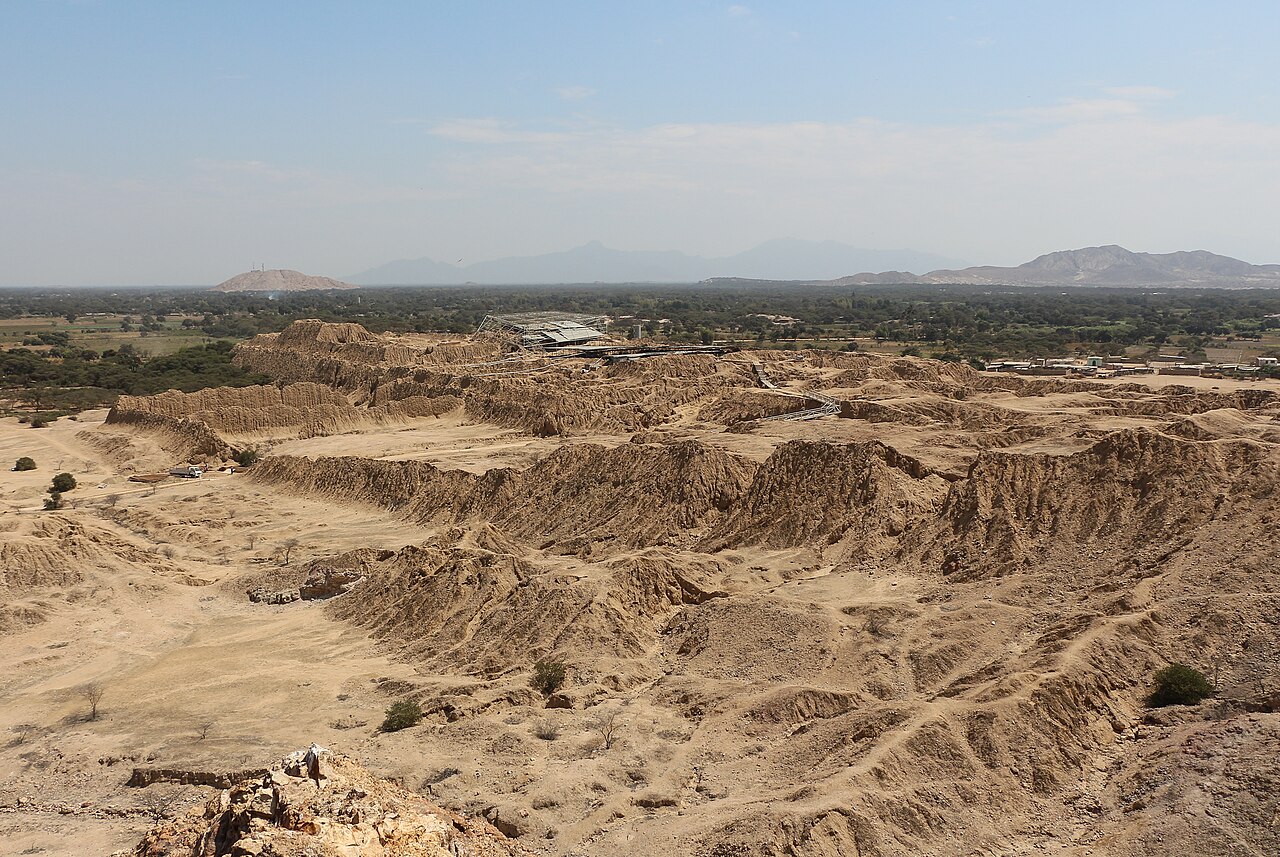
Archaeology places Túcume's founding in the Lambayeque (Sicán) florescence that followed the collapse of Moche society, with local tradition — the legend of Naymlap, the dynasty founder said to have arrived by sea with his court on balsa rafts — preserved by colonial chroniclers. The excavations of 1988 into the early 1990s, co-directed by Sandweiss and Narváez under the Túcume Archaeological Project, documented monumental construction in the classic north-coast manner: millions of mould-made adobes laid in segmented columns, plastered facades, ramps and summit enclosures serving elite residence, ritual and craft production.
The sequence is unusually complete. Chimú occupation added administrative architecture; under the Incas, Huaca Larga was crowned with the stone-faced Temple of the Sacred Stone, and burials of sacrificed individuals attest to imperial ritual. Around the Spanish conquest the site was burned and abandoned — colonial extirpators of idolatry later encouraged locals to see it as a place of the devil, and its Spanish nickname was El Purgatorio.
For mainstream Andeanists, Túcume's maritime imagery — friezes at Huaca Las Balsas depicting reed boats, bird-men and wave motifs — reflects the genuine importance of fishing, coastal trade and sea ideology in north-coast culture, including long-distance exchange by balsa raft up to Ecuador for Spondylus shell. None of it requires contact beyond the Americas.
- Radiocarbon and ceramic sequences placing the founding c. AD 1000-1100 in the Lambayeque culture
- Continuous north-coast architectural tradition from Moche antecedents to Chimú and Inca phases
- Excavations by Sandweiss and Narváez documenting local craft production and elite activity
- The Naymlap legend recorded by colonial chroniclers as a local dynastic tradition
- Spondylus shell trade showing coastal voyaging within well-attested American networks