Origins of Civilisation · Supe Valley, Peru

Caral & the Norte Chico Civilisation

The oldest city in the Americas — pyramids as old as Giza's, built by a civilisation with no pottery and, apparently, no war.

Mainstream: c. 2600–2000 BC (Late Archaic; contemporary with Old Kingdom Egypt)Alternative: Date not seriously disputed — the debate is how urban civilisation appeared here 'fully formed', without pottery, writing or war-10.89°, -77.52°

At a glance

Caral & the Norte Chico Civilisation
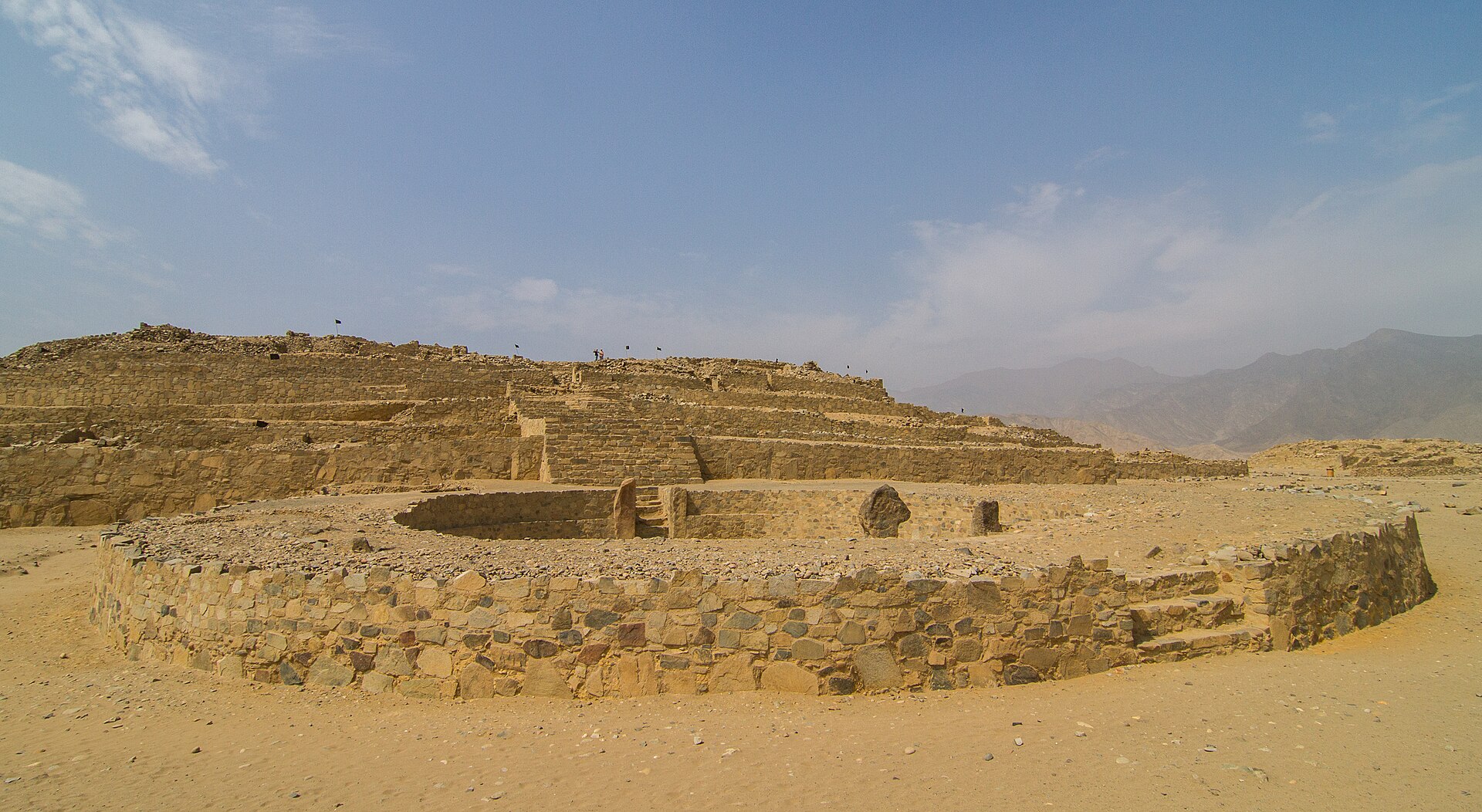
Photo: Jon Gudorf Photography · CC BY-SA 2.0

Caral sprawls across a dry terrace above the green ribbon of the Supe Valley, about 180 kilometres north of Lima: six platform pyramids (the largest, Pirámide Mayor, covers an area equivalent to four football pitches), two sunken circular plazas, elite residences and dense housing, all raised around 2600 BC. It is the flagship of roughly 30 related sites of the Caral–Supe or Norte Chico civilisation — the oldest known urban culture in the Americas, flourishing at the same time as the pyramid builders of Egypt yet developing in total isolation from the Old World. Astonishingly, its people built monumental architecture for a millennium without ever making pottery, and its excavations have yielded no fortifications, no weapons caches and no evidence of warfare.

See it on the globe →
The mainstream view

What archaeology says

Caral was known to explorers from the early 20th century but assumed to be far younger until Peruvian archaeologist Ruth Shady Solís began systematic excavation in 1994. The bombshell came in 2001, when Shady, Jonathan Haas and Winifred Creamer published radiocarbon dates in the journal Science: fibres from 'shicra' bags — reed sacks filled with stone and dumped as construction fill inside the pyramids — dated to 2627 BC and after, backed by dozens of consistent dates across the site. Because the builders left no ceramics at all, the site is classed as 'preceramic': monumental urbanism here precedes pottery, inverting the usual archaeological sequence and making Caral a natural laboratory for how civilisation begins.

The economic engine appears to have been an exchange between coast and valley: irrigation-farmed cotton and gourds traded to fishing communities such as Áspero at the river mouth in return for anchovies and sardines — a variant of Michael Moseley's 'maritime foundations' hypothesis for Andean civilisation. Finds include 32 flutes of condor and pelican bone, cornets of deer and llama bone, evidence of coca and psychoactive-plant use, and a knotted-cord object interpreted by Shady as a proto-quipu — potentially pushing the Andean information technology later perfected by the Inca back more than 4,000 years, though some researchers debate whether it encoded data or was decorative.

The story is still unfolding: in July 2025 Shady's team unveiled Peñico, a 3,800-year-old city in the same valley interpreted as a successor settlement that reorganised Caral's world after drought stressed the region — evidence, the excavators argue, of a society that adapted through trade and cooperation rather than conquest. Across a millennium of digging, the persistent absence of warfare evidence remains one of the most provocative findings in world archaeology.

Key evidence cited
  • 2001 Science paper (Shady, Haas, Creamer) with radiocarbon dates on shicra-bag fibres from 2627 BC
  • Total absence of ceramics, securely placing the city in the preceramic Late Archaic
  • Cotton-for-fish exchange economy linking Caral to coastal Áspero (maritime foundations model)
  • 32 bone flutes, sunken circular plazas and a claimed proto-quipu documenting a rich ceremonial culture
  • Peñico (announced July 2025) showing the civilisation's continuity and adaptation to drought c. 1800 BC
The alternative view

What the skeptics propose

Caral attracts less fringe speculation than Cusco's megaliths — there is no anomalous stonework here, and nobody seriously contests Shady's dates. Instead, alternative writers fold Caral into bigger patterns. Diffusionists note that pyramid-and-plaza ceremonial centres appear at Caral within centuries of Egypt's pyramid age and ask whether that is coincidence, common inheritance, or contact; mainstream archaeology answers firmly that the architectural forms, materials and functions are unrelated, and that mounded ceremonial platforms are simply a recurring human solution.

Graham Hancock, in America Before, uses cases like Caral differently: as evidence that the Americas' deep past keeps getting older and more sophisticated than textbooks allowed, consistent (he argues) with a remote common source of civilising ideas going back to the Ice Age. Sceptics of the mainstream narrative also seize on the 'fully formed' problem: Caral appears in the record as a planned urban centre with monumental architecture, astronomy-aligned plazas and administrative devices, and they ask where the long developmental runway is. The proto-quipu is a favourite exhibit — a sophisticated recording technology at civilisation's very dawn.

Mainstream researchers reply that the runway exists and is being excavated: earlier and contemporary sites along the Norte Chico coast (Áspero, Huaricanga, and older mound traditions reaching back before 3000 BC) show step-by-step growth, and Peñico now documents the aftermath as well. Kenneth Feder and other critics add that invoking a lost civilisation explains nothing Caral's own valley sequence cannot. On the central mystery, though, mainstream and alternative camps largely agree: a thousand years of complex society apparently without war is a profound challenge to theories that states are born from conflict.

Key evidence cited
  • Apparent 'fully formed' arrival of planned urbanism with no long local runway (as sceptics frame it)
  • A knotted-cord proto-quipu implying sophisticated record-keeping at civilisation's dawn
  • Chronological overlap with Egypt's pyramid age, read by diffusionists as more than coincidence
  • Hancock's argument that American antiquity keeps deepening beyond textbook allowances
  • The unexplained engine of a warless state: no fortifications or weapons across a millennium

Genuinely open questions

  1. Was the knotted-cord find really a functioning quipu — and is Andean cord-writing 4,000 years older than the Inca?
  2. How did Caral sustain social order and monumental labour for a millennium with no evidence of warfare?
  3. What ended the Supe Valley florescence around 1800 BC — drought, earthquake, El Niño, or slow economic shift?

Worth knowing

Caral's orchestra survived: archaeologists found 32 flutes made from condor and pelican wing bones, buried together in a pyramid — still playable in form, 4,500 years after the city's musicians last performed.