What archaeology says
Excavation — above all the Huaca de la Luna project directed from 1991 by Santiago Uceda and Ricardo Morales of the National University of Trujillo — has transformed understanding of the Moche capital. Huaca del Sol was built in at least eight stages, largely complete by about AD 450, and the hundreds of distinct maker's marks pressed into its bricks are read as tallies from over a hundred communities contributing labour tax, a system prefiguring the Inca mit'a. It is generally interpreted as the administrative and elite-residential pole of the city, with Huaca de la Luna as its ceremonial counterpart.
Huaca de la Luna's murals depict the fanged deity nicknamed Ai Apaec, the Decapitator, and excavations by Steve Bourget in the 1990s uncovered the remains of some seventy sacrificed men — many bearing healed combat injuries — deposited in episodes linked to El Niño rains. Combined with iconography of ritual combat and prisoner sacrifice on Moche pottery, this gave archaeology one of its clearest cases of ideology, weather and violence entwined.
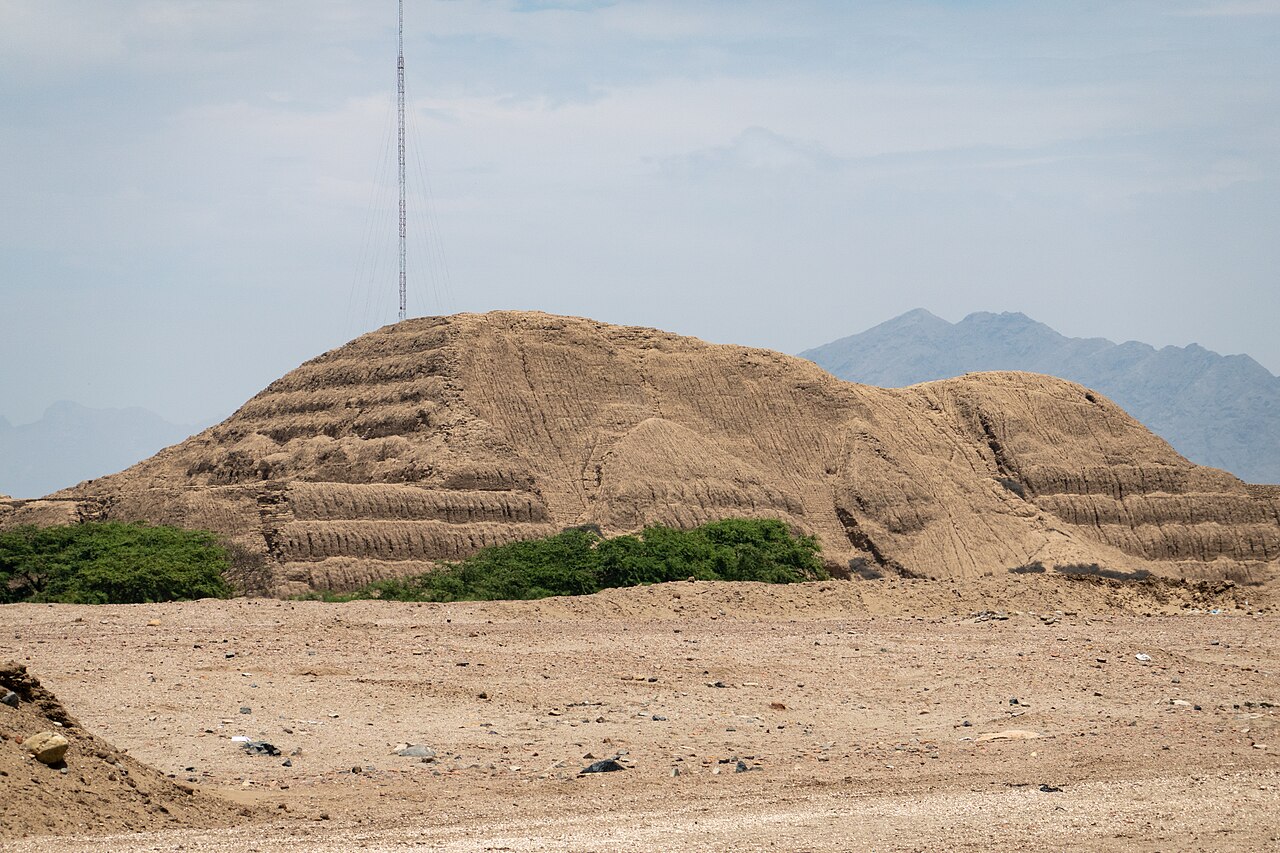
The mound's ruin is largely colonial. In the early seventeenth century Spanish entrepreneurs diverted the Moche River against the base of Huaca del Sol to wash it away and expose tombs — hydraulic mining for grave gold — destroying perhaps two-thirds of the structure. What survives, about 41 metres high, is a fraction of one of the greatest buildings of the pre-Columbian world, and it has never been systematically excavated.
- Over 100 distinct maker's marks on adobes indicating organised community labour contributions
- Eight construction stages at Huaca del Sol, substantially complete by c. AD 450
- Uceda and Morales's excavations revealing superimposed painted temples at Huaca de la Luna
- Skeletons of about 70 sacrificed warriors with healed combat injuries (Bourget, 1990s)
- Continuity of adobe platform architecture on the Peruvian coast from Caral onward
- Colonial records of the Moche River diversion explaining the mound's destruction