Belief & Society · Nazca Desert, Peru

The Nazca Lines

A desert etched with hummingbirds, monkeys and thousand-metre lines — where AI just doubled the catalogue of figures in six months.

Mainstream: c. 100 BC – AD 650 (Paracas and Nazca cultures)Alternative: Date not seriously disputed — the century-long argument is over purpose, from ritual water pathways to von Däniken's 'runways for the gods'-14.72°, -75.13°

At a glance

The Nazca Lines
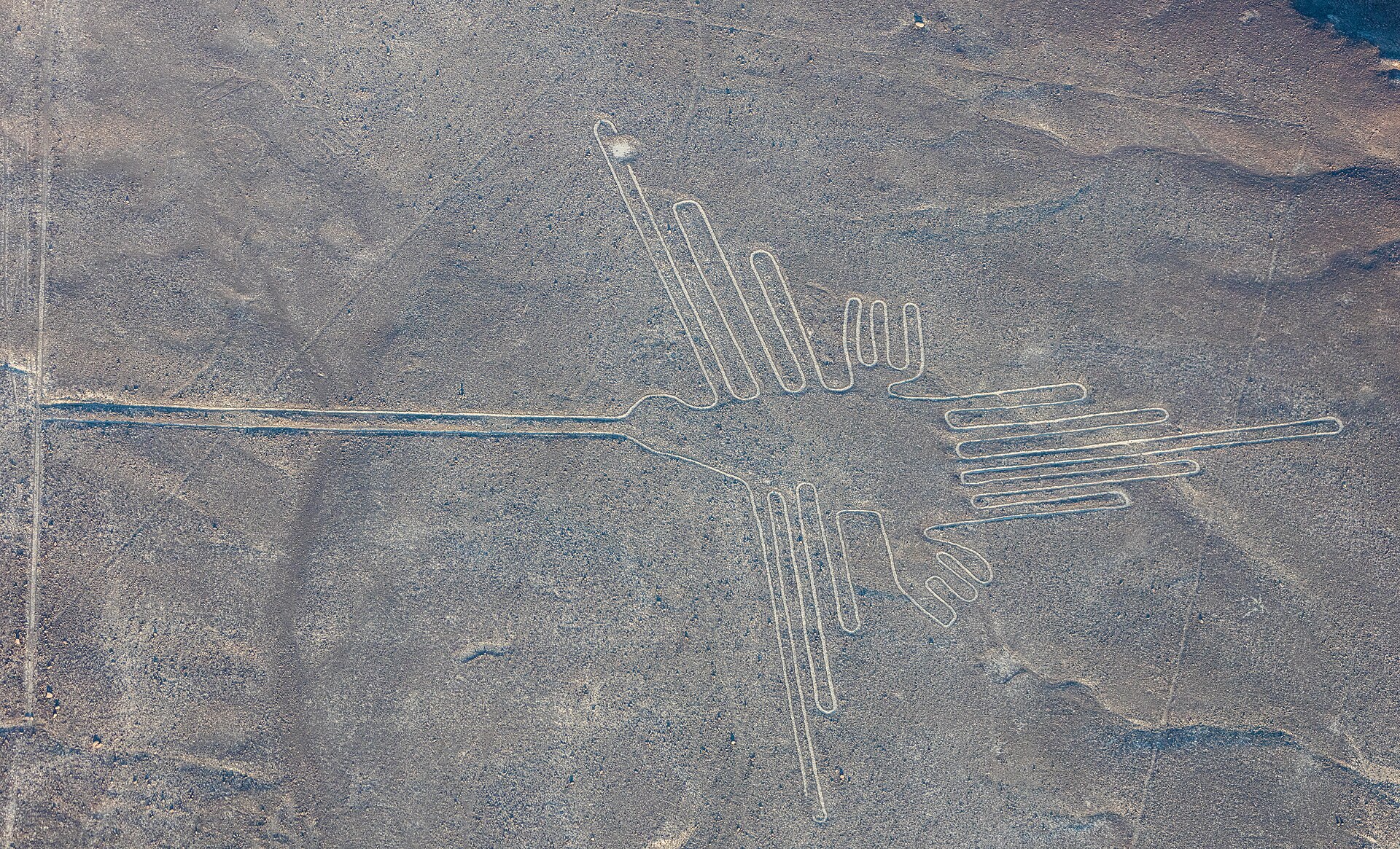
Photo: Diego Delso, delso.photo · CC BY-SA 4.0

Across roughly 450 square kilometres of the stony pampa between the Nazca and Ingenio valleys, ancient people created one of humanity's strangest artworks: hundreds of animal and humanoid figures, and thousands of dead-straight lines, spirals and trapezoids, made by simply raking aside the dark, sun-varnished surface stones to expose the pale ground beneath. The famous figures — the 96-metre hummingbird, the monkey with the spiral tail, the condor — are best appreciated from the air, which fuelled a century of exotic theories, but most are visible from surrounding hills and towers. In the desert's hyper-arid stillness the drawings have survived up to two thousand years, and new ones are still being found — 303 of them in a single AI-assisted campaign published in 2024.

See it on the globe →
The mainstream view

What archaeology says

The lines were spotted from commercial aircraft in the 1920s–30s after Peruvian archaeologist Toribio Mejía Xesspe first reported them from the ground in 1927. American historian Paul Kosok, observing a solstice sunset aligned with a line in 1941, called the pampa 'the largest astronomy book in the world', and his assistant Maria Reiche devoted the next five decades to mapping, protecting and interpreting the geoglyphs as an astronomical calendar. Later work by astronomer Gerald Hawkins and archaeoastronomer Anthony Aveni found that only a small fraction of lines match celestial events — no more than chance predicts — and the field moved on. The consensus that replaced it, built on Aveni's study of 'ray centres' and Johan Reinhard's ethnographic work, sees the lines as a sacred landscape of ritual pathways: routes walked in ceremonies concerned with water and fertility, the desperate currencies of one of Earth's driest places. Supporting this, geoglyphs cluster near water courses, depict creatures associated with rain and sea (spiders, hummingbirds, killer whales), and pottery smashed at line termini matches Nazca ceremonial ware.

Dating rests on multiple converging lines of evidence: the figures' styles match motifs on securely dated Paracas and Nazca pottery; wooden stakes found at line ends radiocarbon date to the Nazca era; and desert-varnish studies are consistent. Construction is no mystery — investigator Joe Nickell reproduced a large condor figure in days in 1982 using period-plausible tools, sighting stakes and cords, and unfinished figures preserve the method.

The 2024 revolution came from Masato Sakai's Yamagata University team working with IBM Research: an AI model trained on aerial imagery flagged candidate geoglyphs, and six months of ground survey confirmed 303 new figures, nearly doubling the known corpus (results published in PNAS). The analysis revealed a pattern: giant line-built animal figures sit along the network of processional lines and trapezoids, apparently for community ritual, while smaller relief-type figures — mostly humans, trophy heads and llamas — flank ordinary footpaths, made to be seen by individuals and small groups, like wayside shrines.

Key evidence cited
  • Figure styles matching motifs on securely dated Paracas and Nazca pottery
  • Radiocarbon-dated wooden stakes at line termini from the Nazca era
  • Aveni and Reinhard's ray-centre and water-cult studies tying lines to ritual pathways
  • Nickell's 1982 reproduction of a giant condor using simple stake-and-cord methods
  • The 2024 Yamagata–IBM PNAS survey showing most figures were sited along ground-level paths
The alternative view

What the skeptics propose

The Nazca Lines are foundational texts of alternative archaeology. Erich von Däniken's 1968 bestseller Chariots of the Gods? proposed that the long trapezoids resembled airfields and that the lines were built — or inspired by — extraterrestrial visitors whose landings the Nazca witnessed, with figures like the owl-eyed 'Astronaut' on a hillside cited as depictions of the visitors. The idea made the lines world-famous and remains in circulation; von Däniken has continued to promote versions of it for over half a century. Maria Reiche spent much of her life publicly rebutting it, pointing out among other things that the soft, stone-cleared ground would make an absurd runway.

A subtler alternative argument concedes human authorship but insists on flight: since the great figures are only fully appreciated from above, researchers Jim Woodman and Julian Nott argued in 1975 that the Nazca could have built hot-air balloons of cotton and reeds — and flew a demonstration balloon, Condor I, built from period-style materials, to prove the possibility. Mainstream critics note the demonstration proves modern ingenuity, not ancient practice: no balloon artefacts, depictions or textual hints exist in the Nazca record. Others, including Graham Hancock in his earlier work, have treated the lines' precision over kilometres as evidence of lost surveying knowledge.

Mainstream responses are unusually complete here: the figures can be laid out with stakes, cords and scale drawings (demonstrated by Nickell); they are visible from foothills and viewing mounds; construction dates and cultural attribution are secure; and the 2024 AI survey's finding that most figures accompany paths made for ground-level viewing directly undercuts the 'audience in the sky' premise. Yet the alternative tradition endures, partly because the mainstream itself concedes the deepest question — exactly what the rituals meant to their makers — remains, and likely always will remain, open.

Key evidence cited
  • Von Däniken's reading of trapezoids as landing zones and the 'Astronaut' figure as a visitor portrait
  • The full designs of the largest figures being appreciable only from altitude
  • Woodman and Nott's 1975 Condor I flight showing balloon flight was materially possible
  • Kilometres-long lines holding dead straight across ridges and gullies
  • Claimed lost surveying or geometric knowledge behind the largest trapezoids

Genuinely open questions

  1. What did the rituals performed on the lines actually involve, and why so many trophy-head images among the new finds?
  2. Why did geoglyph-making continue for eight centuries, and what ended the tradition?
  3. How many figures remain undiscovered — the AI survey suggests hundreds more candidates await ground-truthing?

Worth knowing

Maria Reiche, the 'Lady of the Lines', spent 50 years living beside the pampa in a small hut, sweeping the geoglyphs clean with a broom and paying guards from her own pocket — locals thought she was a witch; Peru eventually gave her its highest honours and a state funeral.