Belief & Society · Majes Valley, near Corire, Arequipa Region, southern Peru

Toro Muerto

A desert of 2,600 carved boulders where zigzags may be songs — and dancers may be travelling between worlds

Mainstream: Mainly c. AD 500-1000 (Wari period), with earlier and later phasesAlternative: 2024 reinterpretation: the geometric panels as songs and dancers on visionary journeys to the other world-16.22°, -72.51°

At a glance

Toro Muerto
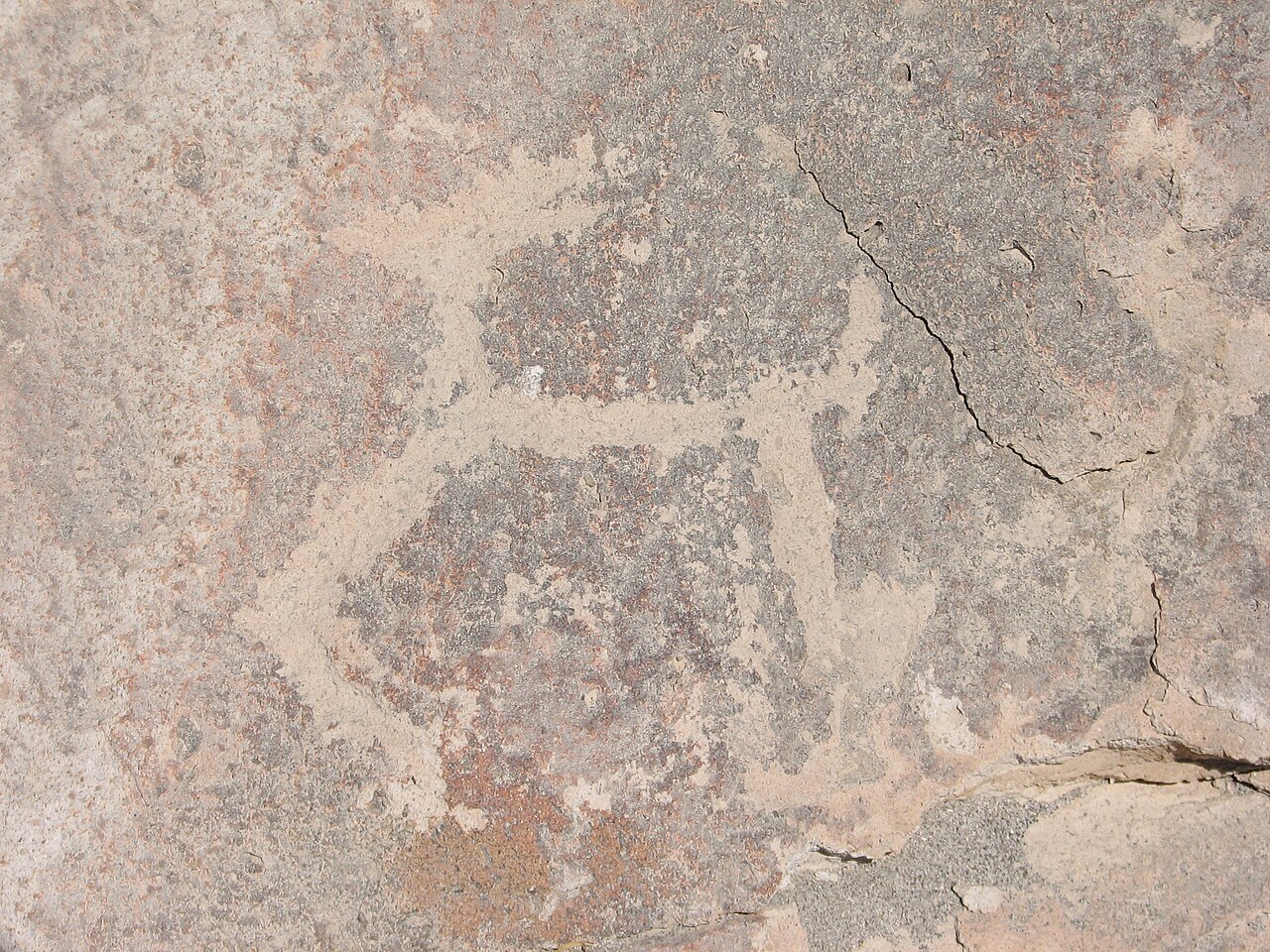
Photo: AgainErick · CC BY-SA 3.0

Scattered across several square kilometres of desert gorge in Peru's Majes Valley, Toro Muerto (Spanish for Dead Bull) is the largest rock art complex in South America: roughly 2,600 volcanic boulders carved with tens of thousands of petroglyphs. Its signature figures are the danzantes — lively dancing human figures with one hand raised — surrounded by dense zigzags, wavy lines and geometric patterns, alongside birds, snakes, felines and geometric-headed beings. Pioneering Peruvian archaeologist Eloy Linares Málaga championed the site from the 1950s, and a Polish-Peruvian project led by Janusz Wołoszyn has re-documented it since 2015. In 2024 Andrzej Rozwadowski and Wołoszyn published a striking hypothesis in the Cambridge Archaeological Journal: the zigzags are not snakes or lightning but graphic embodiments of songs, and the grandest panels may map visionary journeys to the other world.

See it on the globe →
The mainstream view

What archaeology says

Conventional archaeology associates the bulk of Toro Muerto's petroglyphs with the Wari era, roughly AD 500 to 1000, when the Majes Valley was a corridor between highlands and coast, though carving likely began earlier and continued later. The imagery — dancers, birds, serpents, camelids, geometric bands — was long interpreted through familiar Andean lenses: fertility and water symbolism in a hyper-arid valley, territorial marking along travel routes, and ritual activity, with the ubiquitous zigzags usually read as snakes, rivers or lightning. Decades of documentation, from Linares Málaga's surveys to the modern Polish-Peruvian project's digital recording of every boulder, underpin these readings.

The 2024 paper by Rozwadowski and Wołoszyn, Dances with Zigzags in Toro Muerto, is a mainstream academic intervention, not a fringe one, but it is deliberately bold. Drawing an analogy with the Tukano peoples of Colombian Amazonia — whose geometric designs, documented by ethnographers, represent songs and visions experienced in yage (ayahuasca) ceremonies — the authors propose that the linear patterns flanking the danzantes embody sung sound, making the boulders something like frozen performances. They further suggest the largest compositions are graphic metaphors of transfer to the other world: the dancer's soul travelling along the song-lines into a cosmic realm.

The authors themselves flag the hypothesis as unprovable in the strict sense, and colleagues have responded with both enthusiasm and caution — commentary in rock art journals notes the Tukano analogy leaps a continent and perhaps two millennia. But the proposal is credited with shifting attention from what the images depict to what the carving did: turning Toro Muerto from a picture gallery into evidence of music, dance and ecstatic religion in the pre-Columbian Andes.

Key evidence cited
  • Systematic documentation of roughly 2,600 carved boulders by the Polish-Peruvian project since 2015 grounds all interpretation in a full corpus
  • Associated archaeology ties the main carving phases to the Wari-era occupation of the Majes Valley, c. AD 500-1000
  • The danzante-plus-zigzag pairing recurs so consistently that the motifs are plainly a deliberate compositional system, not random decoration
  • The Tukano ethnographic parallel documents a real society whose geometric art encodes songs and yage visions, giving the 2024 hypothesis an anchor
  • The 2024 paper appeared in the peer-reviewed Cambridge Archaeological Journal with its speculative status openly declared
  • Water, serpent and fertility symbolism fits the site's setting beside one of the driest valleys on Earth
The alternative view

What the skeptics propose

Toro Muerto has long attracted more exotic readings. Some ancient-astronaut writers include its geometric-headed figures and rayed beings in the standard catalogue of suited visitors, and popular media have occasionally styled the danzantes as figures in strange gear signalling skyward. The site's sheer scale — thousands of carved boulders in an empty desert — invites the same intuition that fuels speculation at Nazca, two hundred kilometres away: that so much labour in so barren a place must address an audience above.

A larger alternative current embraces the visionary reading and pushes it further than the academics will. Psychedelic-heritage writers seized on the 2024 song hypothesis as confirmation that Toro Muerto records ayahuasca-style trance culture, folding it into a narrative in which Andean and Amazonian civilisations were built around institutionalised plant-medicine journeys. Headlines about dancers on cosmic journeys blurred the line between the authors' careful metaphor and literal claims of shamanic soul-flight encoded in stone. Rozwadowski and Wołoszyn's actual argument is narrower: an analogy about how societies that experience songs visually might carve them.

Andean perspectives add a different register again. Quechua-speaking communities of the region maintain relationships with powerful places — apus (mountain lords), springs and huacas — and some local tradition treats the Toro Muerto gorge as a place of the ancestors. Such views resist both the alien framing and any purely aesthetic archaeology: the boulders are not messages to the sky nor mere artefacts, but part of a landscape that is itself alive. Peruvian heritage authorities, meanwhile, are pursuing UNESCO World Heritage listing for the site.

Key evidence cited
  • Geometric-headed and rayed figures at Toro Muerto are cited by ancient-astronaut writers as part of the global suited-being pattern
  • The enormous labour investment in a remote desert is argued to imply an audience or purpose beyond the everyday
  • Proponents of psychedelic-heritage readings cite the 2024 song-and-journey hypothesis as academic vindication of trance-based interpretation
  • The proximity of Nazca and other south-Peruvian anomalies is presented as evidence of a regional tradition of sky-directed works
  • Some motifs remain genuinely unexplained, including boulders carved on faces hidden from any viewer

Genuinely open questions

  1. Can the song-embodiment hypothesis be tested — for instance through acoustic archaeology or finer chronology of the danzante panels?
  2. When did carving at Toro Muerto begin and end, and how many cultural phases does the corpus span?
  3. Were psychoactive plants actually used in Majes Valley ritual life, as the visionary reading implies?
  4. Why were some petroglyphs carved on boulder faces turned away from all possible viewers?

Worth knowing

If Rozwadowski and Wołoszyn are right, Toro Muerto is the world's largest songbook: thousands of boulders recording not what the ancients saw, but what they sang.