Belief & Society · Valcamonica, Lombardy, Italian Alps (Capo di Ponte area)

Val Camonica

Europe's largest rock art archive — 140,000-plus engravings, one sacred rose, and two figures the internet calls astronauts

Mainstream: c. 8000 BC to the medieval period; the famous haloed figures c. 1st millennium BC (Iron Age)Alternative: The 'astronaut' engravings read as depictions of suited visitors, conventionally Iron Age in placement46.03°, 10.35°

At a glance

Val Camonica
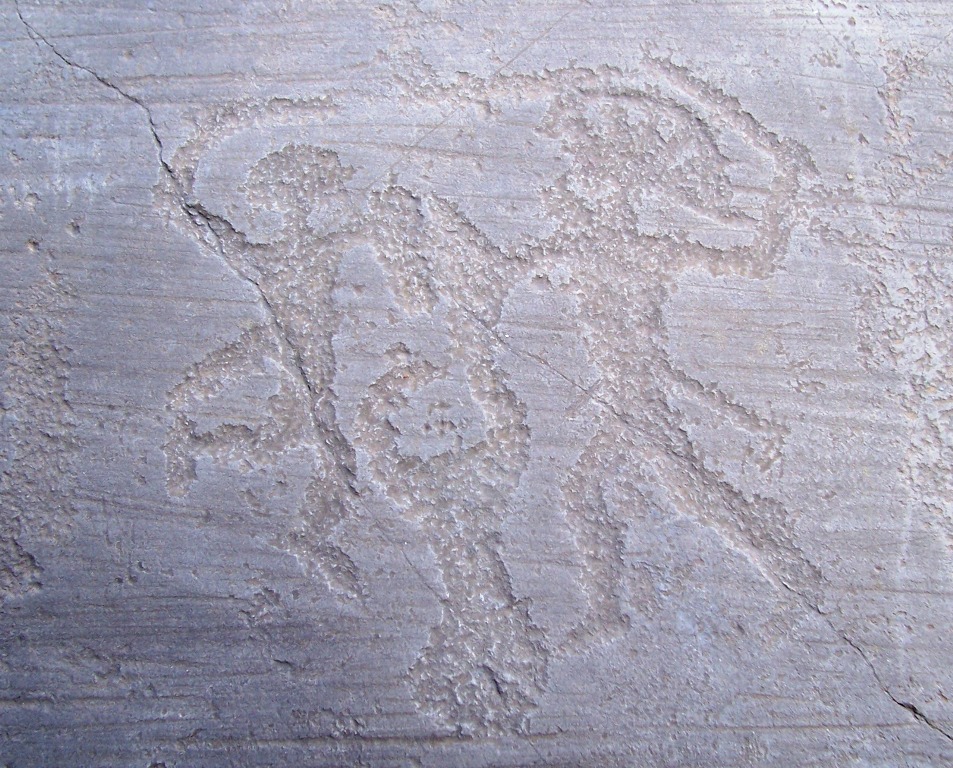
Photo: Luca Giarelli · CC BY-SA 3.0

Val Camonica, an alpine valley in Lombardy, holds the greatest concentration of prehistoric rock engravings in Europe: conservative counts exceed 140,000 figures, and some estimates run to 300,000, pecked into glacier-smoothed sandstone over roughly ten millennia. The sequence runs from Epipalaeolithic hunters through Neolithic farmers, Copper Age statue-stelae, a great Iron Age flowering attributed to the Camunni people, and on into Roman and medieval times. In 1979 it became Italy's first UNESCO World Heritage Site. Systematic study owes much to Emmanuel Anati, who founded the Centro Camuno di Studi Preistorici at Capo di Ponte in 1964. Among the valley's most debated images are the so-called Camunian rose, a looping four-lobed symbol, and a pair of haloed figures at Zurla, near Nadro, popularly dubbed the astronauts.

See it on the globe →
The mainstream view

What archaeology says

Mainstream prehistorians read Val Camonica as a ten-thousand-year diary of alpine life and belief. Emmanuel Anati's chronology, refined by later researchers, tracks the engravings from post-glacial hunting scenes through Neolithic praying figures and ploughing scenes, Copper Age daggers and sun symbols on statue-stelae, and an explosion of Iron Age imagery — warriors, duels, riders, looms, four-wheeled wagons, huts and inscriptions — that matches what archaeology knows of the Camunni, the local people the Romans eventually absorbed. The engravings' subjects evolve in lockstep with excavated material culture, which is the strongest argument that the artists were recording their own world.

The famous 'astronauts' are, to specialists, Iron Age cult figures. The paired anthropomorphs at Zurla hold implements and are surrounded by radiating halos, a convention that appears on many Camunian figures and is generally interpreted as divine light, feathered or horned headdresses, or solar attributes attached to gods, heroes or masked celebrants. Comparable rayed and horned figures occur widely in Iron Age Europe with no suggestion of technology. Superimposition studies place such figures firmly within the local stylistic sequence rather than outside it.

The Camunian rose, engraved dozens of times in the valley, is likewise read as a solar or apotropaic symbol of the Camunni, its four-lobed loop traced around nine cup-marks. Its afterlife is thoroughly modern: a stylised version was adopted in 1975 as the official emblem of the Lombardy region, making a prehistoric petroglyph one of the few to serve as contemporary government branding.

Key evidence cited
  • Over 140,000 documented engravings form a continuous stylistic sequence matching excavated artefacts from Epipalaeolithic to Roman times
  • The haloed 'astronaut' figures share their rayed-head convention with many other Camunian figures interpreted as gods or celebrants
  • Iron Age scenes depict verifiable period technology — looms, wagons, duelling warriors — anchoring the artists in their own material world
  • Emmanuel Anati's Centro Camuno di Studi Preistorici has systematically catalogued the valley since 1964, enabling superimposition-based dating
  • Comparable rayed and horned anthropomorphs occur across Iron Age European art without any technological reading
  • UNESCO's 1979 inscription (Italy's first) rested on the art's demonstrated ten-millennium local development
The alternative view

What the skeptics propose

Ancient-astronaut literature has circulated the Zurla pair for decades, typically cropped and captioned as two beings in helmets and suits. Proponents read the radiating halos as glowing helmets or energy fields, the held implements as instruments or weapons of unfamiliar design, and the figures' side-by-side stance as a crew portrait. The images appear across ancient-aliens books, websites and television, usually attributed simply to 'Italy, 10,000 BC' — an age claim mainstream chronology does not support, since the figures belong stylistically to the first millennium BC. For proponents, Val Camonica supplies the European node in the global network of haloed beings alongside Tassili, the Wandjina and Sego Canyon.

A softer alternative current, associated with writers on archaeoastronomy and comparative religion, does not invoke visitors but argues the mainstream reading is too mundane: the halos, they suggest, record genuine visionary or celestial experiences — plasma phenomena, auroras or altered states — rather than mere headdress conventions. Anati himself, while entirely rejecting aliens, has long argued that rock art worldwide encodes a shared symbolic grammar of the human mind, a view some fringe writers cite selectively as support.

There is no living indigenous tradition attached to the valley's prehistoric engravings — the Camunni left no direct testimony — which is precisely why the images are so contested. With no custodians to correct either camp, the astronauts of Zurla remain a Rorschach test: Iron Age gods to archaeologists, visitors to von Däniken's heirs, and a caution to everyone about how much a halo can carry.

Key evidence cited
  • The Zurla pair's rounded, radiating heads and apparent one-piece bodies visually evoke helmeted, suited figures
  • Proponents note the figures hold unidentified implements unlike everyday tools depicted elsewhere in the valley
  • The recurrence of haloed beings across continents is cited as a pattern pointing beyond local convention
  • Some fringe writers cite Anati's own thesis of a universal symbolic grammar as evidence of a shared extraordinary source
  • Popular captions date the figures to 10,000 BC, which, if true, would predate the conventional Iron Age attribution by millennia (mainstream scholars dispute this dating)

Genuinely open questions

  1. What did the radiating halo convention actually signify to Camunian engravers — divinity, headdress, light, or vision?
  2. How old are the earliest Valcamonica engravings, and how sharply can phases be dated without organic material?
  3. What was the function of the Camunian rose, repeated dozens of times across the valley?
  4. Why did engraving intensity explode in the Iron Age and then collapse under Roman rule?

Worth knowing

A prehistoric petroglyph is on Lombardy's letterhead: since 1975 the Italian region's official emblem has been a stylised Camunian rose, redrawn from the valley's Iron Age engravings.