What archaeology says
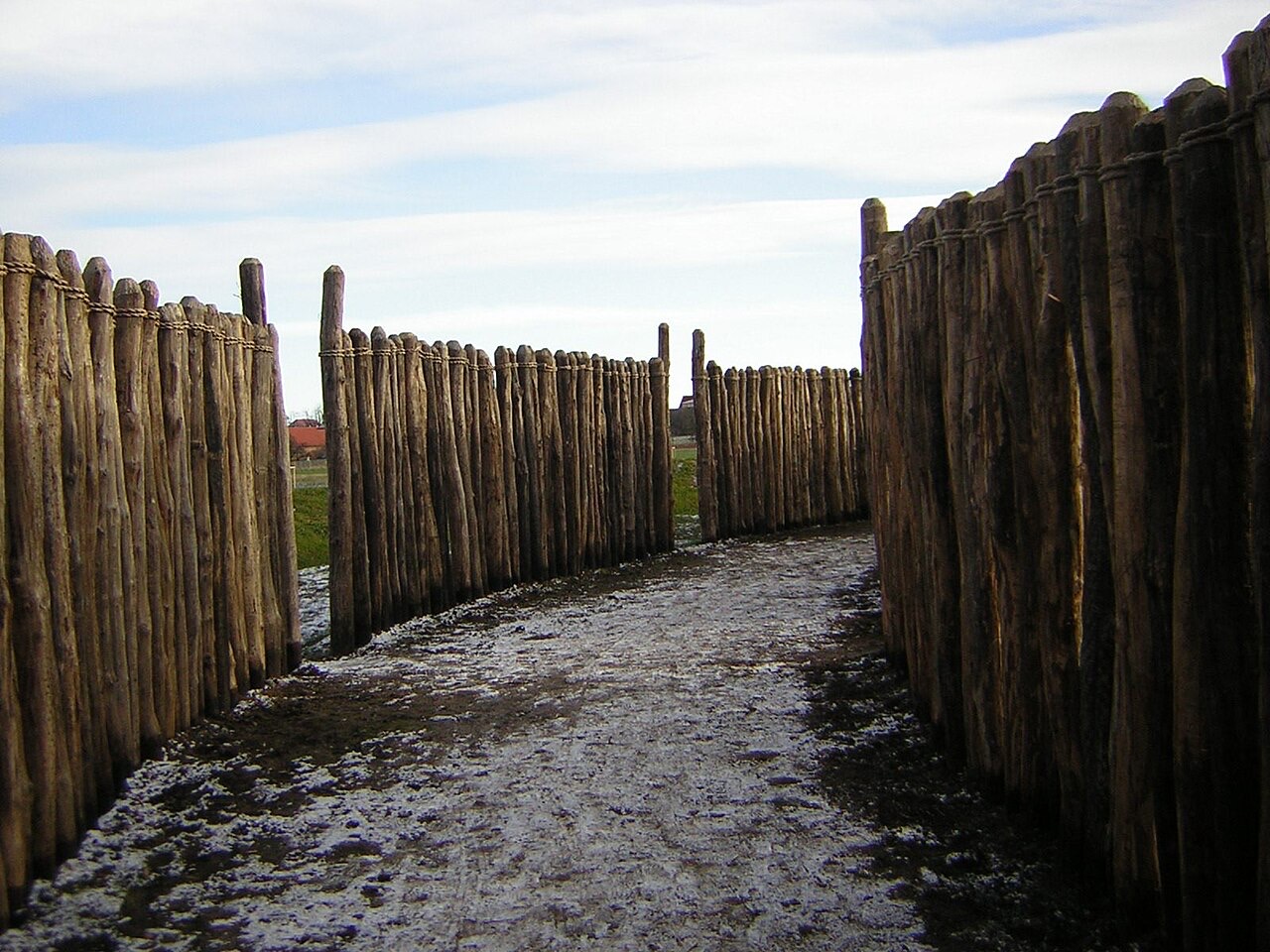
Excavation showed a roughly circular ditch with two concentric timber palisades and three main entrances. Archaeoastronomer Wolfhard Schlosser of the Ruhr University Bochum calculated that, from the centre, the south-eastern and south-western gates aligned with sunrise and sunset at the winter solstice around 4900 BC, while the northern gate may relate to the meridian. The precision is modest — gates several degrees wide rather than surgical sight-lines — but the solstice orientation is widely accepted as intentional.
Most researchers describe Goseck as a ritual and calendrical enclosure rather than an observatory in any scientific sense: a place where a farming community gathered to mark the turning of the year, anchor planting and festival cycles, and perhaps conduct ceremonies of which traces remain in the ditch — including cattle bones, fragments of human remains and evidence of fires.
Goseck belongs to the broader central European phenomenon of Kreisgrabenanlagen (circular ditched enclosures), over 130 of which are known from Germany, Austria, Slovakia, Hungary and the Czech Republic, nearly all built within a few centuries around 4800-4600 BC and then abandoned. Why the tradition began and ended so abruptly remains one of Neolithic Europe's genuine mysteries.
- Radiocarbon dates and Stroke-Ornamented Pottery sherds place construction around 4900 BC and use to about 4700 BC
- Schlosser's survey confirms the two southern gates frame winter solstice sunrise and sunset for that epoch
- The site fits a well-documented horizon of over 130 similar circular enclosures across central Europe
- Deposits of cattle bone, pottery and hearth material in the ditch indicate periodic ritual gatherings
- Full excavation before reconstruction makes Goseck one of the best-documented enclosures of its class