Ancient Technology · Near Tayma oasis, Tabuk Province, Saudi Arabia

Al-Naslaa Rock

The internet's favourite 'laser-cut' boulder — and geology's favourite lesson in how nature draws straight lines.

Mainstream: Natural sandstone formation — the split is a geological joint, likely many thousands of years old; petroglyphs added by oasis peoples within the last few millenniaAlternative: No serious alternative dating — viral claims imagine an ancient 'laser cut' by a lost technology or visitors27.23°, 38.57°

At a glance

Al-Naslaa Rock
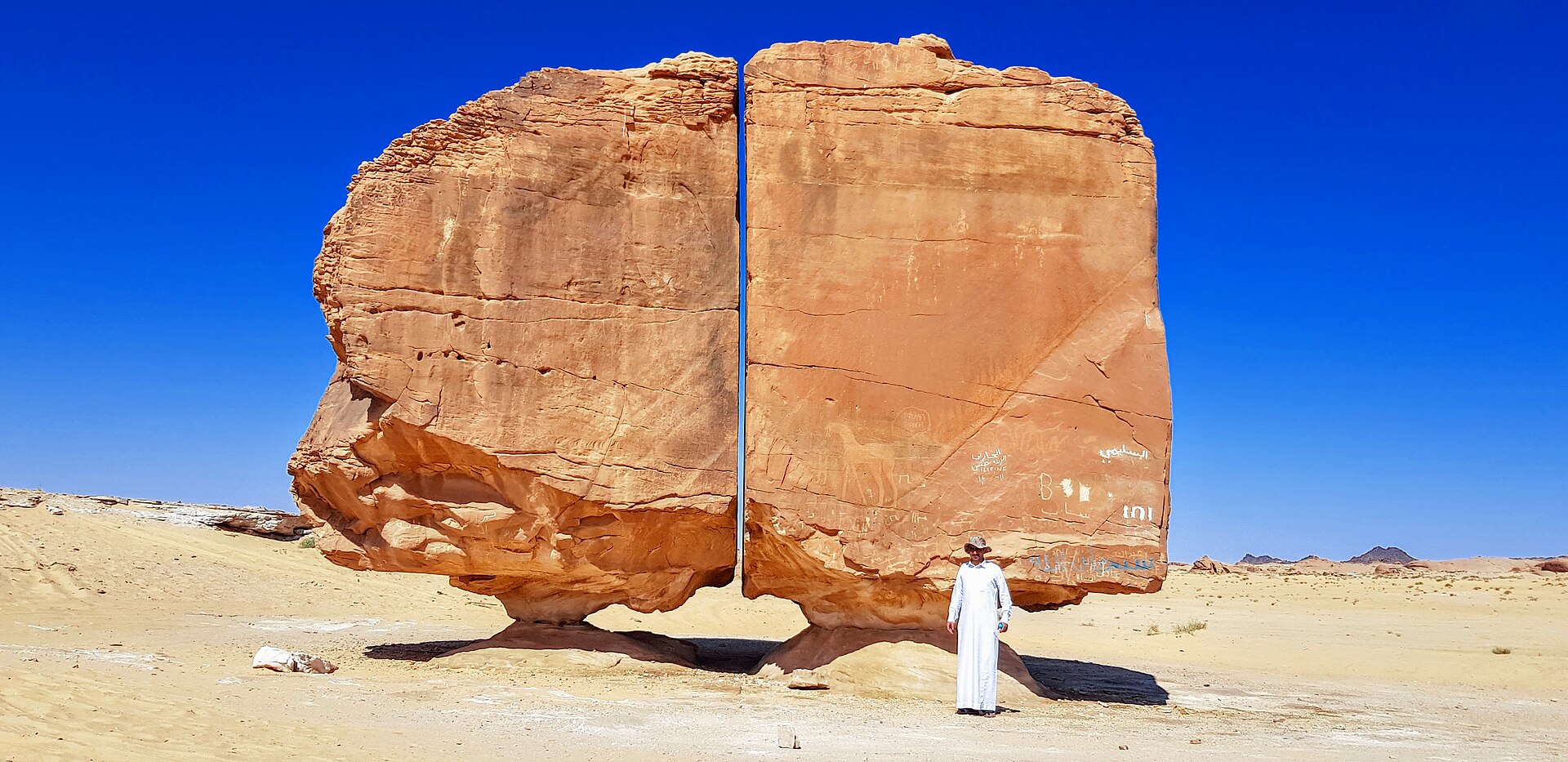
Photo: Disdero · CC BY-SA 4.0

About 50 kilometres south of the ancient oasis of Tayma in north-western Saudi Arabia, a sandstone boulder roughly six metres high and nine metres wide stands cleaved into two halves by a gap so straight and smooth it looks machined. Each half balances improbably on its own small eroded pedestal, and the south-east face carries petroglyphs including horses and ibex, left by the people of a region rich in prehistoric rock art. Photographs of Al-Naslaa circulate endlessly online captioned as evidence of ancient lasers, lost technology or alien intervention, making the rock one of the world's most viral geological features — and a perfect case study in how a striking natural formation can fuel speculation.

See it on the globe →
The mainstream view

What archaeology says

Geologists identify the famous split as a joint — a planar fracture along which the rock has parted without sliding, one of the most common structures in geology. Joints form when stresses in rock are released: by tectonic forces, by the removal of overlying material as erosion unloads the rock, or by the slow prising action of water freezing and thawing in an existing hairline crack — a plausible mechanism during the wetter, colder phases of the region's Pleistocene past. Crucially, joints are frequently very straight, because a crack propagating through a uniform, fine-grained rock like this sandstone follows the plane of stress with remarkable fidelity. Cherry Lewis, honorary research fellow at the University of Bristol, is among the geologists who have publicly explained the feature in these terms, suggesting freeze-thaw action followed by wind erosion. Once open, the gap became a natural wind tunnel: sand-laden desert wind funnelled through the slot for millennia, sanding both faces smooth, while the same abrasive winds undercut the boulder's softer base to leave each half perched on its pedestal — the standard recipe for the region's mushroom rocks.

The human story around the rock is genuine and well documented. Tayma is one of Arabia's great oases, occupied since the Bronze Age, mentioned in Assyrian records and famously home to the Babylonian king Nabonidus for a decade in the sixth century BC; Saudi-German excavations led by the German Archaeological Institute under Ricardo Eichmann and Arnulf Hausleiter have been unravelling its deep history since 2004. The petroglyphs pecked into Al-Naslaa's face belong to the area's long rock-art tradition — people certainly stood here and marked the stone. But no archaeologist working in the region interprets the split itself as artificial: it is one of countless joints in the local sandstone, merely the most photogenic.

Key evidence cited
  • The split matches a geological joint — a stress fracture, one of the commonest structures in rock
  • Joints propagating through uniform sandstone are naturally straight and planar
  • Wind-blown sand funnelled through the gap explains the smoothed faces; undercutting explains the pedestals
  • Comparable straight natural fractures occur worldwide and elsewhere in the same formation
  • No tool marks, cutting debris or working traces have ever been documented on the split faces
The alternative view

What the skeptics propose

Al-Naslaa's fame is a creation of the internet age. Viral posts, ancient-astronaut media and countless YouTube compilations present the split as too straight, too smooth and too clean to be natural — the signature, they suggest, of a laser or some equivalent precision technology wielded thousands of years ago, whether by a lost human civilisation or by visitors. The claims rarely come with named champions or testable detail; the case is essentially visual, resting on the intuition that nature does not draw lines this straight. Supporters point to the flatness of the two facing surfaces, the near-constant width of the gap over the boulder's full height, the improbable balancing act of the twin pedestals, and the petroglyphs as proof that ancient people were present and attached significance to this particular stone. Sites such as Ancient Origins have framed the question sympathetically, asking what could really have split the rock.

The mainstream reply is straightforward: nature draws straight lines all the time. Joint faces of comparable planarity occur worldwide, from the jointed granites of Yosemite to the sandstone slot canyons of the Colorado Plateau, and Al-Naslaa itself carries other, less famous fractures. No tool marks, cut striations, vitrification or debris of any working method have ever been documented on the split faces, and no known ancient technology — nor any modern one short of industrial saws — would cut a six-metre boulder for no evident purpose and leave no other trace in the landscape. Even most alternative-history authors treat Al-Naslaa as a curiosity rather than a cornerstone. It remains valuable, though, as a benchmark: the place where the 'it looks artificial' argument meets geology, and geology wins.

Key evidence cited
  • A gap of near-constant width running the full height of the boulder
  • Two facing surfaces smooth and flat enough to photograph like sawn stone
  • Both halves balanced on separate pedestals, giving a deliberately 'placed' appearance
  • Petroglyphs proving ancient people frequented and marked this exact rock
  • The intuition, endlessly restated online, that no natural process splits stone this cleanly

Genuinely open questions

  1. Which mechanism — tectonic stress, unloading or freeze-thaw — actually opened the joint, and when?
  2. How old are the petroglyphs, and did the striking split give the rock special significance to oasis peoples?
  3. Why do some natural fractures achieve such extreme planarity while neighbouring ones do not?

Worth knowing

Al-Naslaa is now so iconic that Saudi Arabia built a replica of it at the Boulevard World entertainment park in Riyadh — a man-made copy of a rock famous for looking man-made.