What archaeology says
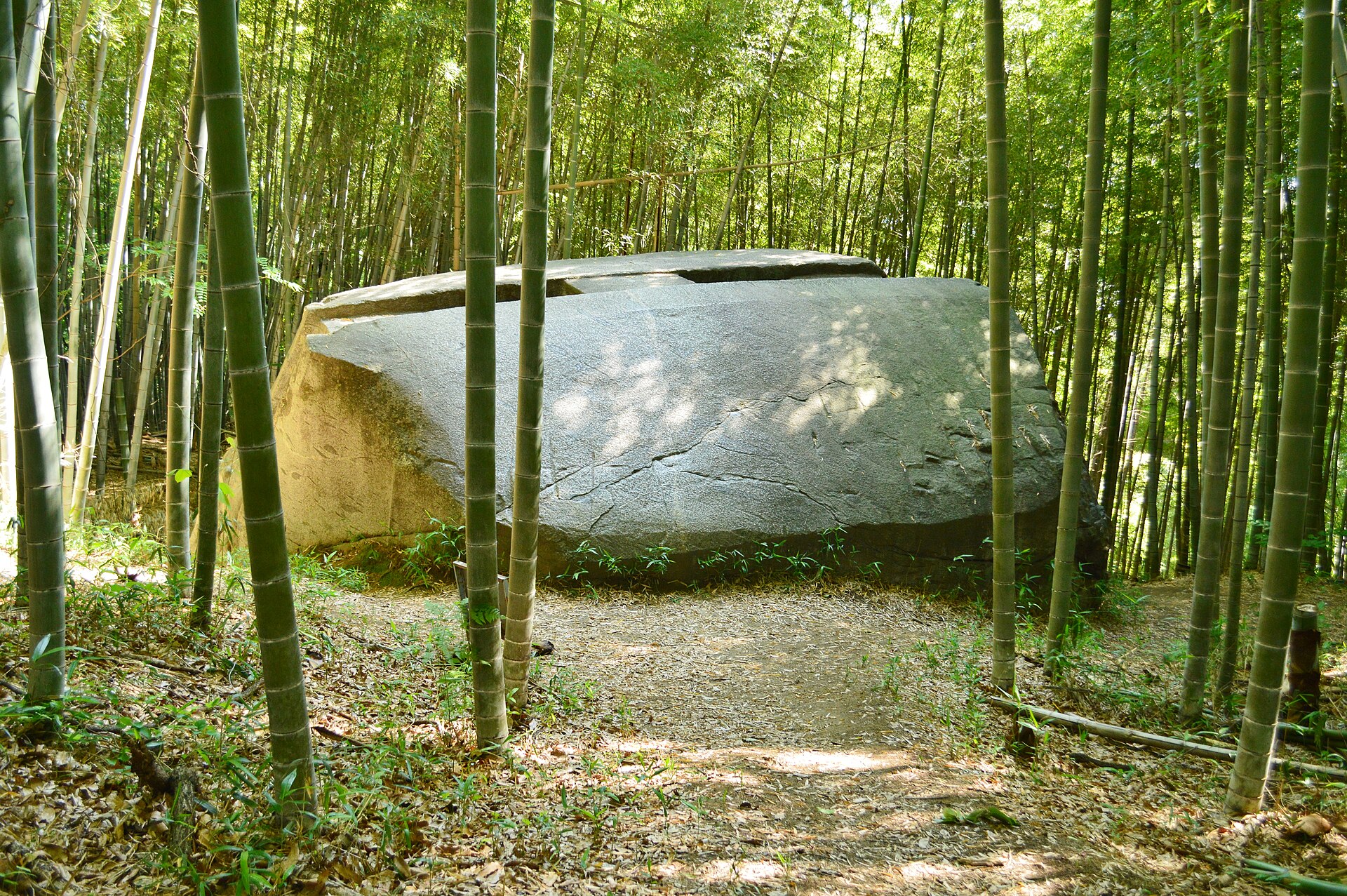
Historians place the stone in the Asuka period (AD 538–710), when the surrounding valley was the seat of Japan's imperial court and the stage for its first Buddhist temples, continental-style palaces and engineered waterworks. The leading scholarly interpretation reads Masuda-no-Iwafune as an abandoned tomb project: the two square shafts closely resemble the initial cuttings for the twin-chambered, rock-cut granite tombs of the era — the nearby Oni-no-Manaita and Oni-no-Setchin are the dismembered floor and lid of exactly such a tomb, and the finely hollowed Kengoshizuka tumulus shows the finished form. On this reading the carvers began sinking a pair of burial chambers from above, struck a flaw or lost their patron, and walked away. The lattice pattern on the flank fits a standard masonry technique: a grid pecked out to guide the systematic flattening of a face.
Rival mainstream proposals keep the debate alive. Some researchers have suggested an astronomical or calendrical function — a sighting platform associated with the court's adoption of continental calendar science in the seventh century — while an Edo-period tradition connects the stone to the construction of the long-vanished Masuda Lake below the hill. What no academic doubts is capability: Asuka's builders, aided by immigrant masons from the Korean kingdom of Baekje, demonstrably cut, moved and dressed hard granite for tomb chambers, temple foundation stones and fountains, using iron tools, abrasives, levers and large organised workforces. The mystery of the rock ship is its purpose, not the possibility of its manufacture.
- The two square shafts match the initial cuttings of twin-chambered Asuka-period rock-cut tombs
- Nearby Oni-no-Manaita and Oni-no-Setchin prove local mastery of monumental granite tomb carving
- The lattice pattern matches a standard pecked grid used to flatten stone faces by hand
- Asuka court records document immigrant Baekje masons and large organised construction workforces
- The stone was carved in place on its hilltop — no transport of 800 tonnes was ever required