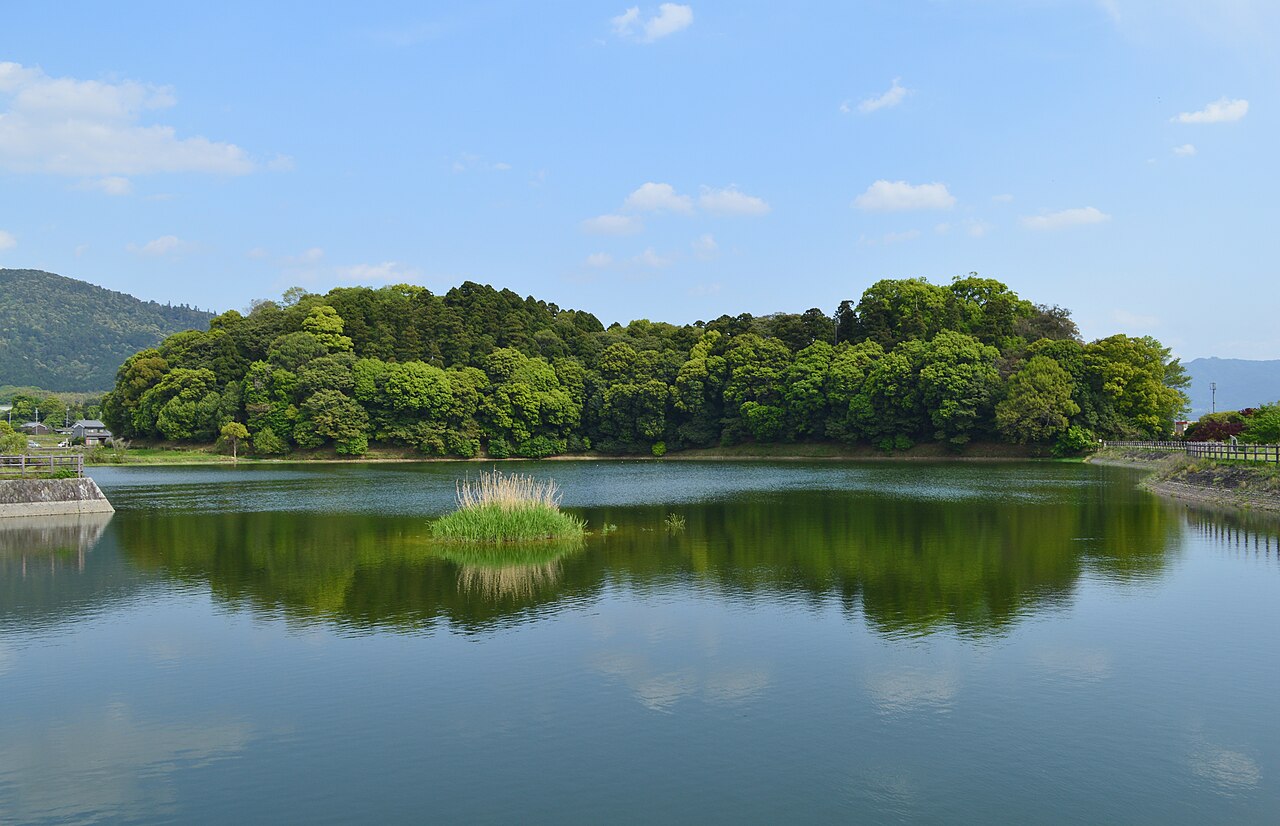
Lost Worlds · Hashihaka Kofun, Sakurai, Nara Prefecture, Japan (leading Kinai-theory candidate for Queen Himiko's tomb)

Yamatai

A shaman queen, a Chinese travel itinerary that leads into the open sea, and Japan's longest-running archaeological argument.

Mainstream: c. AD 180-248 (Himiko's reign, per the Chinese Wei Zhi)Alternative: c. AD 240 (a Kyushu realm, if the Wei Zhi itinerary is read literally)34.54°, 135.84°

At a glance

Yamatai
Photo: Saigen Jiro · CC0

Yamatai was the dominant chiefdom of ancient Japan according to the Wei Zhi, a Chinese chronicle compiled around AD 297, which describes the shaman queen Himiko ruling ninety years earlier over a confederation of some thirty communities, sending envoys to Wei China and receiving the title Ruler of Wa Friendly to Wei along with one hundred bronze mirrors. The chronicle gives directions and distances from Korea to Yamatai — but followed literally, they lead into the Pacific Ocean. For over three centuries Japanese scholars have argued whether Yamatai lay in northern Kyushu or in the Kinai region around Nara, a dispute with real stakes: the Kinai answer makes Himiko's realm the direct ancestor of the Japanese imperial state.

See it on the globe →
The mainstream view

What archaeology says

The controversy crystallised in 1910, when historian Naito Konan argued for the Kinai (Yamato) location while Shiratori Kurakichi championed northern Kyushu — a debate so durable it is often called the oldest controversy in Japanese archaeology. Today most, though not all, academic archaeologists favour the Kinai theory, and its centrepiece is the Hashihaka Kofun at Sakurai in Nara Prefecture: a 280-metre keyhole-shaped tomb, the first of the giant kofun, which radiocarbon work published by the National Museum of Japanese History in 2009 dated to roughly AD 240-260 — strikingly close to Himiko's recorded death around 248.

Supporting the Kinai case is the nearby Makimuku site, a large planned settlement of the early 3rd century with pottery drawn from across Japan, suggesting exactly the kind of supra-regional centre the Wei Zhi describes. The wide distribution of triangular-rimmed bronze mirrors with Wei-era inscriptions, radiating from the Kinai, is read by many as the trace of Himiko's hundred mirrors being redistributed to allied chiefs.

The Imperial Household Agency, however, designates Hashihaka as the tomb of a legendary princess, Yamato Totohi Momoso, and restricts excavation of it as an imperial mausoleum — so the one dig that might settle Japan's greatest historical argument is forbidden. Mainstream scholars on both sides agree on what Yamatai was: a real, historically documented paramount chiefdom marking Japan's transition from scattered Yayoi communities to a unified state; the dispute is purely over where.

Key evidence cited
  • The Wei Zhi (c. AD 297) is a near-contemporary documentary source recording Himiko's embassies to Wei in 238-247, with titles and gifts specified.
  • Radiocarbon dating published in 2009 places the Hashihaka Kofun's construction around AD 240-260, matching Himiko's death date of c. 248.
  • The Makimuku site near Hashihaka shows a planned 3rd-century centre with pottery from many regions of Japan — evidence of a supra-regional polity in the Kinai.
  • Triangular-rimmed bronze mirrors bearing Wei reign dates cluster in distributions radiating from the Kinai region.
  • The name Yamatai is most naturally read as an early transcription of Yamato, the historic heartland of the Japanese state.
  • Both major camps rest on the same accepted documentary and archaeological record; the disagreement is interpretive, not evidential.
The alternative view

What the skeptics propose

The Kyushu school is not fringe — it retains serious academic defenders — but it anchors a spectrum of increasingly adventurous readings. Its core argument is textual literalism: the Wei Zhi's itinerary begins indisputably in northern Kyushu, and its stated distances, if not silently corrected, never reach the Kinai. Kyushu theorists note that northern Kyushu was the gateway for continental trade, is rich in Yayoi-period finds including Chinese mirrors, iron weapons and gold-seal diplomacy (the famous gold seal of AD 57 was found on Shikanoshima, Fukuoka), and that the Wei Zhi's descriptions of climate and customs suit Kyushu. The Yoshinogari site in Saga Prefecture, a spectacular moated Yayoi settlement, has been popularly promoted as a Yamatai candidate since its excavation in the late 1980s.

Beyond the two main camps, alternative writers have proposed dozens of other locations — one survey counted candidates from Okinawa to Java. The novelist and amateur historian Furuta Takehiko developed a heterodox multi-dynasty theory in which a separate Kyushu dynasty, not Yamato, conducted all early diplomacy with China, its history later absorbed and concealed by the Nara court's chroniclers. Others argue the eighth-century compilers of the Kojiki and Nihon Shoki deliberately erased Himiko — a foreign-recorded female paramount who fits no official emperor — hinting, conspiracy-minded readers say, at an inconvenient truth about the imperial line's origins.

A romantic thread also identifies Himiko with the sun goddess Amaterasu herself, reading the goddess's mythical withdrawal into a cave as a memory of the solar eclipses of AD 247 and 248, which coincide suggestively with Himiko's death. Astronomer Saito Kuniji and others have explored the eclipse correlation, which remains a favourite of popular books on the mystery.

Key evidence cited
  • Read literally, the Wei Zhi's directions and distances from Korea never reach the Kinai — the Kinai theory must emend the text (reading south as east), which Kyushu advocates call special pleading.
  • Northern Kyushu dominates the archaeology of continental contact: Chinese mirrors, iron goods, and the AD 57 gold seal found on Shikanoshima.
  • The Yoshinogari site proves that large moated, palisaded settlements of the right period existed in Kyushu.
  • The 8th-century Japanese chronicles never mention Himiko, an omission alternative writers read as deliberate erasure by court historians.
  • Total solar eclipses in AD 247 and 248 coincide with Himiko's death, supporting the popular Himiko-Amaterasu identification.
  • The Imperial Household Agency's refusal to permit excavation of Hashihaka leaves the Kinai theory's key monument unverified, a point pressed by sceptics of the mainstream consensus.

Genuinely open questions

  1. Was Yamatai in Kyushu or the Kinai — and will Hashihaka ever be opened to settle it?
  2. Who is actually buried in the Hashihaka Kofun?
  3. Why do Japan's own earliest chronicles omit Himiko, the best-documented figure of her century?
  4. Does the Himiko-Amaterasu eclipse correlation reflect real events behind the myth, or coincidence?

Worth knowing

The Wei Zhi records that after Himiko died a king was raised in her place, but the people would not obey him — order returned only when a thirteen-year-old girl of her line, Toyo (or Iyo), was made queen, suggesting rule by shaman queens was no one-off in 3rd-century Japan.