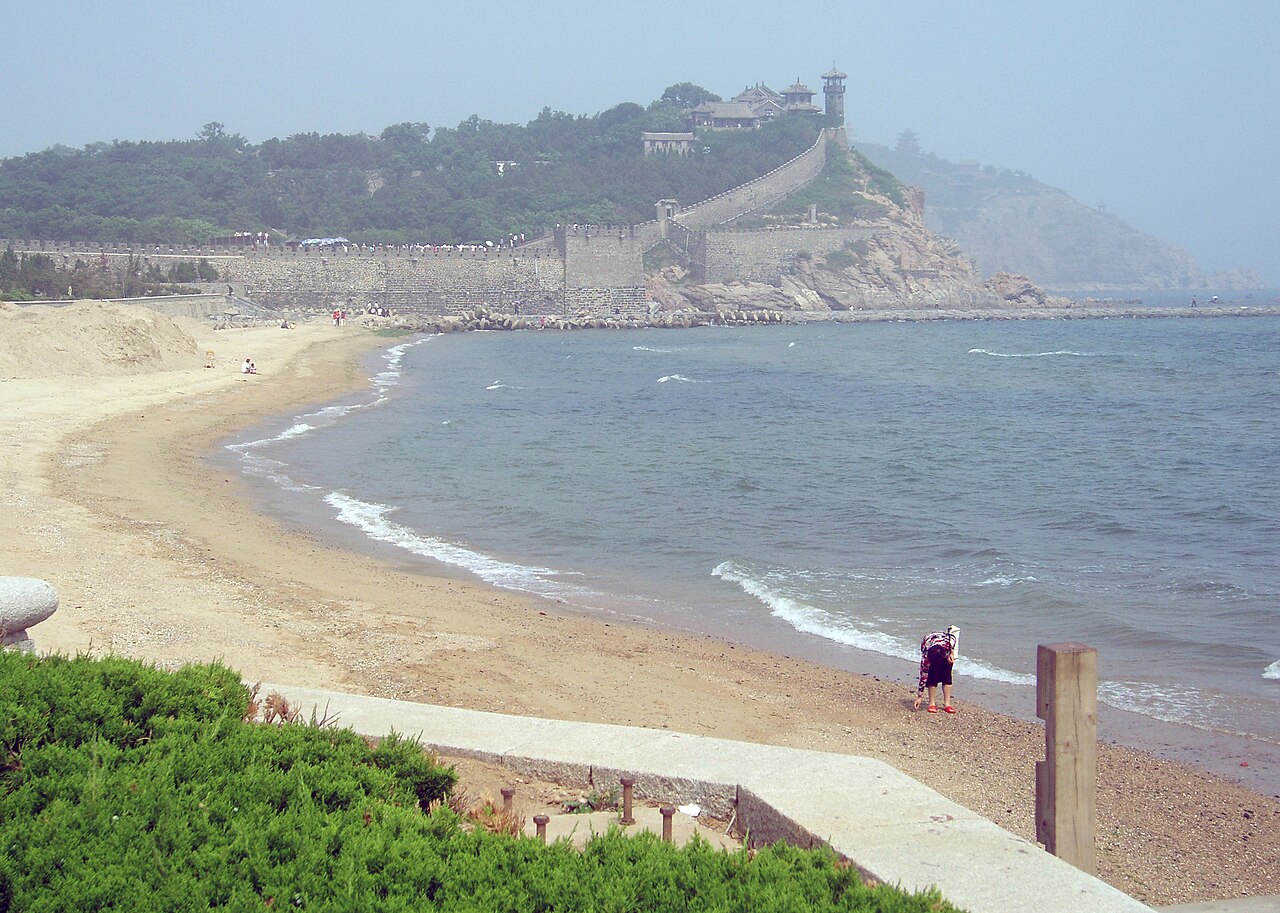
Myth & Memory · Penglai Pavilion, Yantai, Shandong, China (the coastal city named for the legendary isle)

Penglai, Isle of the Immortals

China's First Emperor sent fleets to find the island of immortality — the man he sent never came back, and Japan tells you why.

Mainstream: Legend current by the 4th century BC; Qin expeditions 219-210 BCAlternative: 219 BC (Xu Fu's real voyages to a real destination — Japan)37.83°, 120.75°

At a glance

Penglai, Isle of the Immortals
Photo: Fanghong · CC BY-SA 3.0

Penglai was the chief of three fabled mountain-isles in the Bohai Sea — with Fangzhang and Yingzhou — where immortals dwelt in palaces of gold and silver, every creature was white, and elixirs conferred eternal life. The legend so gripped Qin Shi Huang, unifier of China, that he sent the court sorcerer Xu Fu to sea in 219 BC with a fleet and, tradition says, three thousand boys and girls to find it. Xu Fu sailed twice and never returned from the second voyage. Sima Qian, the great Han historian, recorded the whole affair within a century of the events. On the Shandong coast, the city of Penglai keeps the legend's name — and produces spectacular sea mirages that may explain the whole story.

See it on the globe →
The mainstream view

What archaeology says

Historians treat Penglai as pure mythology — part of a coherent early Chinese cosmology of paradises at the world's edges, the eastern maritime counterpart to the western mountain paradise of Kunlun. What they treat as sober history is the court's response to it: the Shiji of Sima Qian documents Qin Shi Huang's patronage of magicians (fangshi) from the coastal states of Yan and Qi, Xu Fu's commission and enormous funding, his excuse on returning empty-handed (a great fish blocked the way, so the emperor personally shot at sea monsters with crossbows), and his final departure around 210 BC, after which he found flat plains and broad marshes, made himself king there, and never came back.

A favourite mainstream explanation for the legend's grip is meteorological. The Bohai coast at Penglai is one of the world's most reliable venues for superior mirages — fata morgana — in which real islands and ships are stretched into shimmering towers and floating cities above the sea, most often in May and June. Chinese sources across the centuries record these apparitions at Penglai as visions of the immortals' isles; the Song polymath Shen Kuo discussed such sea-market mirages in the 11th century. On this reading, sailors and coastal folk genuinely saw Penglai — as an optical phenomenon.

As for Xu Fu, most historians accept he was a real person — his home is plausibly identified at Xufu village in Jiangsu — and that his non-return reflects either shipwreck, prudent self-exile from an emperor who buried scholars alive, or genuine settlement somewhere overseas that cannot now be verified. The tale mainly illustrates the lengths to which the First Emperor's fear of death drove him: his tomb's rivers of mercury and his fatal consumption of mercury-based elixirs belong to the same obsession.

Key evidence cited
  • The Shiji of Sima Qian (c. 94 BC) documents the Penglai belief and Xu Fu's expeditions in detail within living memory of the Qin court.
  • Penglai belongs to a systematic early Chinese mythology of edge-of-world paradises, paralleling the western Kunlun — a literary cosmology, not geography.
  • The Bohai coast at Penglai is a world-class site for superior mirages, recorded for centuries as visions of immortal isles, offering a natural explanation for sightings.
  • No island matching Penglai exists in the Bohai Sea, which is shallow and was well navigated by the Han period.
  • Qin Shi Huang's documented elixir obsession — including the mercury consumption implicated in his death and the mercury rivers reported in his tomb — explains the expeditions without any real island.
  • The Yayoi transition in Japan began well before Xu Fu's voyages and shows a continental route through Korea, not a single Chinese colonising event.
The alternative view

What the skeptics propose

The great alternative tradition holds that Xu Fu's fleet reached Japan — making the search for Penglai an accidental founding voyage. The idea is ancient rather than modern: Japanese and Chinese sources from the medieval period onwards identify Xu Fu (Jofuku in Japanese) with Japan, and the city of Shingu in Wakayama Prefecture maintains a shrine, a park and a purported tomb of Xu Fu, with local tradition crediting him with introducing agriculture, medicine and papermaking. Other Jofuku traditions cluster at Saga in Kyushu and elsewhere along the western seaboard. Some versions go further, identifying Penglai itself with Mount Fuji and Xu Fu with the legendary first emperor Jimmu — a claim aired by Edo-period writers and kept alive in popular books.

Proponents note the timing is suggestive: Xu Fu's departure coincides with the Yayoi transformation of Japan, when wet-rice agriculture, bronze and iron arrived from the continent and the population grew rapidly. A fleet carrying thousands of young colonists and craftsmen of the five grains, as the Shiji specifies, is exactly the sort of event that could seed such a change — and, advocates argue, Sima Qian's plains and broad marshes where Xu Fu made himself king reads like a real landfall report, not a fairy tale.

Mainstream scholars reply that the Yayoi transition began centuries before 219 BC and flowed mainly through Korea, and that no Japanese archaeological find can be tied to Xu Fu. But the identification remains one of East Asia's most cherished legends, celebrated on both sides: Xuzhou-area and Shandong local histories claim his launching sites, while Japanese towns hold Jofuku festivals to honour their legendary Chinese founder.

Key evidence cited
  • Xu Fu was a real, named historical figure with a documented royal commission, two voyages, and a recorded non-return — the legend has a genuine expedition at its core.
  • Sima Qian states Xu Fu found a land of flat plains and broad marshes and made himself king there — a concrete-sounding landfall, not a mythic flourish.
  • Japan preserves centuries-old Jofuku traditions at Shingu (shrine and tomb), Saga and other sites, with festivals honouring him to this day.
  • The scale of the expedition — thousands of colonists plus craftsmen and seed grain, per the Shiji — is the profile of a colonisation fleet.
  • Broad chronological proximity between the Qin voyages and Japan's Yayoi intensification keeps the connection alive for its advocates.
  • Edo-period Japanese scholars themselves debated the Xu Fu-Japan identification, showing it is a long-standing East Asian tradition rather than a modern fabrication.

Genuinely open questions

  1. Did Xu Fu's second fleet reach Japan, Korea, the Ryukyus — or the bottom of the sea?
  2. How much of the Penglai legend originated in mirage sightings over the Bohai?
  3. Can any archaeological trace of a late 3rd-century BC Chinese colonising party ever be identified in Japan?
  4. Why did the Penglai paradigm — islands of immortals in the eastern sea — take such deep root in Chinese, Japanese and Korean culture alike?

Worth knowing

According to Sima Qian, when Xu Fu returned empty-handed the first time, he claimed a giant fish barred the way to Penglai — so Qin Shi Huang went to the coast and personally shot at a great sea creature with a repeating crossbow. Within months the emperor was dead, poisoned by the very immortality elixirs the isle was supposed to render unnecessary.