Ancient Engineering · Takasago, Hyōgo Prefecture, Japan

Ishi-no-Hōden (The Floating Stone)

A 500-tonne carved monolith that appears to float on its pond — and was already an unsolved mystery when Japan's oldest books were written.

Mainstream: Unknown — most likely Kofun to Asuka period (c. AD 300–700); already ancient when recorded c. AD 713Alternative: Unknown — some alternative writers push it back to the Jōmon era or to a lost pre-Japanese stoneworking culture34.78°, 134.80°

At a glance

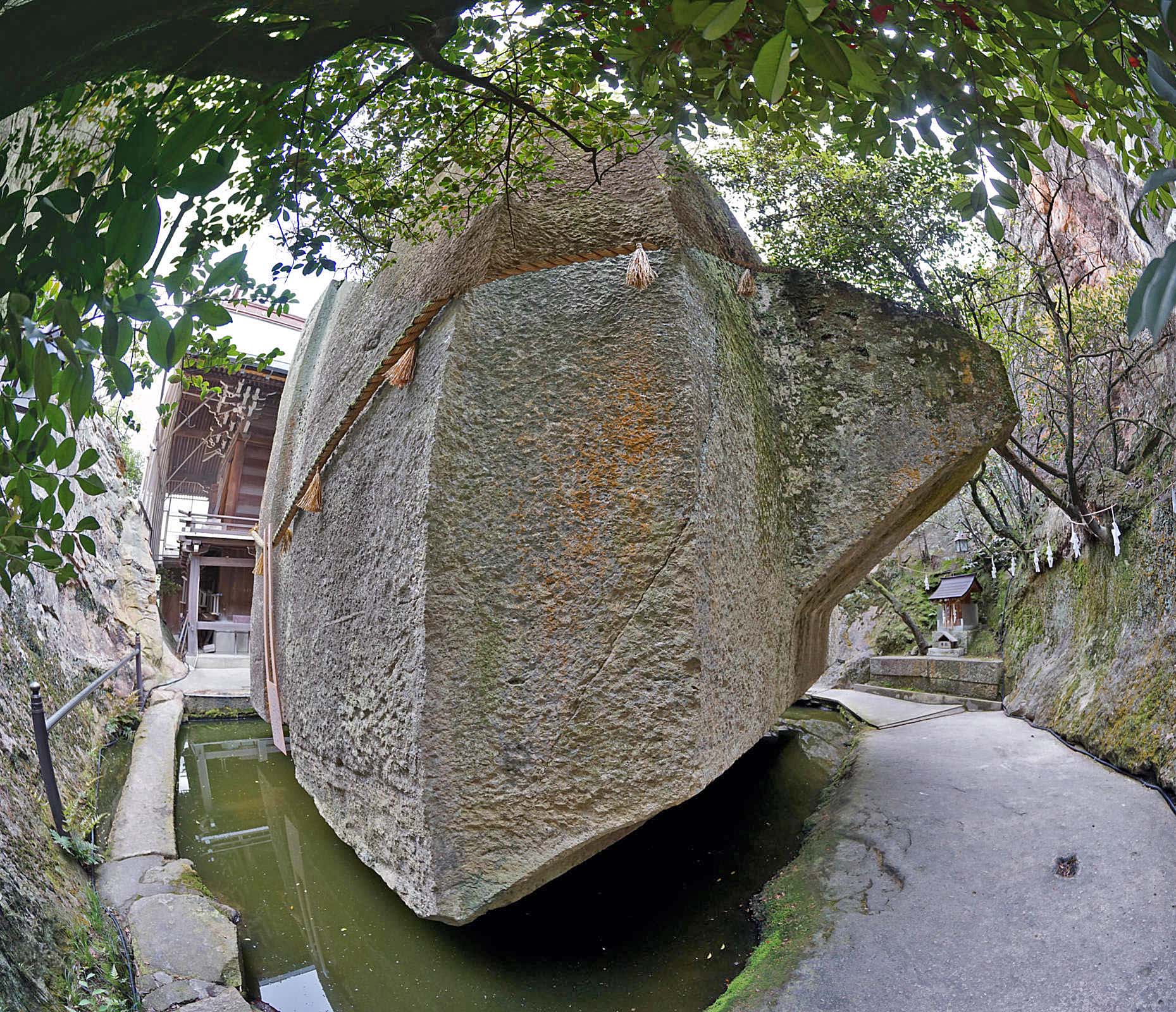
Ishi-no-Hōden (The Floating Stone)
Photo: z tanuki · CC BY 3.0

Ishi-no-Hōden ('Stone Treasure Hall') is a colossal carved block of stone standing in the grounds of the Ōshiko Jinja shrine at Takasago, west of Kobe. Measuring about 6.4 metres wide, 5.7 metres high and 7.2 metres deep and weighing an estimated 500 tonnes, it was hewn directly out of a hillside of volcanic tuff and remains attached to the bedrock beneath, surrounded on three sides by the living rock from which it was cut. A curious prism-shaped projection juts from its rear face, and the pool of water at its base — which by local tradition never dries up — creates the illusion that the giant stone is floating, earning it the nickname Ame no Ukiishi, the 'Floating Stone of Heaven'. It is designated a National Historic Site together with the adjacent Tatsuyama stone quarries.

See it on the globe →
The mainstream view

What archaeology says

No inscription, burial or datable deposit has ever been tied to Ishi-no-Hōden, so archaeologists date it by context. It is carved from Tatsuyama stone — a rhyolitic welded tuff quarried on this same ridge from the Kofun period (c. AD 250–538) onwards, when it was the premier material for the house-shaped sarcophagi of Japan's elite, shipped to royal tombs across the Kinai region. The most widely held reading is that the monolith is an unfinished monument: an enormous sarcophagus, stone chamber or shrine-like block that was meant to be detached, tipped and dressed, but was abandoned mid-project with its base still joined to the mountain. Rival academic proposals place it in the seventh-century Asuka period, when the imperial court developed a distinctive fashion for large carved stones, and compare it directly with the Masuda-no-Iwafune in Nara Prefecture.

The stone's antiquity is bracketed by Japan's earliest literature. The Harima Fudoki, a provincial gazetteer compiled around AD 713–717, already describes the monument and attributes it — anachronistically, since the man was long dead — to Mononobe no Moriya in the time of Prince Shōtoku. In other words, its true origin had been forgotten within living memory of the seventh century, which caps its likely construction date around AD 700 at the latest. The German physician Philipp Franz von Siebold sketched and published the stone in the 1830s, and between 2005 and 2006 the Takasago City Board of Education, with the Otemae University Research Institute, recorded it by three-dimensional laser scanning. Tuff is a relatively soft, workable stone, and the iron chisels available from the Kofun period onwards are fully capable of the carving — the genuine puzzle is not how, but what it was for and why it was abandoned.

Key evidence cited
  • Carved from Tatsuyama welded tuff, the same ridge quarried for elite Kofun-period sarcophagi
  • Base still attached to bedrock, the classic signature of an unfinished, abandoned project
  • The Harima Fudoki (c. AD 713–717) already records the stone, capping its age at about AD 700
  • Iron tools of the Kofun–Asuka periods demonstrably worked this relatively soft tuff at scale
  • 2005–06 laser scanning by Takasago City and Otemae University documented tooled, chisel-dressed surfaces
The alternative view

What the skeptics propose

Ishi-no-Hōden sits at the centre of a rich mythology that alternative writers take as a starting point. Shinto tradition holds that the deities Ōkuninushi and Sukunabikona attempted to raise a stone palace on the hill in a single night before being thwarted by a rebellious local god, leaving the great block lying on its side. Lost-civilisation authors and sites such as Ancient Origins argue that when a monument's builders were already unknown to the compilers of Japan's first books, the honest answer to its age is simply 'unknown' — and some push the origin far earlier, even into the Jōmon era, casting the stone as the relic of a forgotten megalithic culture later absorbed into myth.

Proponents also dwell on the monument's strange geometry. The flat dressed faces, the deep slots isolating it from the hillside and above all the wedge-like projection on its rear face — as if a giant prism had been laid on its side — fit no known sarcophagus or chamber type exactly, and commentators argue that carving a 500-tonne block top-down out of a hill, with no obvious way ever to move it, makes little sense as a practical tomb project. Comparisons are drawn with the Masuda-no-Iwafune and with unfinished megaliths worldwide, from Aswan's obelisk to Baalbek, to suggest a shared lost approach to monolithic stone. Mainstream researchers reply that unfinished monuments are precisely what abandoned projects look like, that tool marks consistent with chisels survive on the faces, and that the Kofun-period sarcophagus industry in this exact stone, on this exact ridge, is the obvious cultural home for the work — though they concede its intended function remains genuinely unresolved.

Key evidence cited
  • Its builders and purpose were already forgotten when Japan's earliest surviving texts were compiled
  • The Fudoki's own attribution is historically impossible, suggesting even eighth-century scribes were guessing
  • Shinto tradition credits deities with the work and names it the Floating Stone of Heaven
  • The prism-shaped rear projection matches no known sarcophagus or chamber design
  • A 500-tonne block carved with no evident means of ever moving it off the hillside

Genuinely open questions

  1. What was Ishi-no-Hōden intended to be — sarcophagus, tomb chamber, shrine or something else entirely?
  2. Why was the project abandoned when the block needed only to be severed from its base?
  3. How did its makers plan to detach, turn and transport a 500-tonne monolith?

Worth knowing

Philipp Franz von Siebold — the physician later expelled from Japan for smuggling maps — published one of the first Western drawings of Ishi-no-Hōden in his monumental work 'Nippon' in the 1830s.