Origins of Civilisation · Hangzhou, Zhejiang, China

Liangzhu

A 5,000-year-old water-engineered city of jade kings that drowned — a millennium before China's recorded history begins.

Mainstream: c. 3300–2300 BCAlternative: Cited as proof of China's '5,000 years of civilisation' and linked to the Great Flood myths30.40°, 119.98°

At a glance

Liangzhu
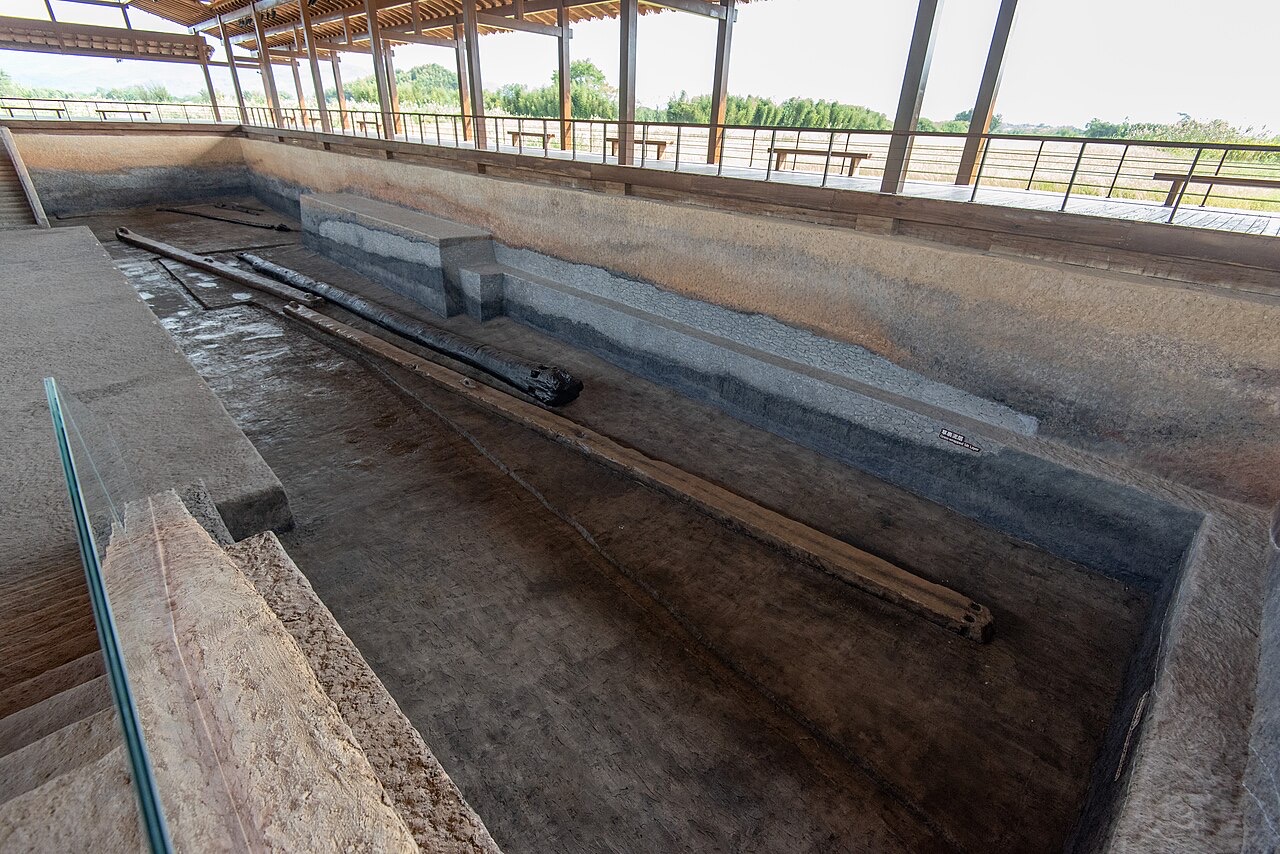
Photo: Siyuwj · CC BY-SA 4.0

Liangzhu, on the wet plain northwest of Hangzhou, was the capital of a jade-working rice state that flourished from about 3300 to 2300 BC. Its walled inner city covered nearly three square kilometres, ringed by the oldest large-scale hydraulic system known anywhere: a network of some eleven dams, levees and canals controlling an area of around 100 square kilometres. Elite graves on the Fanshan and Yaoshan platforms held thousands of ritual jades — the enigmatic square-tubed cong and disc-shaped bi — carved with a staring man-beast emblem. UNESCO listed the city in 2019 as testimony to an early regional state, and its abrupt collapse around 2300 BC is now blamed on catastrophic flooding.

See it on the globe →
The mainstream view

What archaeology says

Liangzhu has transformed the archaeology of early China. Work led by Liu Bin of the Zhejiang Provincial Institute of Cultural Relics and Archaeology, following the 2007 identification of the city walls, revealed a planned capital with a raised palatial precinct at Mojiaoshan, huge rice granaries, and a peripheral hydraulic system whose dams have been radiocarbon dated to about 3100-2900 BC — earlier than any comparable waterworks on Earth. Colin Renfrew, co-writing with Liu Bin, argued in Antiquity that Liangzhu displays state-level society, with coercive labour mobilisation estimated in the millions of person-days, a millennium before the Erlitou culture that traditionally opens Chinese 'civilisation'.

The jade industry anchors the interpretation. Cong tubes and bi discs, produced to standardised forms and concentrated in a few spectacular graves such as Fanshan Tomb 12 (home of the 6.5-kilogram 'cong king'), carry a repeated man-riding-beast motif read as a unifying religious emblem. The extreme concentration of jades marks steep social stratification — kings or priest-kings — without any evidence of writing beyond isolated incised symbols.

The end is equally instructive. A 2021 study in Science Advances led by Zhang Haiwei, analysing cave stalagmites, tied Liangzhu's abandonment around 2300 BC to decades of extreme monsoon rainfall; thick flood silts cap the city's deposits. The world's first hydraulic society, on this account, was destroyed by the very water it had mastered.

Key evidence cited
  • Radiocarbon dates establish the city and dams at c. 3300-2900 BC, the world's earliest large-scale hydraulic system
  • A 2.9-square-kilometre walled city with the raised Mojiaoshan palatial platform and massive rice stores
  • UNESCO World Heritage inscription in 2019 as an early regional state in East Asia
  • Fanshan Tomb 12 and other elite graves with thousands of standardised ritual jades showing steep hierarchy
  • Labour estimates for walls and dams implying coordinated mobilisation of tens of thousands of workers
  • Flood silts over the site and the 2021 speleothem study linking collapse c. 2300 BC to extreme monsoon decades
The alternative view

What the skeptics propose

Liangzhu's most consequential controversy is historiographical. The phrase 'five thousand years of Chinese civilisation' was long dismissed outside China as patriotic rounding-up; Liangzhu is now the official exhibit A that it is literally true, and its UNESCO inscription was pursued explicitly in those terms. Sceptics of the state narrative — and some Western archaeologists — counter that 'civilisation' and 'state' are being defined generously, noting the absence of writing and bronze, the classic Chinese criteria. The debate is less about the dirt than about who owns the word civilisation.

A second strand connects Liangzhu's drowning to myth. Chinese scholars and popular writers alike have linked the flood horizon at 2300 BC to the Great Flood of Gun and Yu, the deluge that opens China's dynastic legends — an association made more tempting by the 2016 Science paper of Wu Qinglong reconstructing a massive Yellow River outburst flood around 1920 BC for the northern version of the tale. Catastrophist authors, including Graham Hancock's followers, fold Liangzhu into a broader picture of advanced coastal societies erased by water, pointing out that a city of hydraulic engineers annihilated by flooding is precisely the kind of memory deluge myths would preserve.

Finally, the cong tubes themselves attract speculation — their square-outside, round-inside geometry has been read as a cosmological model of earth and heaven, a shamanic instrument, even (on the fringe) a record of something seen. Mainstream scholars admit candidly that nobody knows what a cong was for, which keeps the question honestly open.

Key evidence cited
  • A city drowned by water it once mastered, matching the pattern of Chinese Great Flood legends of Gun and Yu
  • Officially championed as literal proof of 5,000 years of Chinese civilisation — a claim critics say outruns the evidence
  • No writing system despite state-scale organisation, unsettling standard definitions of civilisation
  • The unexplained cong tubes, whose square-and-circle geometry invites cosmological readings
  • The man-beast emblem repeated with near-mechanical precision on jades worked without metal tools
  • Hydraulic engineering appearing apparently mature, with its developmental stages still poorly documented

Genuinely open questions

  1. Was Liangzhu a true state, and should writing be required for the word civilisation?
  2. What were the cong and bi actually used for?
  3. Did the memory of Liangzhu's flood survive into the Gun-Yu deluge legends?
  4. Where did Liangzhu's population go after 2300 BC, and what did later cultures inherit from them?

Worth knowing

Liangzhu craftsmen carved the man-beast emblem in lines finer than a millimetre — five or six engraved strokes within the width of a single human hair's breadths — using no metal tools at all, probably just shark teeth, quartz points and heroic patience on some of the hardest stone worked in the ancient world.