What archaeology says
For Chinese and international archaeology, Sanxingdui is the flagship of the ancient Shu civilisation of the Sichuan basin and the strongest single argument that Chinese civilisation had multiple regional cradles rather than one Yellow River origin — the 'pluralistic unity' model now standard in Chinese scholarship. The walled city at Sanxingdui covered around 3.6 square kilometres, with monumental earth walls, sacrificial zones and elite craft production including bronze casting technology, related to, but stylistically utterly distinct from, Shang metropolitan work at Anyang.
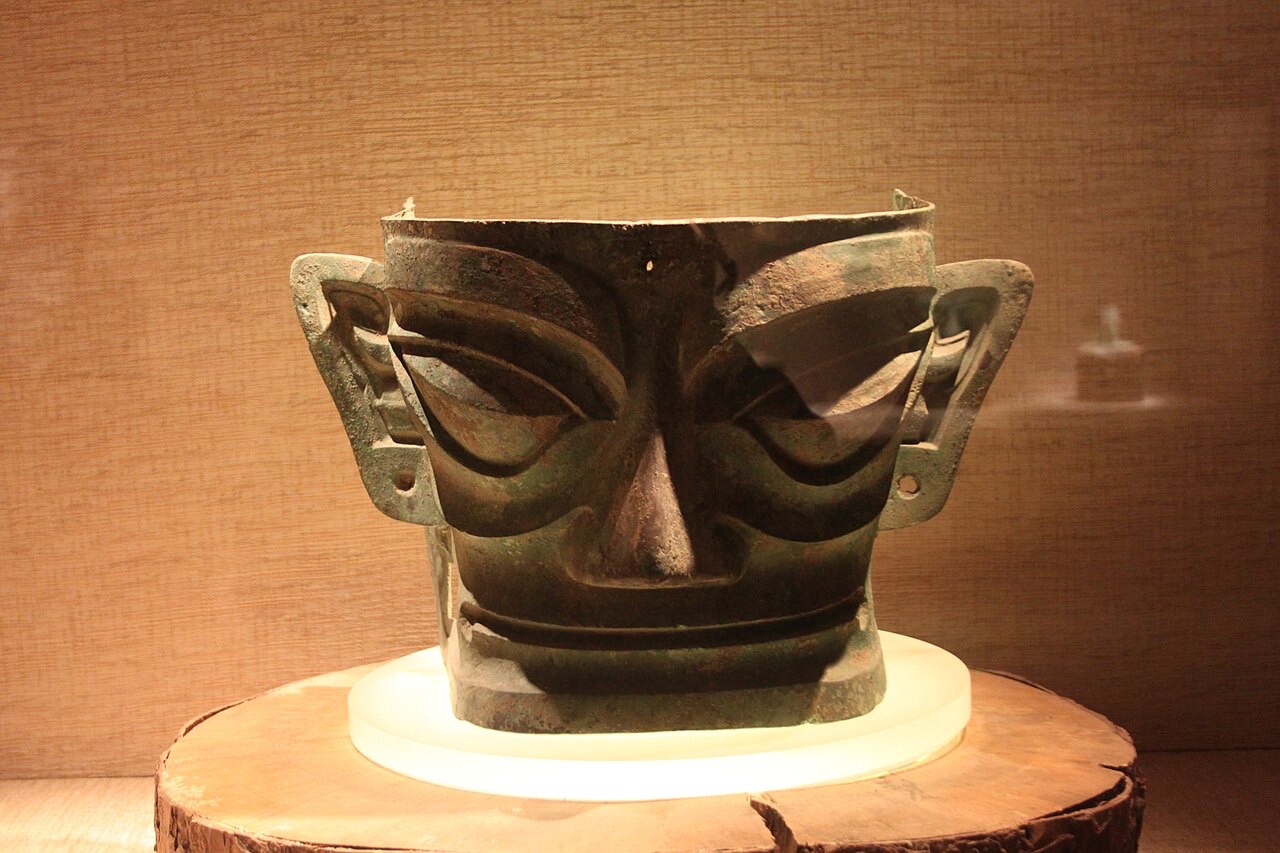
The 2020-2022 campaign, led by the Sichuan Provincial Cultural Relics and Archaeology Research Institute with Ran Honglin directing the Sanxingdui work, applied laboratory-grade excavation — climate-controlled cabins, hazmat suits, on-site conservation — and recovered over 13,000 catalogued items from pits 3 to 8, among them the largest bronze mask ever found (1.31 metres wide), a bronze sacrificial altar, and gold and jade in profusion. Radiocarbon dates on the new pits centre on roughly 1200-1000 BC, and cross-pit joins between broken pieces show the pits were filled in a coordinated event or series of events.
The favoured interpretation is ritual termination: objects of a temple or state cult were smashed, burned and buried, perhaps amid political upheaval, flood, or the shift of power to the successor centre at Jinsha, near Chengdu, where closely related material continues to about 600 BC. The bulging-eyed masks are usually connected to Can Cong, the legendary first Shu king said in much later texts to have had protruding eyes.
- Radiocarbon dating places the city c. 1600-1100 BC and the new pits c. 1200-1000 BC, contemporary with the Shang dynasty
- Some 13,000 artefacts recovered from six new pits in 2020-2022 under laboratory conditions
- Bronze alloy compositions and casting methods show shared technology with the Shang world despite unique styles
- Cross-pit joins of broken objects demonstrate deliberate, coordinated ritual burial rather than catastrophe
- Continuity of jade, gold and bronze traditions at the successor site of Jinsha links Sanxingdui to the later, historically recorded Shu kingdom
- Silk residues found on artefacts in the new pits indicate advanced local textile ritual