Ancient Technology · Dendera, near Qena, Egypt

Dendera Temple of Hathor

Home of the 'Dendera light bulb' crypt reliefs and a zodiac ceiling that once threatened to rewrite the age of the world.

Mainstream: c. 54 BC – AD 60 (present temple, late Ptolemaic to early Roman; the site was sacred millennia earlier)Alternative: Reliefs claimed to depict electric lighting of much older origin; the zodiac ceiling was once dated to c. 14,000 BC by early French savants (astronomical dating now places it c. 50 BC)26.14°, 32.67°

At a glance

Dendera Temple of Hathor
Photo: Twthmoses · CC BY 2.5

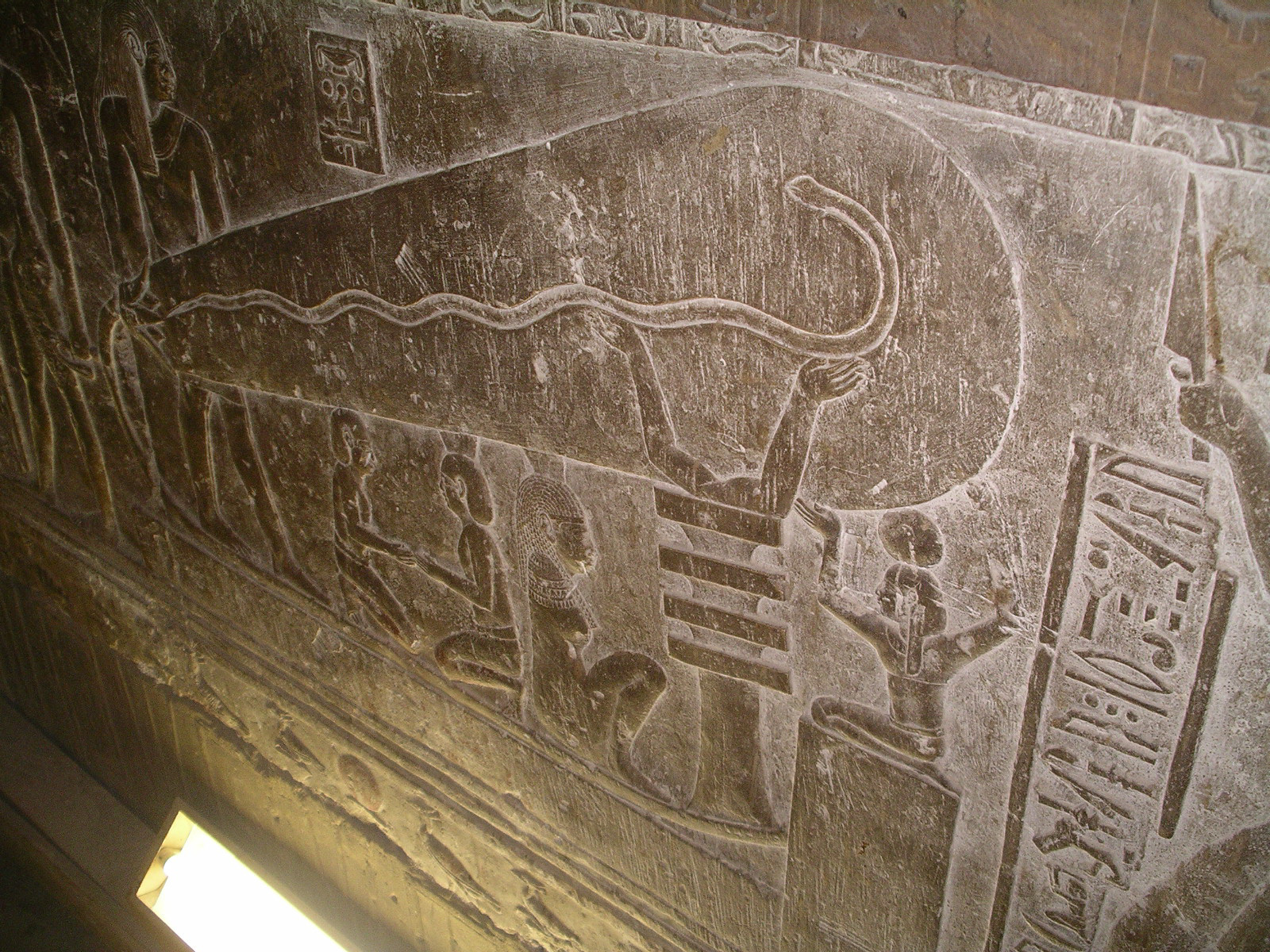
The Temple of Hathor at Dendera is one of the best-preserved temples in Egypt, its ceilings still carrying original paint and its roof and crypts still accessible. Begun in the late Ptolemaic period and decorated into Roman times, it stands on ground sacred to the goddess Hathor since the Old Kingdom. Two features have made it a battleground: a set of unusual reliefs in the subterranean crypts showing giant lotus-flowers enclosing serpents inside bubble-like envelopes — the so-called 'Dendera light' — and the famous circular zodiac from a rooftop chapel, whose age was once so hotly contested that it fuelled a European debate about the age of the Earth itself.

See it on the globe →
The mainstream view

What archaeology says

Egyptologists read the crypt reliefs through the temple's own inscriptions, which describe the scenes in detail. The 'bulb' is a hn-container or the womb of the sky-goddess Nut; the 'filament' is the serpent-form of Harsomtus (Horus the uniter), the creator-god emerging at dawn from a lotus flower; the 'cable' is the lotus stem; and the 'socket' supported by a djed pillar is the symbol of stability whose outstretched arms carry the sun. The same lotus-and-serpent motif appears elsewhere in Egyptian art in unmistakably mythological contexts, and Egyptologist Wolfgang Waitkus, who published the definitive study of the crypt texts, found the accompanying hieroglyphs narrate a creation scene — not a technical diagram. The crypts themselves were secure stores for the temple's cult statues and ritual equipment, decorated with images of the objects kept there.

The zodiac controversy is a classic of scientific history. When Napoleon's savants publicised the ceiling after 1798, astronomers such as Joseph Fourier and Johann Karl Burckhardt argued from the positions of the constellations that it might be 4,000 to 14,000 years old — placing it before the Biblical creation date and igniting a furious row between science and church. Jean-François Champollion, after deciphering hieroglyphs, read the royal cartouches and dated the chapel firmly to the Greco-Roman era. He has been vindicated: modern analysis (notably by Éric Aubourg) shows the five visible planets are drawn in positions matching around 50 BC, and two eclipses depicted correspond to real events of 52 and 51 BC. The dating is now considered settled.

Key evidence cited
  • Crypt inscriptions describing the scenes as Harsomtus emerging from the lotus at creation (studied by Wolfgang Waitkus)
  • Standard parallels for every element — lotus, serpent, djed, hn-container — across Egyptian religious art
  • Planetary positions on the zodiac matching the sky of c. 50 BC, with eclipses of 52 and 51 BC depicted
  • Royal cartouches and building inscriptions dating the temple to the late Ptolemaic and Roman periods
  • No excavated wires, bulbs, sockets or generators anywhere in dynastic Egypt
The alternative view

What the skeptics propose

The electric reading of the crypt reliefs was popularised by Erich von Däniken and developed most fully by Austrian authors Peter Krassa and Rainer Habeck in their 1992 book Light of the Pharaohs, building on an observation first made by a Norwegian electrical engineer; Austrian engineer Walter Garn then built a working glass-envelope discharge lamp modelled directly on the relief. Proponents map the imagery onto components: the bubble as a glass bulb, the serpent as a filament or plasma arc, the lotus as a socket, the stem as a cable running to a box (a battery or generator), and the djed pillar as an insulator. They link the idea to the 'Baghdad battery' — Parthian-era jars from Iraq that can produce a small voltage when filled with electrolyte — and argue that electric light would explain how artists decorated deep tombs and crypts, in which, they claim, no lamp soot is found.

Some proponents add that the kneeling baboon holding knives beside one relief reads naturally as a warning about a dangerous device, and note the crypts' oddly restricted, hidden character. The broader suggestion — argued by von Däniken in one register and by lost-civilisation writers in another — is that the priests of Dendera preserved garbled knowledge of a technology far older than the Ptolemaic temple.

Mainstream rebuttals are extensive: the accompanying inscriptions describe a mythological sunrise, not apparatus; soot deposits do exist on Egyptian tomb and temple ceilings, and experiments show olive-oil lamps with salted wicks burn nearly soot-free anyway, while light could also be relayed by mirrors; a Baghdad-battery cell yields well under a volt, hopelessly short of powering an arc or discharge tube, and no wire, glass bulb, socket or generator has ever been excavated from any Egyptian context. Sceptics also point out that the 'unique' elements of the scene all have standard iconographic parallels across Egyptian religious art.

Key evidence cited
  • Visual resemblance of the relief to a discharge lamp, strong enough that Walter Garn's replica actually lit
  • Krassa and Habeck's component-by-component electrical mapping of the scene
  • The Baghdad battery as proof-of-concept that ancient cells could generate current
  • Claimed scarcity of lamp soot in deep tombs and the Dendera crypts
  • The crypts' hidden, restricted-access character, suggesting protected knowledge

Genuinely open questions

  1. How exactly were Egypt's deepest tombs and crypts lit during decoration — lamps, mirrors, or both?
  2. Why does the lotus-serpent motif take such an elaborate, envelope-enclosed form at Dendera specifically?
  3. Does the zodiac encode astronomical knowledge (such as precession) older than the ceiling itself, as writers like John Anthony West argued?

Worth knowing

The circular zodiac at Dendera today is a plaster copy — the original was cut from the ceiling with saws and gunpowder in 1821, shipped to Paris, bought by Louis XVIII for 150,000 francs, and now hangs in the Louvre.