What archaeology says
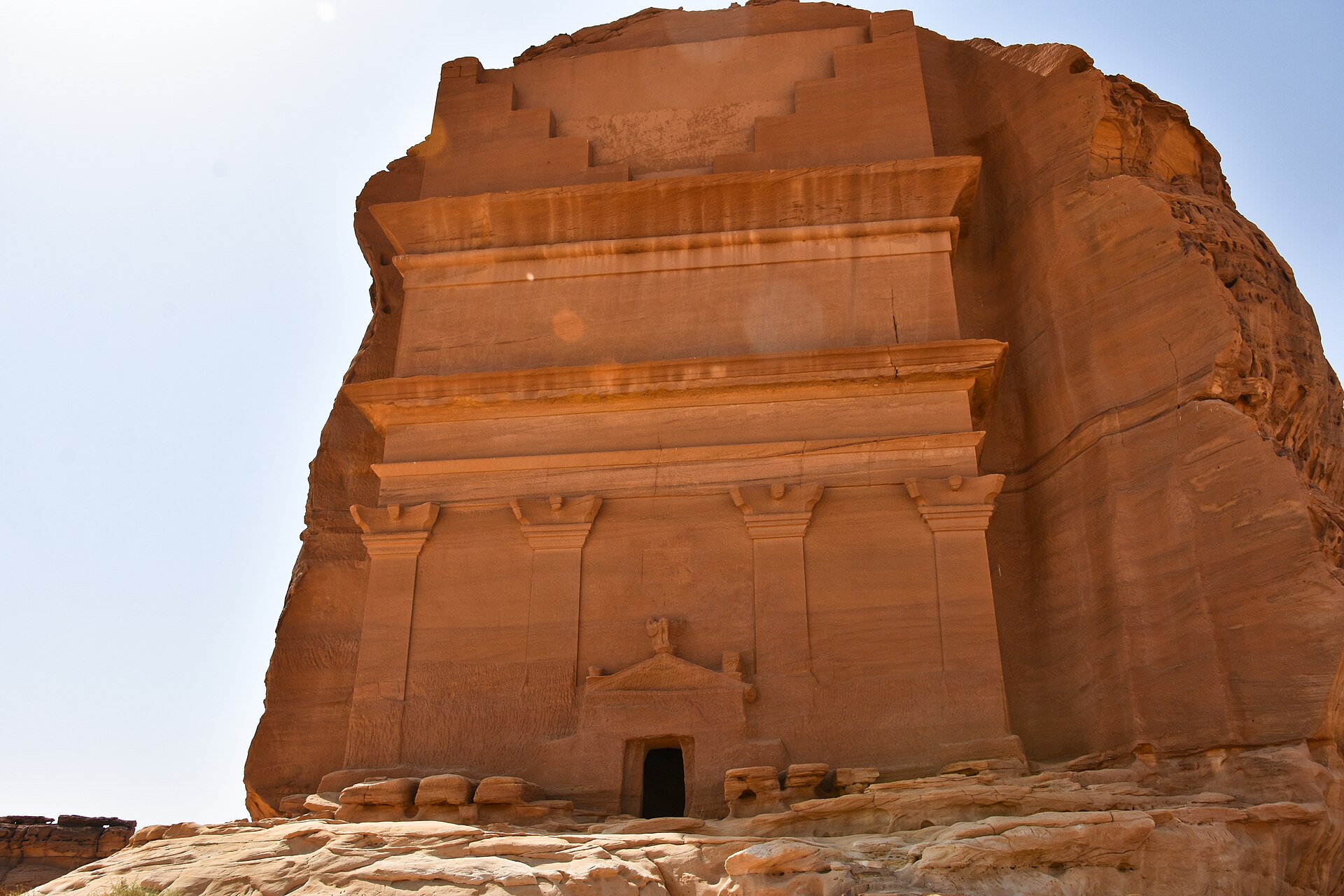
Hegra is among the best-dated rock-cut sites in the ancient world, because the Nabataeans did something almost unique: they signed and dated their tombs. More than thirty facades carry legal inscriptions naming the owner, the family members entitled to burial, the fines for violation, sometimes the mason who carved it — and the regnal year of the Nabataean king, yielding firm dates between AD 1 and AD 75. A Franco-Saudi mission co-directed by Laila Nehme of the CNRS has excavated the site since 2002 (intensively since 2008), tracing the city's history from earlier Dadanite and Lihyanite occupation of the oasis, through the Nabataean peak, to the Roman annexation of the kingdom in AD 106 — after which Latin inscriptions and a garrison appear, and monumental tomb-carving stops.
The unfinished tombs give an unusually complete picture of method. Masons began at the top of a cliff face, cutting a ledge and working downward with picks and chisels, finishing the crow-step crenellations and cornices first and leaving the lowest register rough until last; abandoned examples preserve diagonal tool strokes, quarry steps and half-emerged columns. No lost technology is required — the soft Quweira sandstone cuts readily with iron tools, and the whole sequence is legible on the rock.
Work under the Royal Commission for AlUla has accelerated discovery since 2017: analyses of human remains from tombs such as IGN 117 informed the 2023 facial reconstruction of 'Hinat', a Nabataean woman, unveiled at the Hegra Welcome Centre, and a conservation programme launched in 2024–2025 is diagnosing erosion on the facades. Nehme's team has also documented at Hegra the developmental stages by which the Nabataean script evolved toward the Arabic alphabet — making the site a key witness to the birth of Arabic writing.
- Over thirty tomb facades carrying dated Nabataean legal inscriptions spanning AD 1–75, naming owners and masons
- Unfinished facades such as Qasr al-Farid preserving the complete top-down carving sequence and iron tool marks
- Franco-Saudi excavations since 2002 (Nehme and colleagues) tracing Dadanite, Nabataean and Roman phases
- Latin inscriptions and garrison evidence marking the Roman annexation of AD 106, when monumental carving ceased
- Human remains from excavated tombs, including the individual behind the 2023 'Hinat' facial reconstruction