Ancient Engineering · Karmouz, Alexandria, Egypt

Catacombs of Kom el-Shoqafa

A three-storey city of the dead beneath Alexandria, where Anubis wears Roman armour — allegedly found when a donkey fell through the street.

Mainstream: c. 1st–2nd century AD, in use until about the 4th centuryAlternative: Date not seriously disputed — debate surrounds the discovery legend, the 'Hall of Caracalla' massacre story and how deliberate the style-blending was31.18°, 29.89°

At a glance

Catacombs of Kom el-Shoqafa
Photo: Carole Raddato · CC BY-SA 2.0

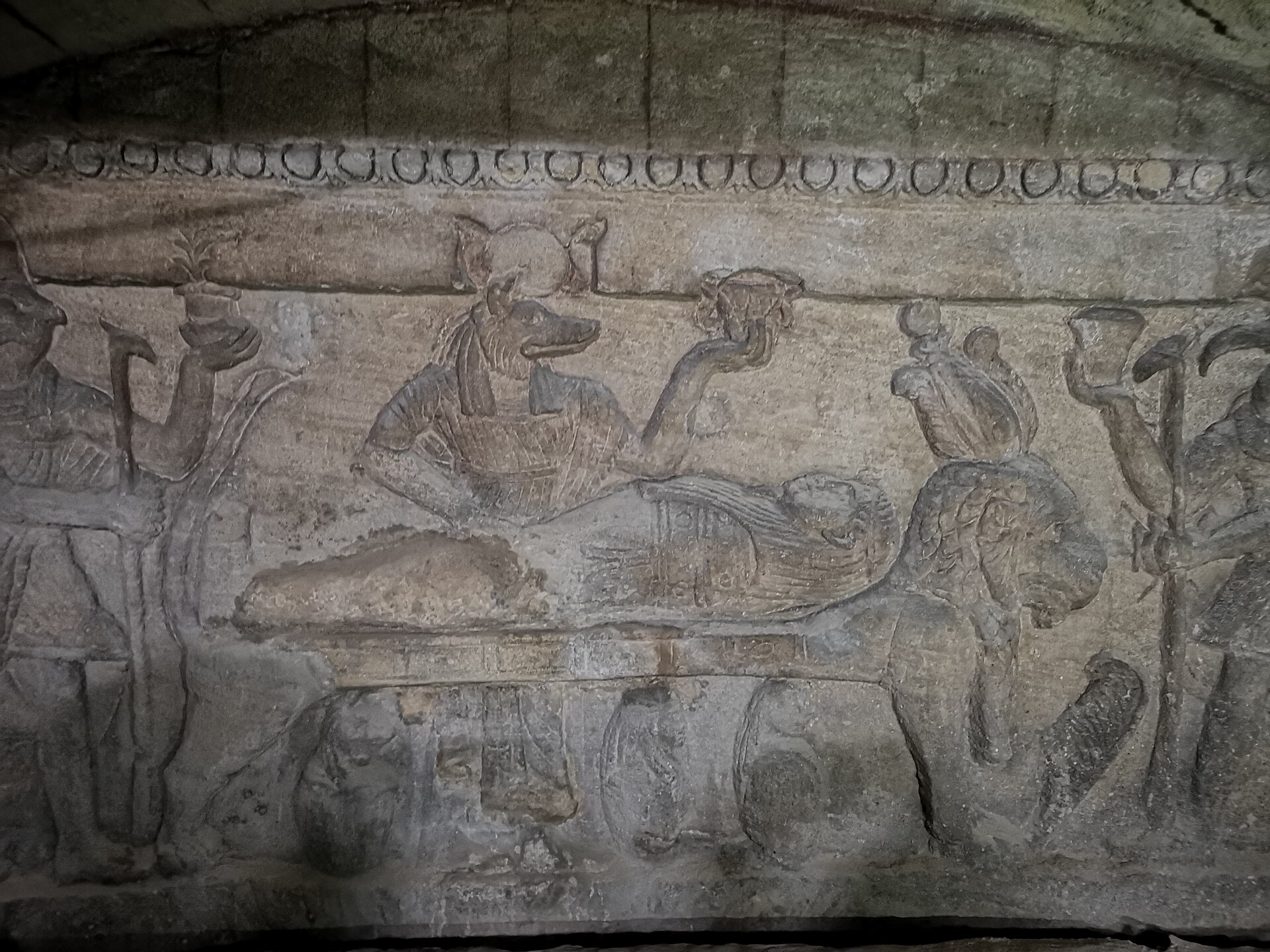
Beneath the densely packed Karmouz district of Alexandria lies the largest known Roman-era burial complex in Egypt: a necropolis spiralling some 35 metres down through three levels of solid bedrock. Visitors descend a spiral staircase wrapped around a central shaft — down which bodies were lowered on ropes — past a rotunda and a triclinium, a banqueting room where mourners reclined to feast in honour of the dead, into a principal tomb chamber of startling hybrid art. The name Kom el-Shoqafa, 'Mound of Shards', records the heaps of broken pottery left by centuries of funeral meals, since vessels used at the tombs were considered unlucky to carry home. What makes the catacombs world-famous is their fusion of three cultures in one grave. Egyptian gods and pharaonic iconography are executed in Roman techniques with Greek details: Anubis, the jackal-headed embalmer, appears dressed as a Roman legionary; bearded serpents wear the double crown of Egypt while carrying Greek caduceus and thyrsus staffs; Medusa heads guard sarcophagi carved with Egyptian mummification scenes. Nothing else surviving from antiquity blends the three traditions so completely, which is why the site is sometimes ranked among the 'seven wonders of the Middle Ages'.

See it on the globe →
The mainstream view

What archaeology says

Archaeologists date the complex to the late 1st or early 2nd century AD, probably begun as the private hypogeum of a single wealthy Alexandrian family and progressively expanded into a communal necropolis managed, on the evidence of comparable Alexandrian tombs, by a funerary association; burials continued into the 4th century. The lowest of the three levels is permanently flooded by groundwater — the second was only cleared and reopened after major pumping and drainage works completed in 1995, and managing the water table remains the site's chief conservation battle, addressed by an Egyptian-American dewatering project in the 2010s.

The hybrid art is read by scholars such as Marjorie Venit, whose studies of Alexandria's monumental tombs remain standard, as a deliberate visual strategy rather than confusion: Alexandria's elite were simultaneously Greek by culture, Roman by citizenship and administration, and Egyptian by land and religion, and in death they hedged their bets — Egyptian gods guaranteed resurrection, Greek and Roman forms guaranteed status. The catacombs are thus prime evidence for how multicultural identity actually worked in a Roman provincial metropolis.

The discovery is conventionally dated to 28 September 1900, when the ground gave way beneath a donkey (in some tellings, a donkey-drawn cart) on Rue Karmouz, dropping the animal into the main shaft. The German archaeologist Theodor Schreiber and the founder of Alexandria's Graeco-Roman Museum, Giuseppe Botti, had in fact been hunting for the catacombs in that district for years, and excavation followed immediately under the museum's auspices, continued by Botti's successor Evaristo Breccia.

Key evidence cited
  • Artistic style, architectural form and finds dating the complex firmly to the 1st–2nd centuries AD
  • Parallels with other documented Alexandrian hypogea studied by Marjorie Venit, showing a local tomb tradition
  • The triclinium, rotunda and shaft system matching known Roman-era funerary practice for family and association burials
  • Contemporary 1900 excavation records by Botti, Schreiber and the Graeco-Roman Museum
  • Pottery heaps ('shoqafa') consistent with centuries of documented Roman funerary banqueting customs
The alternative view

What the skeptics propose

Kom el-Shoqafa attracts little lost-civilisation speculation — its Roman date is secured by style, coin finds and parallels — so the contested ground lies in its stories. The donkey tale is the first: charming, canonical and repeated in every guidebook, it is viewed by some historians as at least embellished, given that Botti and Schreiber had been systematically searching the area and quarrying and building work regularly broke into ancient voids. The sceptical steelman is that the donkey story conveniently romanticises what was really a patient, unglamorous archaeological search; the defence is that the accident is recorded in contemporary accounts and that both things can be true — the searchers knew roughly where to look, and a collapsing street found the shaft first.

The second dispute concerns the so-called Hall of Caracalla, a separate but connected gallery (properly the Nebengrab) containing jumbled human and horse bones. Early excavators linked these to the emperor Caracalla's notorious massacre of Alexandrian young men in AD 215, when ancient sources say thousands were butchered after the city mocked him — the horses being cavalry mounts slaughtered alongside their riders, or honoured racehorses. Critics note the bones were never demonstrated to date to 215, that mass burial of massacre victims with horses in an existing private catacomb is odd behaviour, and that the label owes more to Victorian drama than stratigraphy; the identification remains unproven either way.

Finally, some popular writers present the style-blending as evidence of a secret syncretic cult or hidden initiatory chambers beneath Alexandria, occasionally tied to speculation about tunnels linking the city's lost wonders. Mainstream scholars answer that every element of the imagery has a straightforward funerary function, that flooding — not secrecy — keeps the third level unexplored, and that Alexandria's genuinely vast unexcavated underground (most of the ancient city lies beneath the modern one, below the water table) needs no embellishment to be tantalising.

Key evidence cited
  • The 1900 donkey-fall discovery story, preserved in early accounts but arguably romanticised in retellings
  • The mixed human and horse bones of the 'Hall of Caracalla', linked by early excavators to the AD 215 massacre
  • The unparalleled completeness of the Egyptian-Greek-Roman fusion, read by some as evidence of an organised syncretic cult
  • The permanently flooded third level, which has never been fully explored or published
  • Alexandria's largely unexcavated underground, fuelling speculation about connected tunnels and chambers

Genuinely open questions

  1. What lies in the flooded third level, and can modern dewatering or underwater survey ever record it properly?
  2. Do the bones in the Hall of Caracalla really belong to victims of the AD 215 massacre, or to unrelated later burials?
  3. Who was the founding family, and how did a private tomb evolve into a managed communal necropolis?

Worth knowing

Pottery smashed at funeral feasts gave the site its name: mourners believed vessels used in a tomb were too unlucky to take home, so they shattered them on the spot — building the 'Mound of Shards' that later hid the entrance for 1,500 years.