Ancient Engineering · Zawyet el-Aryan, Egypt

Unfinished Pyramids of Zawyet el-Aryan

A colossal granite-floored shaft, an oval stone bathtub, and a site sealed inside a military zone for sixty years.

Mainstream: c. 2650-2500 BC (3rd-4th Dynasty)Alternative: 4th Dynasty date questioned; the granite shaft floor attributed to earlier, unknown builders29.94°, 31.15°

At a glance

Unfinished Pyramids of Zawyet el-Aryan
Photo: Franck Monnier · Public domain

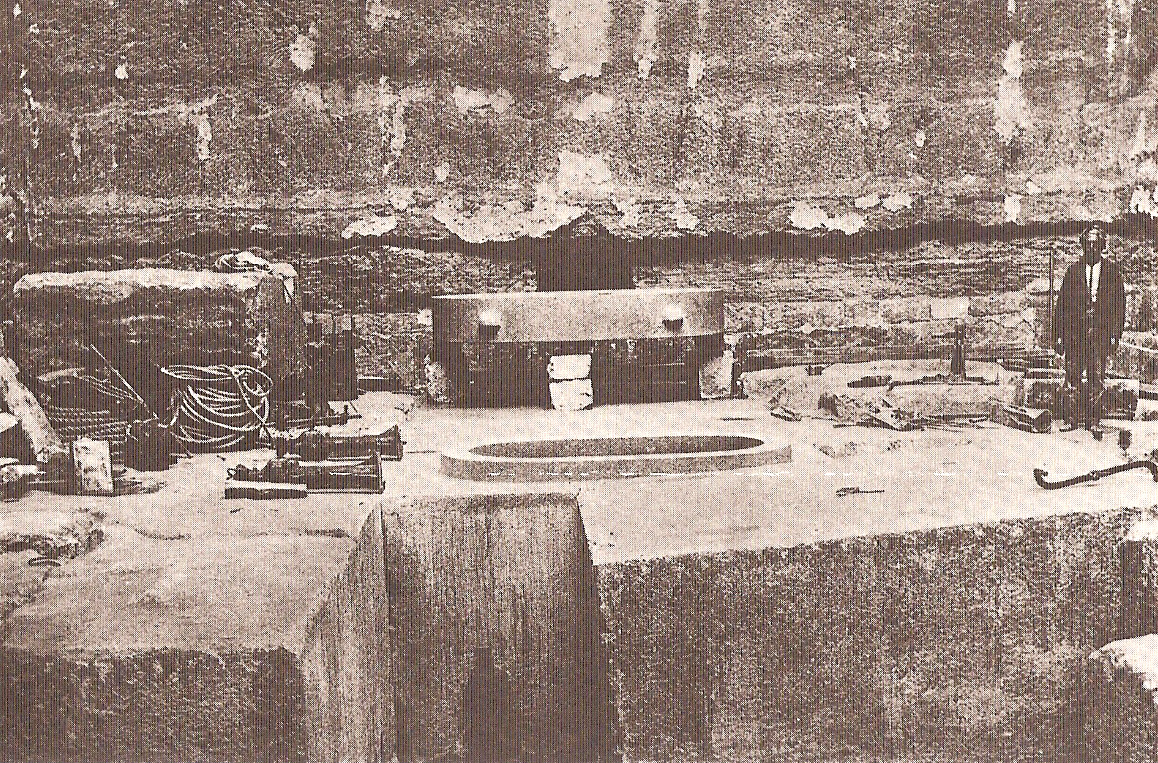
Between Giza and Abusir lies Zawyet el-Aryan, home to two abandoned pyramid projects: the Layer Pyramid, usually assigned to the shadowy 3rd Dynasty king Khaba, and the so-called Unfinished Northern Pyramid, a vast rock-cut shaft complex attributed to an obscure 4th Dynasty ruler. The Italian archaeologist Alessandro Barsanti excavated the northern monument between 1904 and 1912, revealing a descending trench and shaft some 21 metres deep, floored with enormous granite blocks and containing a strange oval granite vessel sunk flush into the pavement. Since 1964 the site has sat inside a restricted Egyptian military zone, closed to archaeologists.

See it on the globe →
The mainstream view

What archaeology says

Egyptologists date the Unfinished Northern Pyramid to the early or mid 4th Dynasty on the strength of its architecture — the great open trench and shaft closely resemble the substructure of Djedefre's pyramid at Abu Rawash — and of red-painted quarry marks recorded by Barsanti, which include a royal name variously read as Baka, Bakare or Nebkara. Miroslav Verner and others associate it with the ephemeral king known to later Greek tradition as Bikheris, perhaps a son of Djedefre whose brief reign explains why work stopped almost as soon as the foundations were cut.

What Barsanti found remains remarkable by any standard: a shaft floor paved with granite and limestone blocks up to 4.5 metres long and weighing several tonnes apiece, and an oval granite vessel over three metres long, its polished lid still cemented in place, set into the floor like a bath. Barsanti reported it contained a dark liquid residue when opened. Most Egyptologists interpret the vessel as an innovative form of sarcophagus installed before the superstructure rose, though its shape is without close parallel.

The tragedy of Zawyet el-Aryan is access. Barsanti died in 1917 before publishing full plans, and since the site was absorbed into a military installation in 1964 no re-excavation has been possible; reports suggest the great shaft has even been used as a dump. Mainstream scholars are as frustrated by this as anyone.

Key evidence cited
  • Architectural near-identity with Djedefre's substructure at Abu Rawash, anchoring a 4th Dynasty date
  • Red-painted quarry marks with a royal name read as Baka/Bakare recorded by Barsanti
  • An unfinished trench-and-shaft layout consistent with a project halted by a king's early death
  • Barsanti's excavation reports of 1904-1912, the only systematic record of the monument
  • The nearby Layer Pyramid's mudbrick and masonry match known 3rd Dynasty techniques
The alternative view

What the skeptics propose

For alternative researchers, Zawyet el-Aryan is Egypt's locked room. Authors and tour leaders such as Brien Foerster highlight the precision of the granite floor and the flawlessly hollowed oval vessel — comparing it to the granite boxes of the Serapeum — and argue that such work sits uneasily with copper-age tools and an unfinished, hastily abandoned royal tomb. In this reading, the shaft and its enigmatic tub could be relics of an earlier, technologically advanced phase later adopted by dynastic builders.

The oval vessel itself invites speculation because it genuinely lacks parallels: no other Egyptian sarcophagus is oval, sunk into a floor, or sealed with a lid found still cemented shut and holding liquid. Some writers propose it was never a coffin at all but a functional installation — suggestions run from ritual basin to industrial vat — noting that no body, canopic equipment or funerary goods were ever recovered.

Finally, the sixty-year military closure has made the site a magnet for suppression narratives, with popular accounts dubbing it Egypt's Area 51. Sober alternative voices do not claim to know what lies unexcavated there; their argument is simply that a monument this anomalous, sealed off before modern archaeology could study it, should not be treated as a closed case.

Key evidence cited
  • Granite floor blocks up to 4.5 metres long fitted at the bottom of a 21-metre shaft
  • A unique polished oval granite vessel with sealed lid and liquid residue, unlike any known sarcophagus
  • No burial, inscription in situ, or funerary equipment ever found
  • Comparisons drawn by Brien Foerster and others to Serapeum-grade precision work
  • Six decades of military closure preventing any modern verification of Barsanti's findings

Genuinely open questions

  1. Who was the owner — Baka, Bikheris, Nebka, or someone else entirely?
  2. What was the oval granite vessel for, and what was the liquid Barsanti found inside it?
  3. How much of Barsanti's unpublished documentation survives, and what did he leave unrecorded?
  4. What condition is the shaft in today, and will archaeologists ever regain access?

Worth knowing

The one pyramid shaft in Egypt floored with megalithic granite has reportedly spent recent decades serving as a military rubbish dump.