Origins of Civilisation · Giza Plateau, Egypt

The Great Sphinx & the Water Erosion Debate

The fissures in a limestone enclosure wall carry the whole argument: did rain that stopped falling millennia before the pharaohs carve these scars?

Mainstream: c. 2500 BC (reign of Khafre, 4th Dynasty)Alternative: c. 9700–5000 BC (Schoch's rainfall-erosion dating; Reader argues merely pre-Khafre; one marine hypothesis claims 800,000 years)29.98°, 31.14°

At a glance

The Great Sphinx & the Water Erosion Debate
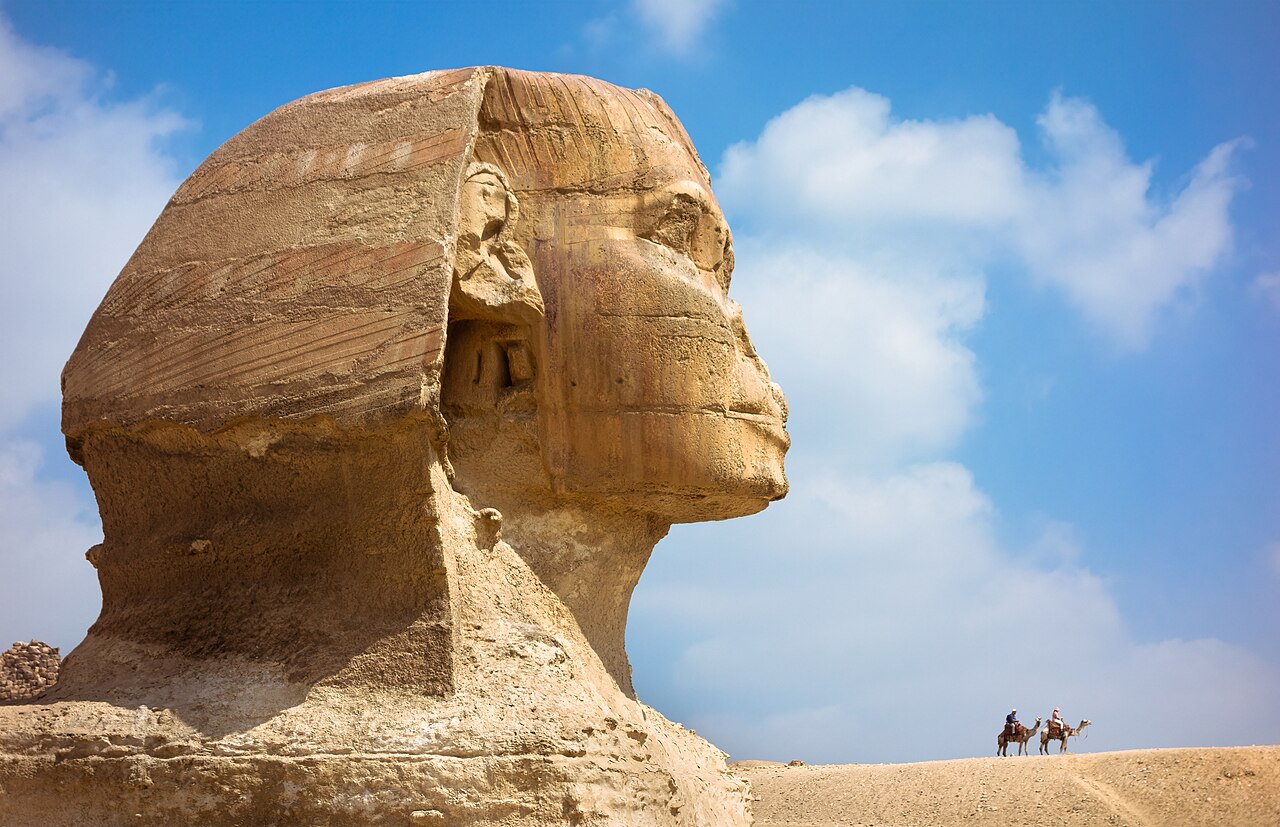
Photo: Petar Milošević · CC BY-SA 4.0

The Great Sphinx — a 73-metre lion-bodied colossus with a king's head — was not built but carved, cut downward into the living limestone of the Giza Plateau so that the monument sits in a quarried enclosure of its own making. That enclosure is the battlefield. Its walls, and the Sphinx's body, carry deep, rolling, vertically fissured weathering that a Boston University geologist argued in 1991 could only be the work of prolonged heavy rain — rain Egypt has not reliably had since the early Holocene. If he is right, the Sphinx's core predates dynastic Egypt by millennia and history's most famous monument becomes its most consequential anomaly. Three decades on, the 'water erosion debate' remains the flagship argument of alternative prehistory, and one of the few conducted largely in the technical language of geology.

See it on the globe →
The mainstream view

What archaeology says

Egyptology dates the Sphinx to the reign of Khafre, around 2500 BC, on converging contextual evidence rather than any inscription — the monument names no builder. Mark Lehner's mapping showed the Sphinx, its temple and Khafre's valley temple form one integrated quarry-and-construction scheme: blocks cut from the Sphinx enclosure were hauled directly into the adjacent temples, some with marine fossils matching the enclosure beds still legible in their cores. The Sphinx sits on the axis of Khafre's causeway, and most specialists read the face as royal portraiture of his dynasty. A century of excavation has produced no pottery, tools or graffiti from any earlier culture anywhere on the plateau.

The geological counter-case holds that rain is not required. K. Lal Gauri and James Harrell attribute the rounded profiles and fissures to salt weathering (haloclasty): the Mokattam limestone wicks moisture — dew, groundwater, even damp sand — and expanding salt crystals flake the surface preferentially along joints and softer beds, producing exactly the undulating pattern at issue. The fissures follow pre-existing karst joints in what was once a sea floor; the enclosure's beds weather at visibly different rates; and Zahi Hawass notes the monument required rescue restoration within dynastic times — the earliest repairs are New Kingdom — showing how fast this stone fails without any rain at all. Geoarchaeology has also shown significant rainfall continued into the Old Kingdom, blurring Schoch's climatic cut-off. In 2023 a New York University fluid-dynamics team led by Leif Ristroph added a coda: lion-like yardang forms emerge naturally from wind erosion of layered rock, supporting the older suggestion that the carvers may have started from a natural landform.

Within geology the dissent is mostly about degree: Colin Reader, an English engineering geologist, accepts that rain-fed runoff cut the enclosure's western wall but concludes it needs only an Early Dynastic Sphinx — centuries before Khafre, not millennia — tying the monument to the earliest phase of Giza's use rather than a lost civilisation.

Key evidence cited
  • The Sphinx, its temple and Khafre's valley temple form one integrated quarry scheme — enclosure blocks were built directly into the temples.
  • Salt weathering (haloclasty) reproduces the rounded, fissured profile without rainfall, per Gauri and Harrell.
  • The fissures follow pre-existing karst joints in the limestone; beds of different hardness weather at different rates.
  • Rainfall persisted into the Old Kingdom, undermining the hypothesis's climatic cut-off.
  • No artefact of any pre-dynastic monument-building culture has ever been excavated on the plateau.
The alternative view

What the skeptics propose

The modern debate began when author John Anthony West, developing René Schwaller de Lubicz's passing observation that the Sphinx appeared 'weathered by water', recruited geologist Robert Schoch to test it. Schoch's fieldwork in 1990–91 concluded that the enclosure's deep, rounded, vertically accented weathering profile is the classic signature of prolonged precipitation, unlike the sharper wind-and-sand abrasion elsewhere on the plateau; he presented the case at the Geological Society of America in 1991 and initially dated the Sphinx's core to at least 7000–5000 BC. A seismic refraction survey with geophysicist Thomas Dobecki found the subsurface weathering around the enclosure dramatically deeper on three sides than on the western floor — implying, Schoch argued, thousands of years of exposure before the enclosure's rear was even fully cut. After Göbekli Tepe demonstrated monumental construction in the 10th millennium BC, Schoch moved his estimate back to around 9700 BC, the end of the Younger Dryas.

Proponents emphasise what the mainstream concedes: no inscription names the builder; the 'Khafre' attribution rests on context and a contested syllable in the Dream Stela of Thutmose IV; and the Late Period Inventory Stela — dismissed by Egyptology as pious fiction — explicitly describes the Sphinx as already standing before Khufu. The head, conspicuously less weathered and undersized for the body, is read as a dynastic recarving of an earlier, perhaps leonine, original. Independent geologist David Coxill inspected the enclosure and endorsed the water-erosion observation while remaining cautious on dates, and proponents note that Reader — no friend of lost-civilisation claims — still found the orthodox chronology geologically inadequate.

For Graham Hancock and West the Sphinx anchors a larger architecture: paired with the Orion correlation's 10,500 BC epoch (when a leonine monument would have faced its own constellation at equinox sunrise), it becomes the surviving monument of the civilisation they believe the Younger Dryas destroyed. The strongest form of the claim, from Ukrainian geologists Manichev and Parkhomenko, reads the enclosure's hollows as wave-cut marine terraces hundreds of thousands of years old — a position even Schoch declines to follow.

Key evidence cited
  • Schoch's reading of the enclosure's deep, rolling, vertically fissured weathering as a precipitation signature.
  • The 1991 Dobecki seismic survey showing sharply asymmetric subsurface weathering depths around the enclosure.
  • No inscription names a builder; the Dream Stela's 'Khafre' reading is fragmentary and the stela is lost in part.
  • The Inventory Stela describes the Sphinx as standing before Khufu (Egyptology treats it as Late Period fiction).
  • The undersized, better-preserved head suggests dynastic recarving of an older monument.

Genuinely open questions

  1. Can salt weathering alone fully reproduce the enclosure's vertical fissure profile, or does some rainfall component survive scrutiny?
  2. Why does the subsurface weathering measured in 1991 vary so sharply around the enclosure — and would a modern replication survey settle it?
  3. How much older than Khafre could the Sphinx be while remaining within known Egyptian cultural development, as Reader proposes?
  4. Was the original form a natural yardang, a lion, or something else entirely before the pharaonic head was cut?

Worth knowing

For most of its life the Sphinx has been buried to the neck in sand — Thutmose IV, Ramesses II, and modern excavators all dug it out — which means the fiercely debated weathering had to accumulate in the comparatively brief windows when the body stood exposed at all.