Ancient Engineering · Giza, Egypt

Great Pyramid of Giza & the Giza Plateau

The last surviving Wonder of the Ancient World — and the centre of the fiercest dating debate in archaeology.

Mainstream: c. 2560 BC (reign of Khufu, 4th Dynasty)Alternative: c. 10,500 BC (proposed for the Sphinx and plateau ground-plan)29.98°, 31.13°

At a glance

Great Pyramid of Giza & the Giza Plateau
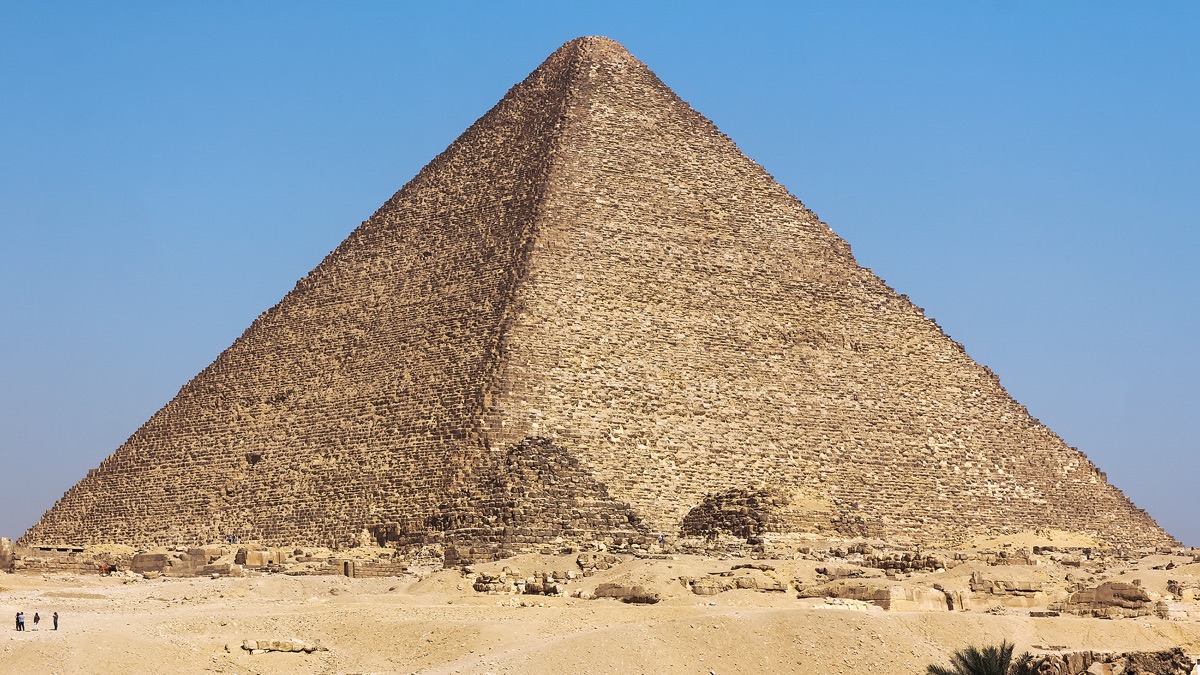
Photo: Douwe C. van der Zee · CC BY-SA 4.0

The Great Pyramid is the largest of the three pyramids on the Giza Plateau, originally standing about 146.6 metres tall and containing an estimated 2.3 million blocks of limestone and granite weighing roughly 6 million tonnes. Built with a precision that still impresses modern engineers — its base is level to within centimetres and aligned to true north within a twentieth of a degree — it was the tallest human-made structure on Earth for more than 3,800 years. Together with the pyramids of Khafre and Menkaure and the Great Sphinx, it forms one of the most studied and most argued-over archaeological landscapes in the world.

See it on the globe →
The mainstream view

What archaeology says

Egyptologists attribute the Great Pyramid to Pharaoh Khufu of the 4th Dynasty, built as his tomb over roughly two decades around 2560 BC. The evidence base is unusually rich. Workers' graffiti naming Khufu's work gangs (such as 'Friends of Khufu') was found in the sealed relieving chambers above the King's Chamber, where no modern forger could plausibly have placed it. In 2013, archaeologists at Wadi al-Jarf on the Red Sea recovered the 'Diary of Merer' — the oldest inscribed papyri ever found — a logbook kept by an official whose boat crews ferried Tura limestone to Giza in the 27th year of Khufu's reign.

Excavations led by Mark Lehner and Zahi Hawass uncovered the workers' town of Heit el-Ghurab south of the plateau, complete with bakeries, breweries, dormitories and cemeteries, showing the builders were paid, well-fed Egyptian labourers rather than slaves or a mystery people. Quarries for the core limestone sit a few hundred metres from the pyramid, and a 2022 study of sediment cores confirmed a now-vanished branch of the Nile (the 'Khufu branch') ran close to the plateau, explaining how stone barges reached the site. Radiocarbon dating of organic material in the mortar (campaigns in 1984 and 1995) brackets construction to the Old Kingdom, though intriguingly some samples ran a century or more older than the historical dates — attributed to the Egyptians burning old wood.

The Sphinx is dated to the reign of Khafre (c. 2500 BC) on the basis of its position within Khafre's causeway-and-temple complex, the stratigraphy of its quarry, and stylistic parallels — though it carries no original inscription naming its builder.

Key evidence cited
  • Workers' gang graffiti naming Khufu inside sealed relieving chambers
  • The Diary of Merer papyri (c. 2560 BC) logging limestone deliveries to Giza
  • Excavated workers' town (Heit el-Ghurab) with bakeries, dorms and cemeteries
  • Radiocarbon dates from mortar consistently in the Old Kingdom range
  • 2022 sediment-core evidence of a lost Nile branch serving the construction site
The alternative view

What the skeptics propose

The best-known alternative case centres on the Sphinx. Geologist Robert Schoch of Boston University, working with author John Anthony West, argued in the early 1990s that the deep, rolling, vertical-fissured weathering of the Sphinx enclosure walls is the signature of prolonged heavy rainfall, not wind and sand — pushing the monument's origin back to at least 7000–5000 BC and possibly earlier, into a wetter African climate phase. Mainstream geologists such as James Harrell and K. Lal Gauri counter that salt weathering, wet-sand contact and the variable quality of the limestone beds can explain the erosion within a conventional timeline, but Schoch maintains his position and the debate has never fully closed.

Graham Hancock and Robert Bauval extended the argument with the 'Orion Correlation Theory': the claim that the three Giza pyramids mirror the belt stars of Orion, and that the layout — together with the lion-bodied Sphinx gazing due east — best matches the sky of around 10,500 BC, the astronomical age of Leo. They propose the plateau preserves the ground-plan or legacy of a lost civilisation destroyed at the end of the last Ice Age, later monumentalised by dynastic Egyptians. Astronomers such as Ed Krupp have objected that the correlation only works if the map is inverted, and that the match is loose.

A separate strand, associated with engineer Christopher Dunn, argues the precision of the granite work implies machining capabilities beyond copper tools and stone pounders — his 'Giza Power Plant' theory recasts the pyramid as a machine rather than a tomb. In March 2025, Italian researchers Corrado Malanga and Filippo Biondi claimed satellite radar revealed vast structures descending hundreds of metres beneath the Khafre pyramid; the claim went viral but was not peer-reviewed, was rejected by radar specialists such as Lawrence Conyers as physically implausible for the technique, and was dismissed by Egyptian authorities — while some widely shared supporting images proved to be AI-generated.

Key evidence cited
  • Schoch's analysis of rainfall-type erosion on the Sphinx enclosure walls
  • Bauval and Hancock's proposed Orion's Belt layout matching the sky of c. 10,500 BC
  • Christopher Dunn's measurements of granite precision he argues exceeds copper-tool capability
  • Absence of any original inscription on the Sphinx naming its builder
  • Some mortar radiocarbon dates running older than Khufu's accepted reign

Genuinely open questions

  1. What is the purpose of the 'Big Void' detected above the Grand Gallery by muon scanning in 2017 (with a hidden corridor confirmed in 2023)?
  2. Exactly how were the blocks raised — no ramp system yet proposed fully fits the archaeological traces?
  3. How should the anomalously old radiocarbon dates in the pyramid's mortar be explained?

Worth knowing

The Diary of Merer, the world's oldest inscribed papyrus, is essentially a 4,500-year-old delivery driver's logbook — and it names the Great Pyramid's construction project ('Akhet Khufu') directly.