Belief & Society · Near Persepolis, Fars Province, Iran

Naqsh-e Rostam & the Ka'ba-ye Zartosht

Four Persian emperors entombed in colossal crosses of rock — facing a windowless stone tower whose purpose is still unsolved.

Mainstream: c. 522–404 BC (Achaemenid royal tombs); Elamite relief possibly c. 1000 BC; Sasanian reliefs 3rd century ADAlternative: Date not seriously disputed — the fight is over the Ka'ba-ye Zartosht tower: fire temple, royal archive, calendar observatory, or something else entirely29.99°, 52.87°

At a glance

Naqsh-e Rostam & the Ka'ba-ye Zartosht
Photo: Diego Delso · CC BY-SA 4.0

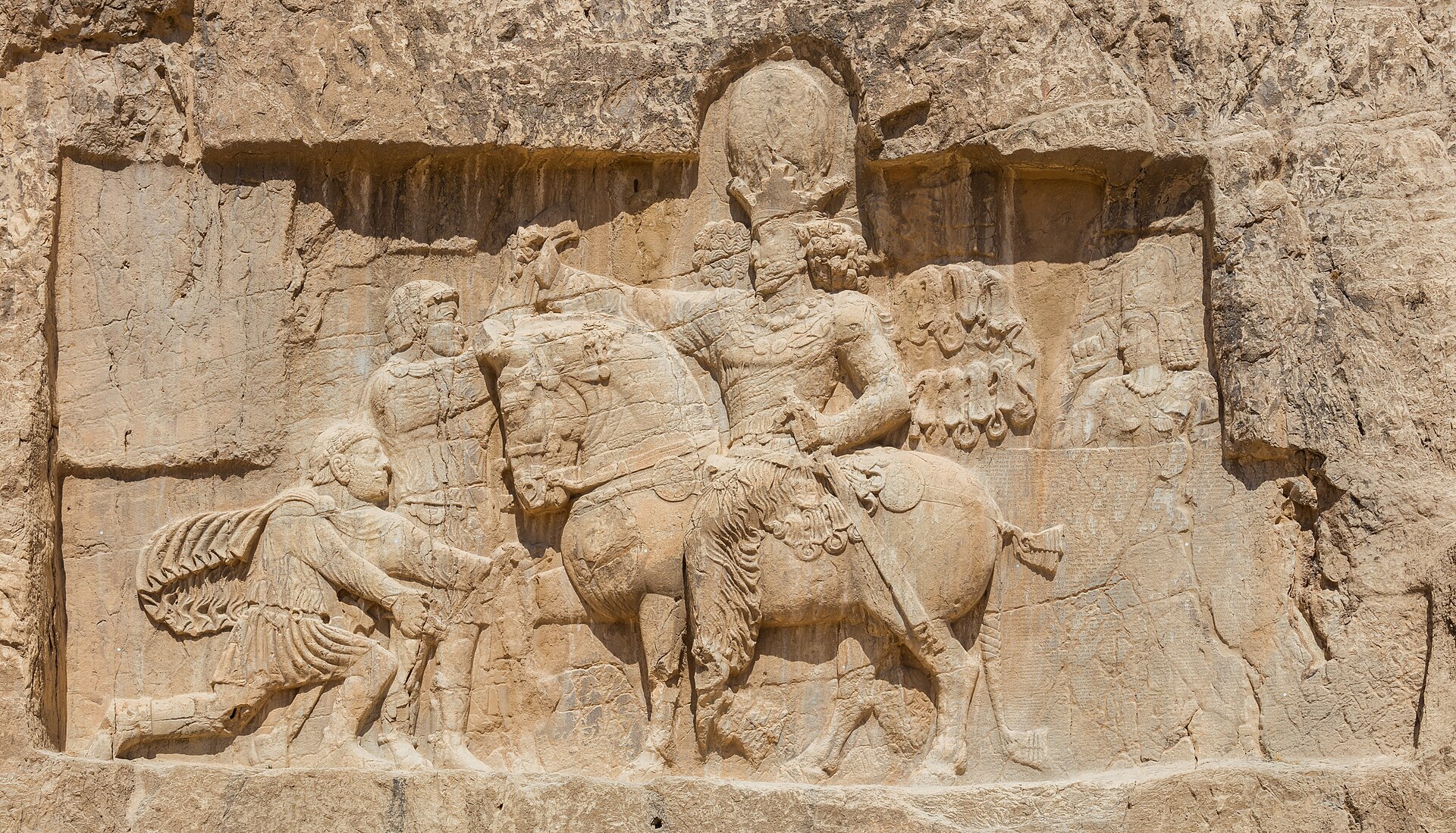
A few kilometres north of Persepolis, a sheer cliff of grey limestone carries four enormous cross-shaped tombs cut high above the plain — the resting places of Darius the Great and his successors, emperors of the largest empire the world had yet seen. Each cruciform facade, often called a 'Persian cross', shows the king standing before a fire altar beneath the winged symbol of Ahura Mazda, raised on a throne platform borne by figures representing the subject peoples of the empire. Behind small doorways, burial chambers with rock-cut cists are hollowed into the cliff. The site was sacred long before and long after the Achaemenids: a heavily worn Elamite relief may date to around 1000 BC, and in the 3rd century AD the Sasanian kings carved seven monumental reliefs below the tombs, including the famous scene of Shapur I humiliating the captured Roman emperor Valerian. Facing the cliff stands the site's greatest enigma — the Ka'ba-ye Zartosht, the 'Cube of Zoroaster', a 12.5-metre windowless tower of finely fitted white limestone whose original function remains one of the genuine unsolved puzzles of Near Eastern archaeology. Centuries later, locals who had forgotten the kings assumed the reliefs showed the mythical hero Rostam — hence the name, 'Pictures of Rostam'.

See it on the globe →
The mainstream view

What archaeology says

Only one tomb is identified with certainty: the trilingual DNa inscription of about 490 BC names Darius the Great, lists the lands of his empire from Macedon to India, and proclaims his devotion to Ahura Mazda. On stylistic and historical grounds the other three are attributed to Xerxes I, Artaxerxes I and Darius II, spanning roughly 486 to 404 BC. The site was excavated scientifically by Erich Schmidt of the University of Chicago's Oriental Institute between 1936 and 1939, and classical sources record that the tombs were looted after Alexander's conquest — Ctesias preserves the detail that even relatives could reach Darius's tomb chamber only by being hauled up on ropes, so high was the entrance cut.

The Ka'ba-ye Zartosht is an Achaemenid tower of the early 5th century BC, twin to the ruined Zendan-e Soleyman at Pasargadae, with a single raised chamber reached by a now-lost stair. Its purpose has divided scholars for a century. Kurt Erdmann and others argued for a fire temple; critics answer that a permanently sealed, windowless chamber with no smoke vent is a poor place for a sacred fire. Ernst Herzfeld proposed a repository for royal archives or the sacred Avesta; the Dutch Iranologist Heleen Sancisi-Weerdenburg suggested in 1983 that the towers were connected with royal investiture — coronation towers; still others see a temporary royal tomb. What is certain is that the tower mattered enormously later: in the 3rd century AD the Sasanian high priest Kartir and King Shapur I had major inscriptions carved on its walls, including Shapur's account of his victories over three Roman emperors — effectively a state gazette chiselled onto the mystery building.

Key evidence cited
  • The trilingual DNa inscription naming Darius the Great and dating his tomb to c. 490 BC
  • Erich Schmidt's 1936–1939 Oriental Institute excavations documenting the site's Achaemenid and Sasanian sequence
  • The twin tower at Pasargadae (Zendan-e Soleyman), anchoring the Ka'ba-ye Zartosht in early Achaemenid architecture
  • Sasanian inscriptions of Shapur I and the priest Kartir on the tower, showing its continued prestige and reuse
  • Tool marks, unfinished tomb cuttings and classical accounts documenting rope-and-scaffold construction methods
The alternative view

What the skeptics propose

The liveliest alternative theory comes from the Iranian independent researcher Reza Moradi Ghiasabadi, who has argued that the Ka'ba-ye Zartosht is a sophisticated solar calendar and observatory: on his reading, the arrangement of the tower's blank stone 'windows' and the play of shadows across its stepped facades against the cliff would have let Achaemenid astronomers track solstices, equinoxes and the calendar reform attributed to Darius's era. The idea has a large popular following in Iran, where the tower is sometimes presented as a national monument of ancient science. Academic Iranologists have not been persuaded — they note that the shadow alignments are loosely defined, that similar effects occur on almost any rectangular building, and that the twin tower at Pasargadae stands in a different orientation, which is awkward for a precision instrument.

A broader strand of alternative writing focuses on the engineering of the tombs themselves: the facades are cut with crisp precision into a vertical cliff beginning many metres above the ground, and popular channels regularly showcase Naqsh-e Rostam alongside Egypt's granite work as evidence that ancient rock-cutting outstripped what hand tools should allow — some going as far as claims of lost high technology or, on the fringes, extraterrestrial help. Mainstream archaeologists reply that unfinished Achaemenid monuments, abandoned tomb cuttings (including an incomplete fifth tomb at Persepolis itself) and abundant tool marks document exactly how the work proceeded — top-down from scaffolds and cut ledges, with iron and bronze tools whose marks are still visible.

There is also a genuine scholarly dispute at the ancient end of the timeline: the ghostly pre-Achaemenid relief, mostly erased by a Sasanian carving, is dated by Ernst Herzfeld and Heidemarie Koch as far back as around 2000–1000 BC, while other specialists such as Alireza Shapour Shahbazi favoured a later Elamite date near 1200–1000 BC. Either way, the Persians chose a cliff that had already been holy for centuries — a continuity alternative writers see as evidence of a far older sacred tradition at the site.

Key evidence cited
  • Reza Moradi Ghiasabadi's analysis of the tower's blind windows and shadow lines as a solar calendar and observatory
  • The sealed, ventless chamber that makes the traditional fire-temple identification physically awkward
  • No archive, treasure or burial was ever found inside — every functional theory rests on an empty room
  • The crisp precision of cruciform facades cut high on a vertical cliff, cited by lost-technology proponents
  • The worn Elamite relief suggesting the cliff was sacred perhaps a millennium before the Achaemenid tombs

Genuinely open questions

  1. What was the Ka'ba-ye Zartosht actually for — fire temple, archive, coronation tower, calendar, or a tomb that was never used?
  2. Which kings truly lie behind the three unnamed cruciform facades, and where were the last Achaemenids buried?
  3. What did the almost-erased pre-Achaemenid relief depict, and how old is the sanctity of the cliff itself?

Worth knowing

By the Islamic era locals had entirely forgotten the Persian emperors — they decided the giant reliefs showed the superhero Rostam from the Shahnameh epic, and the name stuck: Naqsh-e Rostam, 'Pictures of Rostam'.