What archaeology says
Georgian historical sources and the site's own inscriptions and frescoes give Vardzia an unusually secure chronology. Construction began under King Giorgi III (1156–1184), and his daughter Tamar — crowned co-ruler in her father's lifetime and reigning in her own right from 1184 — expanded it into a great royal monastery. The Church of the Dormition at the complex's heart was carved and painted between 1184 and 1186; its frescoes, executed by a painter who signed himself Giorgi, include a rare contemporary portrait of Queen Tamar shown unmarried, which art historians use to pin the date. Tradition holds that Tamar prayed at Vardzia before the pivotal victory of Basiani against the Seljuks around 1202.
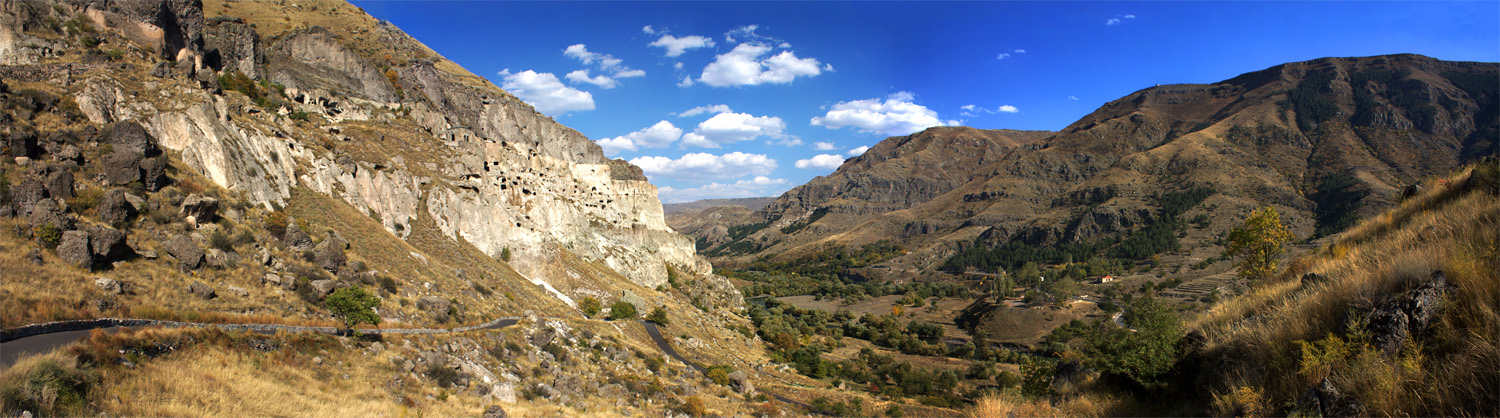
Archaeologists count roughly 500 to 650 surviving rooms across the eastern and western sections — a fraction of the original complex, most of which fell with the cliff in 1283. The monastery was partly rebuilt afterwards (a bell tower was added in the late 13th century) but never fully recovered; it was sacked by the Persian Shah Tahmasp I in 1551, when the monks were killed or enslaved and treasures carried off, and abandoned under Ottoman control later that century.
Since 2012 conservators from the Courtauld Institute of Art in London have worked with Georgia's National Agency for Cultural Heritage Preservation to stabilise the fragile Dormition frescoes, while Georgian and international teams monitor rockfall risk along the earthquake-weakened cliff — the same geological instability that both destroyed and revealed the city.
- Frescoes of 1184–1186 in the Church of the Dormition, including a datable contemporary portrait of Queen Tamar
- Georgian chronicles and the Vardzia Gospel notation documenting construction, the 1283 earthquake and the 1551 Persian sack
- The painter Giorgi's signature and inscription evidence tying the decoration to Tamar's early reign
- Roughly 500–650 surveyed rooms whose carving technique and church architecture match 12th-century Georgian practice
- Courtauld Institute and Georgian heritage agency conservation studies since 2012 confirming the medieval fresco technique