What archaeology says
What is securely established about Metsamor is impressive enough without astronomy. Excavations revealed a citadel with cyclopean walls, dense occupation from the Early Bronze Age (Kura-Araxes culture) through the Iron Age and beyond, and one of the largest known ancient metallurgical complexes in the region — dozens of smelting furnaces, casting moulds and slag heaps processing copper, bronze and later iron. Rich Late Bronze Age tombs yielded imports including an Egyptian faience frog-weight and a carnelian seal with Babylonian connections, showing Metsamor sat in far-reaching trade networks. Polish-Armenian excavations since 2013, led by Krzysztof Jakubiak with Ashot Piliposyan, continue to refine the sequence.
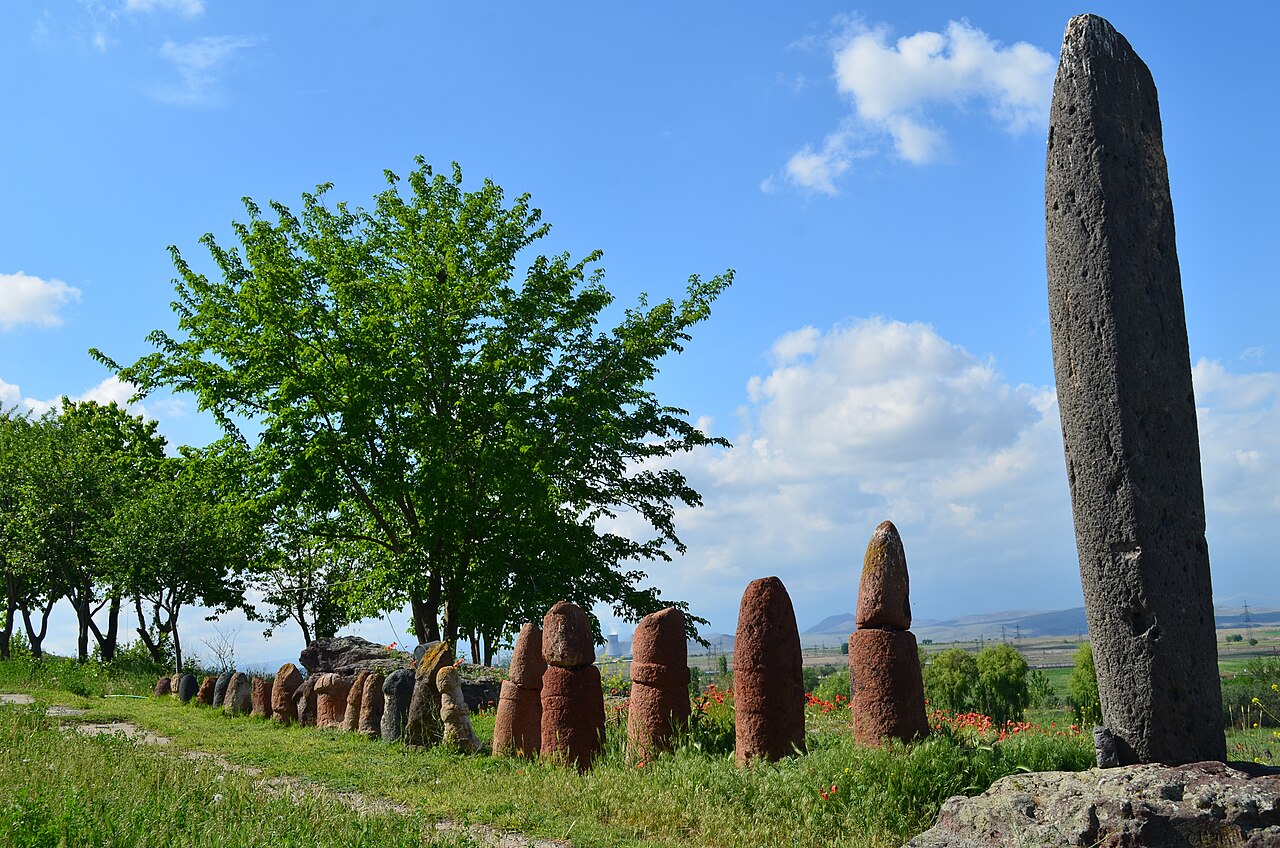
The 'observatory' is another matter. The southern rock spur does carry artificial steps, basins, grooves and pecked markings, some resembling stars or geometric figures. But mainstream archaeologists note that such rock-cut installations are common at highland sanctuaries and can relate to libations, metallurgy or cult; the astronomical interpretation rests on selecting particular grooves as sight-lines. No peer-reviewed modern survey has confirmed Parsamian's alignments, and international literature on archaeoastronomy generally lists Metsamor as an intriguing but unverified claim.
Scholars also point to the Soviet context: the 1960s-80s saw enthusiastic nationalist archaeoastronomy across the USSR, and Armenia's claims for Metsamor and the Zorats Karer ('Karahunj') stones served understandable cultural pride. That context calls for careful re-examination, not automatic dismissal.
- Continuous occupation from the fourth millennium BC is documented through stratified excavation since 1965
- Extensive smelting installations make Metsamor one of the oldest large metallurgical centres known in the Near East
- Imported Egyptian and Babylonian prestige objects in the tombs confirm long-distance connections, not isolation
- The rock-cut platforms, steps and basins parallel ritual installations at other highland sanctuaries without needing astronomy
- No modern peer-reviewed survey has verified the proposed alignments, leaving the observatory unproven by current standards