What archaeology says
The excavated facts are solid: twelve pits of varying size and shape, arranged in a shallow arc about 50 metres long, dug and maintained by pre-agricultural communities. Radiocarbon dates show the pits were created around 8000 BC and — remarkably — re-cut and kept open episodically for nearly four millennia, until about 4000 BC when farming reached the region. Some pits held posts or stone settings at various times, and the alignment sits in a landscape later chosen for an early Neolithic timber hall, suggesting persistent significance.
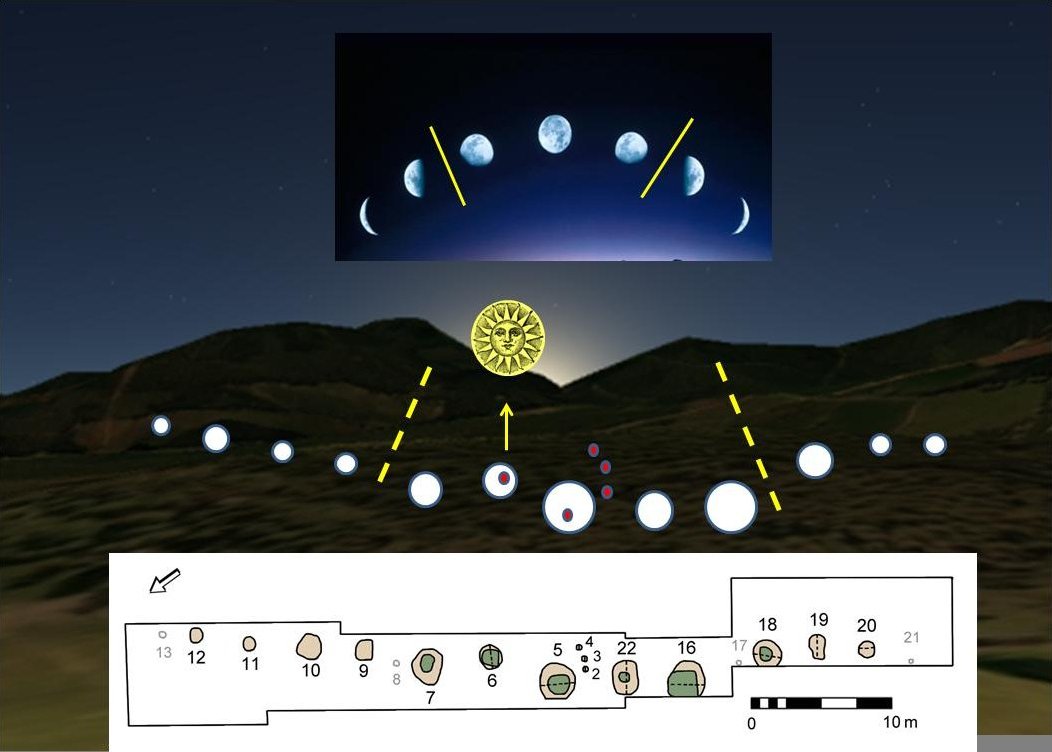
Gaffney's team, publishing in Internet Archaeology in 2013 with colleagues including Simon Fitch, Christopher Gaffney and Richard Bates, noted that the twelve pits vary in size in a pattern resembling the waxing and waning moon, with the largest, roundest pit at the centre of the sequence; that twelve pits approximate the lunar months of a year; and that the arc's south-east orientation frames the midwinter sunrise in a dip of the Slug Road pass on the horizon. They argued the monument allowed hunter-gatherers to track lunar months and correct the count against the solar year each midwinter — 'time reckoning' serving seasonal aggregation, salmon runs and migrating game.
Even the authors framed this as interpretation, and the excavators were more cautious still: Hilary Murray publicly noted the calendar reading was one possibility among several for pits whose contents show burning and possible ritual deposition. Many Mesolithic specialists prefer to call Warren Field a 'monumental pit alignment of unknown purpose' — itself extraordinary for hunter-gatherers — while acknowledging the calendar hypothesis is testable and serious.
- Excavation in 2004-06 confirmed twelve substantial Mesolithic pits with radiocarbon dates around 8000 BC
- Episodic re-cutting shows the alignment was maintained for nearly 4,000 years, implying transmitted significance
- The arc's south-east orientation faces the midwinter sunrise over a marked notch in the horizon
- Pit sizes vary systematically along the arc, with the largest at the centre of the proposed lunar sequence
- The 2013 interpretation was published in a peer-reviewed journal by an established multi-institution team