Ancient Knowledge · Isle of Lewis, Outer Hebrides, Scotland

Calanais Standing Stones

A stone cross on a Hebridean ridge where, every 18.6 years, the moon walks the hills

Mainstream: c. 2900-2600 BCAlternative: A precision lunar observatory (Thom's reading), with claims of use back to c. 3400 BC58.20°, -6.74°

At a glance

Calanais Standing Stones
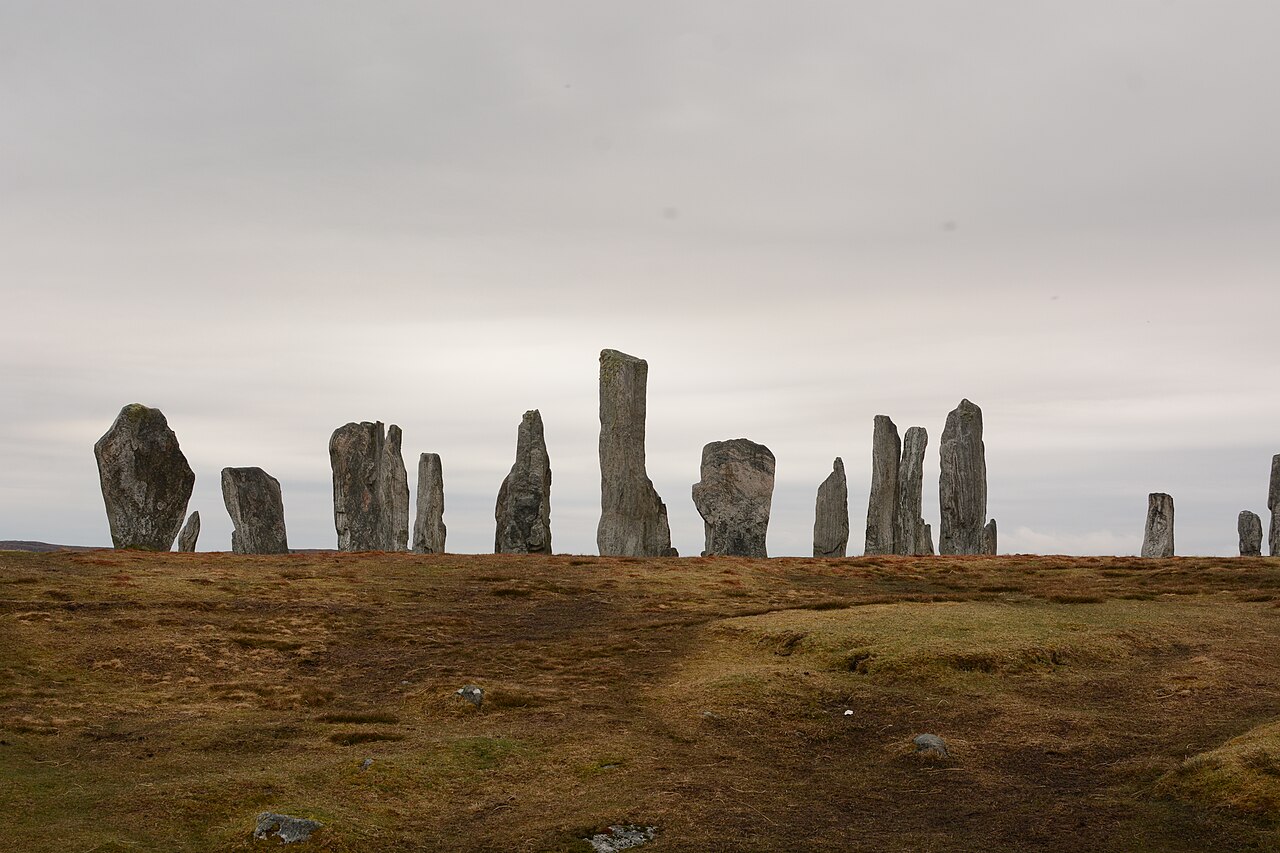
Photo: Andrew Gray · CC BY-SA 4.0

Calanais (Callanish) I is the centrepiece of a remarkable cluster of megalithic sites on the Isle of Lewis: a circle of thirteen tall gneiss stones with a central monolith and chambered cairn, approached by a long avenue and three shorter rows forming a rough cross. Erected around 2900 BC, centuries before Stonehenge's sarsens, the stones face a southern skyline formed by the hills of Cailleach na Mointeach — the 'Old Woman of the Moors', or Sleeping Beauty. Every 18.6 years, at the major lunar standstill, the full moon skims this reclining figure and appears to set into the stone circle itself, a spectacle re-observed by crowds and researchers through 2024-25.

See it on the globe →
The mainstream view

What archaeology says

Excavations by Patrick Ashmore in 1980-81 dated the circle's erection to about 2900-2600 BC, with the small chambered tomb inserted later and the site eventually abandoned and engulfed by peat, which preserved it until the 1850s. Calanais I sits within a concentration of at least a dozen circles and arrangements around Loch Roag, suggesting a ceremonial landscape of regional importance across a millennium.

On the astronomy, mainstream opinion accepts a striking but low-precision lunar relationship. From the avenue, at the major standstill the southern moon rises out of the Sleeping Beauty hills, glides low along the horizon, and re-gleams within the circle — an effect documented by Gerald and Margaret Ponting (later Margaret Curtis) from the 1980s and endorsed as plausible intentional theatre by sceptical archaeoastronomers including Clive Ruggles, who notes the avenue's orientation fits the standstill setting position. The event's power is dramatic and ritual rather than instrumental: no fine measurement is needed to stage it.

The 2024-25 major standstill brought organised observation programmes to Calanais, with researchers and thousands of visitors confirming and filming the moon's passage along the Old Woman's silhouette — while ongoing conservation work addresses peat regrowth and climate-driven erosion around the stones.

Key evidence cited
  • Ashmore's excavations and radiocarbon dates place the circle's construction around 2900-2600 BC
  • The avenue and circle sit within a dense complex of monuments around Loch Roag, indicating planned ceremonial landscape use
  • The major standstill moon demonstrably rises from the Sleeping Beauty hills and re-appears within the circle, as filmed in 2024-25
  • Ruggles' regional surveys confirm the avenue's orientation is consistent with the southern moonset at major standstill
  • Peat growth sealed and preserved the site from the Bronze Age until Victorian clearance, securing its integrity
The alternative view

What the skeptics propose

Calanais was a foundation stone of Alexander Thom's grand theory of megalithic science. Surveying it from 1933, the Oxford engineering professor classed the site as a precision lunar observatory, part of a Britain-wide network in which stone rows and distant horizon notches allowed 'megalithic astronomer-priests' to measure the moon's small standstill wobbles, predict eclipses, and lay out geometry using a standard 'megalithic yard'. Thom's Calanais work convinced many that Neolithic Britain hosted an intellectual elite of Pythagorean sophistication.

Later statistical reviews, notably by Ruggles, dismantled the high-precision claims: the alignments cluster at low accuracy, horizon notches were selected after the fact, and the megalithic yard fails rigorous testing. Yet a middle position survives — Margaret Curtis spent decades demonstrating repeatable standstill phenomena across the wider Calanais landscape, arguing several satellite circles were placed specifically to frame the low moon, and her fieldwork earned respect even from critics of Thom.

Fringe traditions have gathered around the site too: seventeenth-century islanders called the stones 'false men' turned to stone, and modern writers have linked Calanais to Atlantean refugees, ley networks and the classical legend of the Hyperborean temple where 'the god visits every nineteen years' — a line from Diodorus Siculus that even some sober scholars concede fits the 18.6-year lunar rhythm at this latitude suspiciously well.

Key evidence cited
  • Thom's surveys catalogued multiple proposed lunar sight-lines at Calanais with sub-degree claimed precision
  • Margaret Curtis documented repeatable standstill alignments at several satellite circles over successive 18.6-year cycles
  • Diodorus Siculus' account of a northern island temple visited by the god every nineteen years matches the standstill interval
  • The stone rows' cross-shaped plan is argued to combine solar, lunar and stellar functions in one integrated design
  • Regional oral tradition of the 'shining one' walking the avenue at midsummer hints at remembered ceremonial astronomy

Genuinely open questions

  1. Was the Sleeping Beauty moonrise the circle's founding purpose or a later-discovered bonus?
  2. Do the satellite circles really form a coordinated lunar landscape, as Curtis argued?
  3. What stood at Calanais before the stones — and does the ard-marked ploughsoil beneath imply earlier sanctity?
  4. Is Diodorus' Hyperborean temple a garbled report of Calanais, Stonehenge, or pure legend?

Worth knowing

Local tradition held that the stones were giants who refused Christianity and were petrified by St Kieran — yet islanders still quietly visited them at midsummer 'when the shining one walks', long after the kirk disapproved.