Belief & Society · Adams County, Ohio, USA

Serpent Mound

A 411-metre serpent uncoiling along a ridge inside an ancient meteorite scar — and archaeologists still cannot agree who built it.

Mainstream: c. 320 BC (Adena) or c. AD 1070 (Fort Ancient) — genuinely unresolvedAlternative: Graham Hancock argues the design references the sky of c. 12,800 years ago; New Age proponents focus on 'earth energies' rather than a date39.03°, -83.43°

At a glance

Serpent Mound
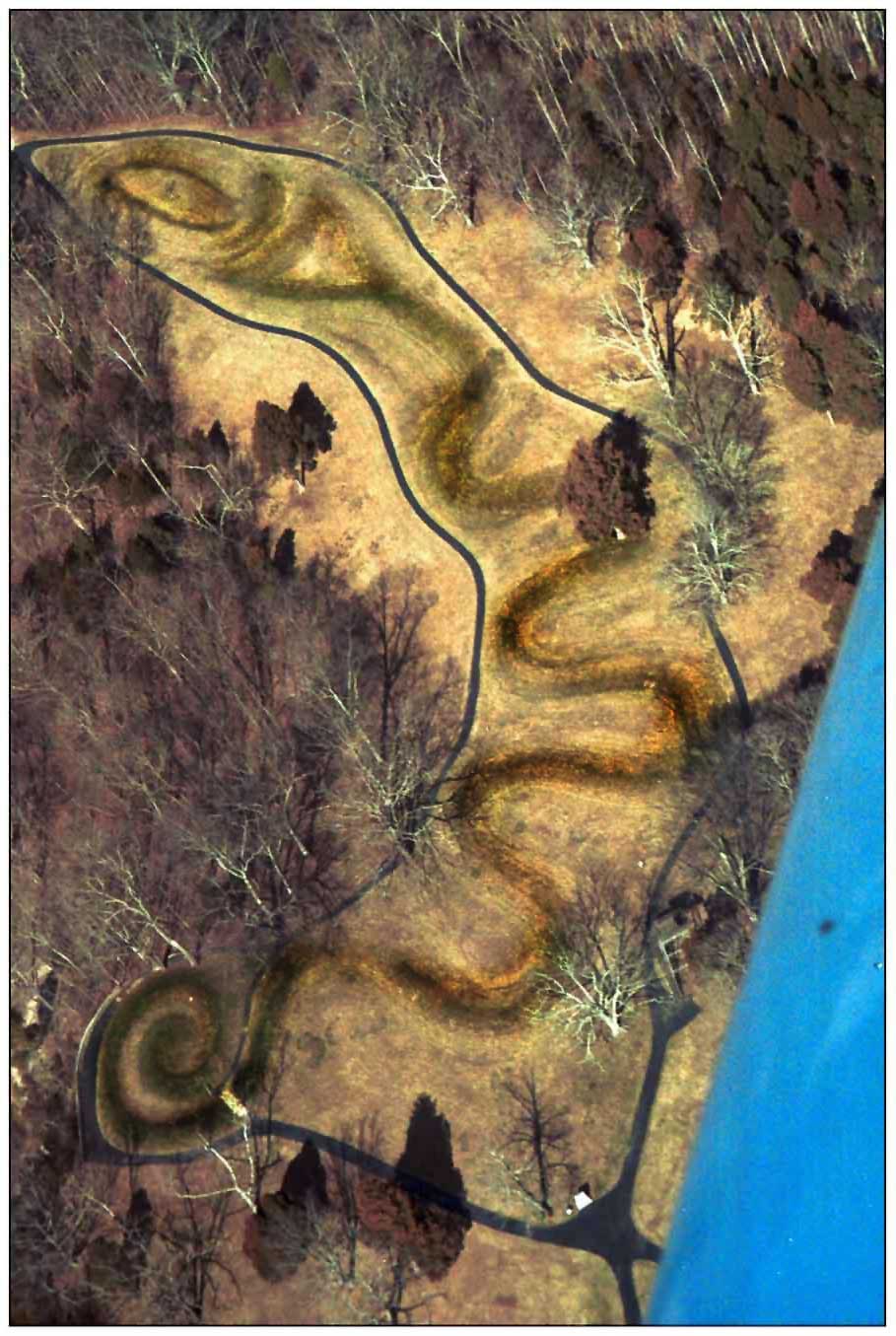
Photo: Timothy A. Price & Nichole I. Stump · CC BY 2.5

Serpent Mound is the largest documented serpent effigy in the world: a sinuous embankment of earth about 411 metres long and up to a metre high, winding along a bluff above Brush Creek in southern Ohio. The snake's coiled tail anchors one end while its open jaws close around an oval embankment often read as an egg — or the sun being swallowed. Uniquely, the effigy lies inside the Serpent Mound crater, an eroded 8-kilometre structure created by a meteorite impact roughly 300 million years ago, which left the local bedrock faulted, jumbled and magnetically strange. The mound was saved from destruction in the 1880s by Harvard's Frederic Ward Putnam, who excavated, restored and helped protect it in one of America's first acts of archaeological conservation.

See it on the globe →
The mainstream view

What archaeology says

Remarkably, mainstream archaeology is split down the middle on Serpent Mound's age. Because effigy mounds contain no burials or artefact caches, dating depends on scraps of charcoal and soil chemistry. In the 1990s a team including Bradley Lepper of the Ohio History Connection obtained radiocarbon dates of around AD 1070, assigning the effigy to the Fort Ancient culture — which fits, Lepper argues, because Fort Ancient people demonstrably built Ohio's only other effigy (Alligator Mound), used serpent imagery constantly in their art, and lived in a village at the foot of the Serpent Mound bluff. The date also tantalisingly coincides with the AD 1054 supernova and the 1066 apparition of Halley's Comet.

The rival camp — William Romain, Edward Herrmann, G. William Monaghan and colleagues — cored the mound in 2011 and published radiocarbon dates in 2014 averaging around 320 BC, which would make the serpent a work of the much earlier Adena culture, whose conical burial mound stands nearby. They argue the AD 1070 charcoal reflects a later repair of an already ancient monument, and further dates published in 2019 supported the older estimate. Lepper's team counters that the old dates come from soil humates, a material notorious for returning ages older than the construction they are meant to date. The exchange has run through formal rejoinders and replies for a decade without resolution.

What is not disputed is the effigy's astronomy and artistry: the serpent's head and oval align closely with the summer solstice sunset, and Romain has argued the coils reference lunar rise and set points. Nor is the setting an accident — the builders chose a ridge inside a cryptovolcanic impact structure, though whether they recognised the ground as unusual is unknowable.

Key evidence cited
  • Radiocarbon dates of c. AD 1070 from charcoal recovered in the 1990s (Lepper and colleagues)
  • Radiocarbon dates of c. 320 BC from 2011 sediment cores (Herrmann, Monaghan and Romain, published 2014, supported 2019)
  • A Fort Ancient village and an Adena burial mound both sit immediately adjacent, giving each camp a candidate builder
  • Fort Ancient culture built Ohio's only other effigy (Alligator Mound) and used serpent imagery extensively
  • Documented summer solstice sunset alignment of the serpent's head and oval embankment
The alternative view

What the skeptics propose

Serpent Mound opens Graham Hancock's 2019 book America Before. Hancock accepts that Native Americans built the effigy but argues its solstice alignment worked even more precisely around 12,800 years ago — his favoured date for a lost Ice Age civilisation destroyed by the Younger Dryas comet impact — and suggests the serpent-and-egg design encodes an ancient sky-ground scheme transmitted across millennia. He also finds it meaningful that a serpent effigy sits astride a genuine cosmic impact scar. Critics, including Lepper, reply that no excavation has produced any material of remotely that age, that projecting alignments backward until they 'fit' a preferred epoch is circular, and that the effigy's date debate runs between 320 BC and AD 1070 — not 10,800 BC. The dispute turned institutional when the Ohio History Connection declined to let Hancock's Netflix series Ancient Apocalypse film at the site, prompting accusations of censorship from his supporters.

A separate, older strand treats Serpent Mound as an 'energy vortex'. Since the Harmonic Convergence gathering of August 1987 drew thousands to the mound, New Age visitors have attributed healing energies to the site, sometimes linking them to the impact structure's real magnetic and gravitational anomalies. Site managers have had to deal with visitors burying crystals in the effigy to 'charge' them, and in 2012 dowsers and 'lightworkers' were controversially permitted a solstice ceremony. Archaeologists and geologists respond that no measurable 'energy field' distinguishes the site, and that the anomalies are ordinary consequences of shattered, faulted bedrock.

Steelmanned, the alternative camp raises a fair point: a monument whose age mainstream science cannot pin down within 1,400 years invites humility, and the choice of such a geologically extraordinary location does suggest the builders perceived something special about the place — an idea some archaeologists, including Romain, take seriously in naturalistic terms.

Key evidence cited
  • Hancock's argument that the solstice alignment was tighter c. 12,800 years ago, matching his Younger Dryas lost-civilisation chronology
  • The effigy's placement inside a genuine meteorite impact structure, read as deliberate cosmic knowledge
  • Serpent-swallowing-the-sun imagery paralleled in eclipse myths worldwide, suggested as a shared ancient inheritance
  • Real magnetic and gravity anomalies in the crater, cited by energy-vortex proponents
  • The mainstream's own 1,400-year dating disagreement, used to argue the site's history is far from settled

Genuinely open questions

  1. Was Serpent Mound built by the Adena around 320 BC or the Fort Ancient culture around AD 1070 — and can new excavation ever settle it?
  2. Did the builders recognise the impact-shattered landscape as unusual, and did that influence the choice of site?
  3. What does the oval at the serpent's jaws actually represent — an egg, the sun, an eclipse, or something else entirely?

Worth knowing

Serpent Mound is one of the only monuments on Earth where an ancient serpent effigy coils across a genuine meteorite impact scar — and site staff have had to ask New Age visitors to stop burying crystals in it.