What archaeology says
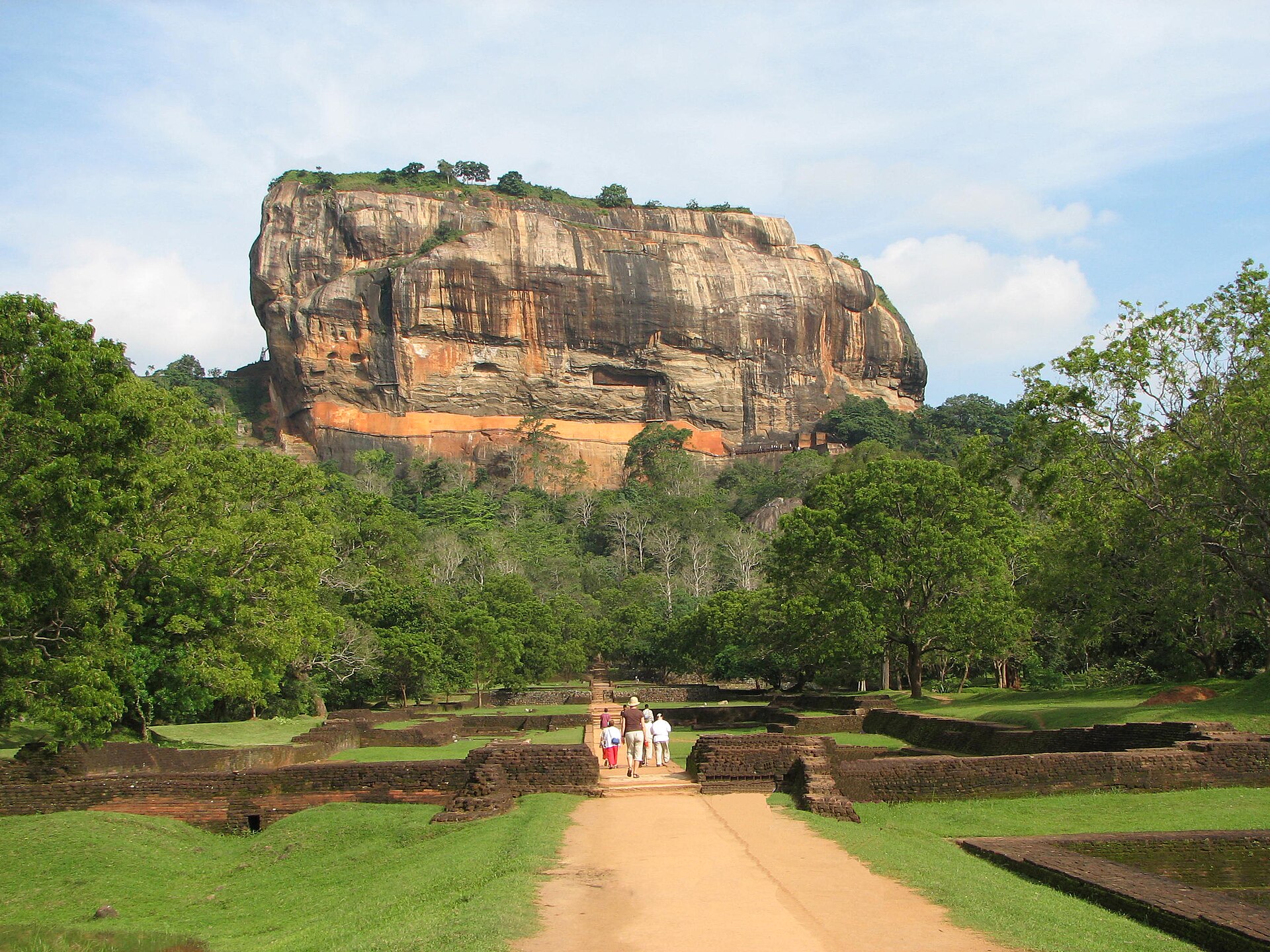
The Culavamsa, the continuation of Sri Lanka's great monastic chronicle, tells the story in detail. Prince Kashyapa seized the throne in AD 477 after entombing his father, King Dhatusena, alive, and — fearing the return of his exiled brother Moggallana — moved the capital from Anuradhapura to the summit of Sigiriya, building his palace-fortress there in a reign of eighteen years. When Moggallana finally came with an army in 495, Kashyapa's forces broke, and the king took his own life; the site was handed to Buddhist monks and remained a monastery until about the 13th century. Archaeology matches this arc: the pleasure-garden architecture, frescoes and summit palace belong to a single short, lavish building phase, while drip-ledged caves with Brahmi inscriptions show a monastic community on and around the rock from about the 3rd century BC, and the Aligala rock shelter preserves Mesolithic occupation thousands of years earlier.
The hydraulic engineering is celebrated in mainstream scholarship rather than disputed by it. The water gardens deploy surface and subsurface conduits, silt traps and pressure differentials so precisely that several limestone fountain sprinklers still operate in the rainy season, and the whole western precinct is laid out on a strict axial-symmetry plan integrated with moats and ramparts. Senake Bandaranayake, who led UNESCO-backed excavations from the 1980s, read Sigiriya as a planned garden city and theatrical statement of kingship as much as a fortress. The Mirror Wall — brick-faced, coated in polished lime plaster that once reflected the frescoes above — carries graffiti from the 8th to 10th centuries, some of the earliest Sinhala poetry, proving the site was already a tourist attraction over a thousand years ago.
Sri Lanka's broader hydraulic civilisation supplies the context: by Kashyapa's day the island had been building sophisticated reservoir-and-canal systems for centuries, so the gardens are an apex of a documented native tradition, not an anomaly.
- The Culavamsa chronicle's detailed account of Kashyapa's usurpation, fortress capital and fall (AD 477–495)
- A single coherent late-5th-century construction phase across gardens, gallery and summit palace
- Mirror Wall graffiti of the 8th–10th centuries describing the site much as it survives today
- Drip-ledged monastic caves with Brahmi inscriptions showing occupation from c. 3rd century BC
- Continuity with Sri Lanka's documented reservoir-and-canal hydraulic tradition