What archaeology says
The archaeological and epigraphic record at Dambulla is unusually coherent. Early Brahmi inscriptions carved beneath the drip-ledges of the caves — the grooves cut to shed rainwater, a signature of Sri Lanka's earliest monastic caves — record their donation to the Buddhist sangha around the 3rd to 1st centuries BC, consistent with the Valagamba tradition preserved in the chronicles. Sri Lanka's pioneering epigraphist Senarath Paranavitana catalogued such inscriptions across the island, and Dambulla fits a well-documented pattern of natural rock shelters converted to monasteries in the earliest Buddhist centuries.
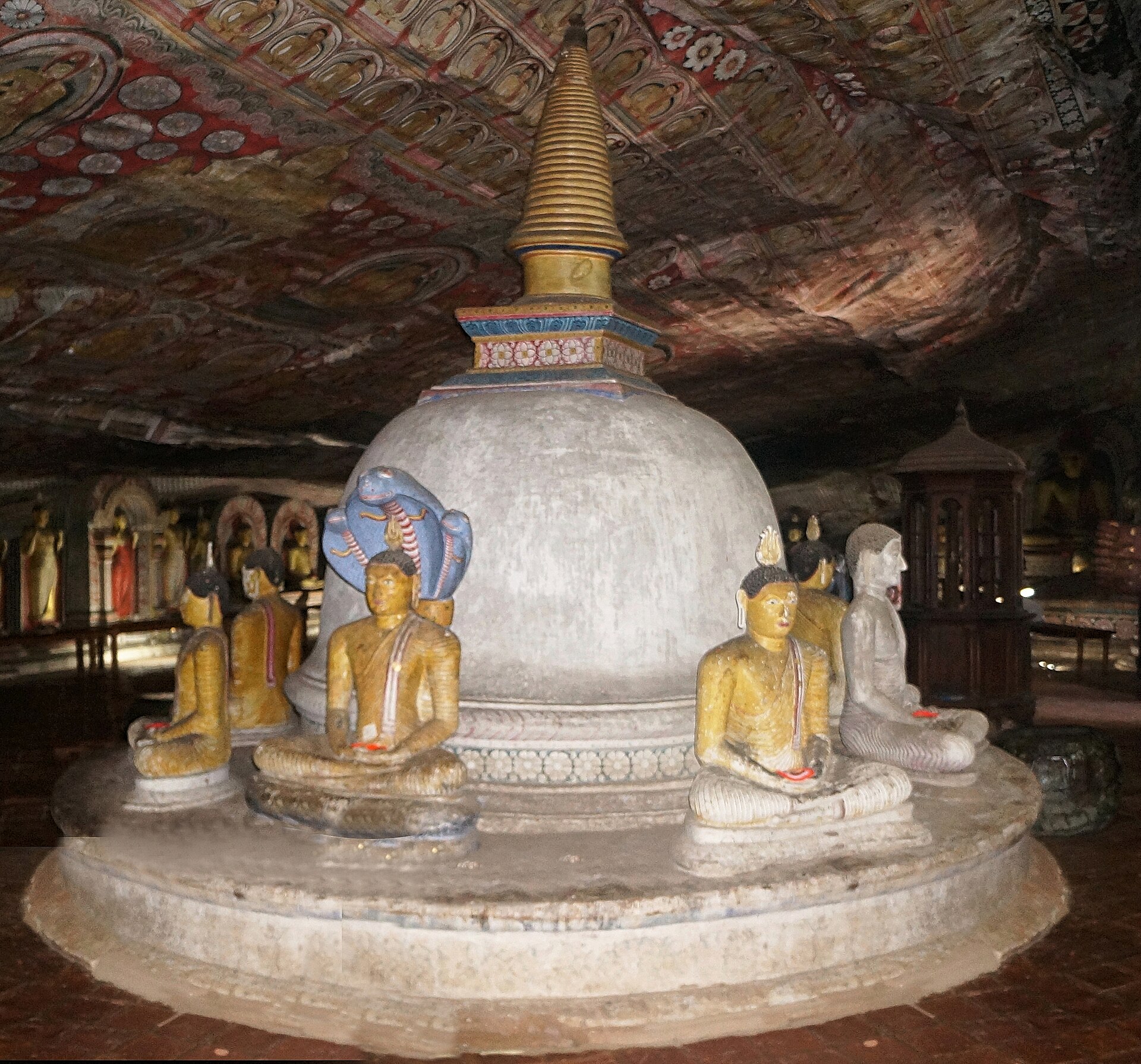
The temple as visitors see it is a layered artefact of royal patronage: Nissanka Malla gilded the interiors in the 12th century (earning the name Rangiri, 'golden rock'), and the great Kandyan king Kirti Sri Rajasinha commissioned the comprehensive 18th-century repainting that gives the murals their present character. Archaeologists led by Sri Lankan teams (with German collaboration) excavated the Ibbankatuwa cemetery in the 1980s and 2010s, finding stone-lined cist graves with pottery, iron tools, carnelian and gemstone beads — evidence of an organised Early Iron Age society trading over long distances centuries before Buddhism arrived in 250 BC.
For mainstream scholars, Dambulla therefore tells an evolutionary story: indigenous megalithic communities, then early Buddhist monasticism grafted onto their landscape, then two thousand years of unbroken devotional use. Nothing about the sequence requires mystery — but its completeness is exceptional, and researchers continue to study human remains from the wider site cluster for what they reveal about the island's pre-Buddhist population.
- Early Brahmi drip-ledge inscriptions recording donation of the caves to Buddhist monks around the 3rd–1st centuries BC
- Chronicle tradition of King Valagamba's refuge and temple foundation, consistent with the epigraphy
- Ibbankatuwa megalithic cist burials (c. 700–400 BC) with pottery, iron tools and imported gem beads, 3 km from the temple
- Documented royal renovation history — Nissanka Malla's 12th-century gilding, Kirti Sri Rajasinha's 18th-century repainting
- Over 2,000 square metres of stratified mural layers studied and conserved as a continuous artistic record