Ancient Engineering · Upper Mustang, Kali Gandaki valley, Nepal

Sky Caves of Mustang

Ten thousand hand-dug caves honeycomb the cliffs of a Himalayan desert — tombs, homes and monasteries whose first builders no one can yet name.

Mainstream: Earliest use c. 1000 BC; cave burials to c. AD 800; residential and monastic phases 10th–15th centuries ADAlternative: Not a dating dispute so much as an engineering one — who first cut some 10,000 caves into sheer, crumbling cliffs, and how they reached openings 50 metres up, remains genuinely unresolved28.93°, 83.91°

At a glance

Sky Caves of Mustang
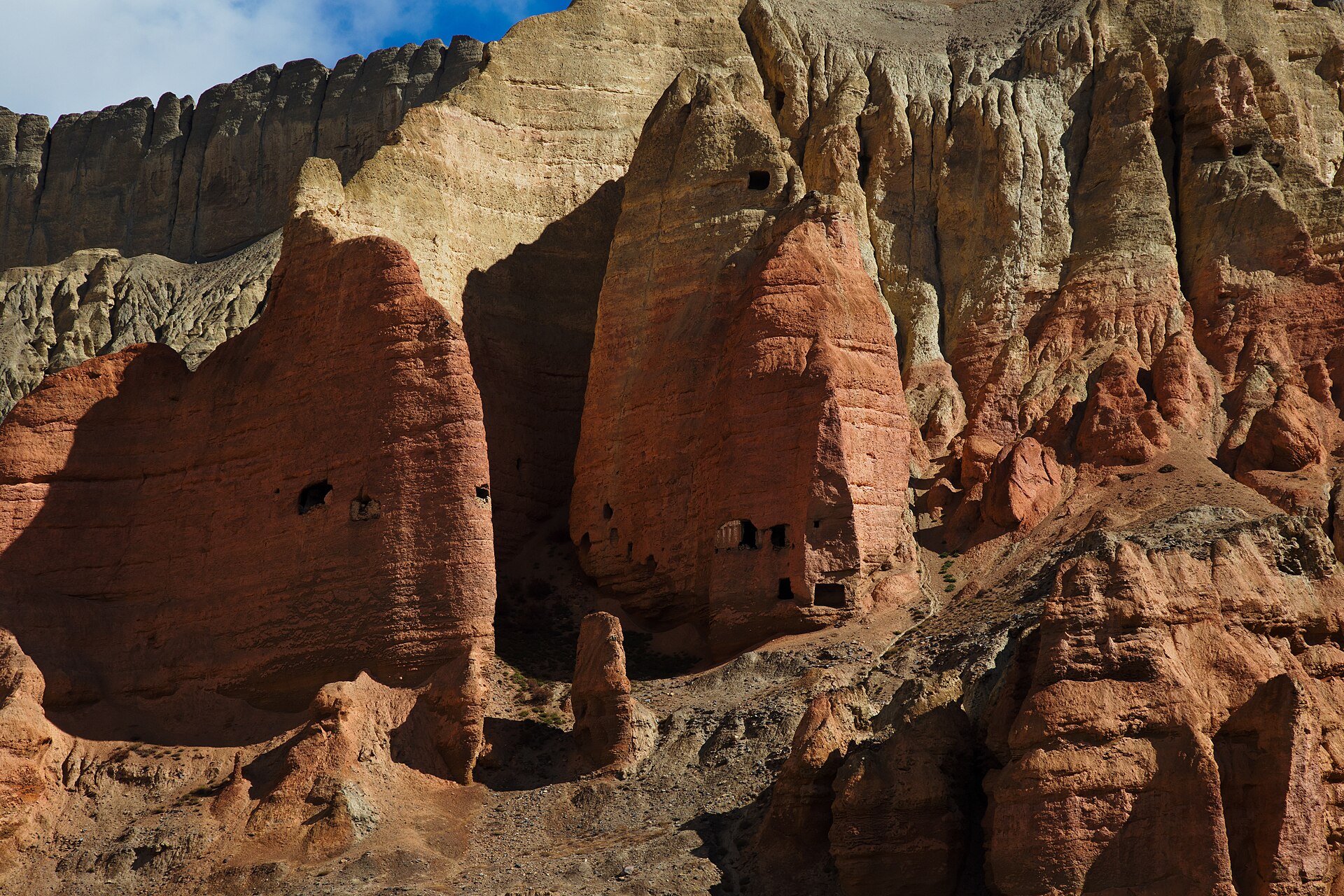
Photo: Jmhullot · CC BY 3.0

In the high-altitude desert of Upper Mustang, where the Kali Gandaki River has sliced one of the world's deepest gorges between Annapurna and Dhaulagiri, the tan cliffs are riddled with openings — roughly 10,000 man-made caves, singly and in vast honeycombed clusters, some gaping from rock faces fifty metres or more above any standing surface. Some are single chambers; others, like the famous Shija Jhong cave at Chhoser, are multi-storey complexes of dozens of rooms joined by internal shafts and ladders. They constitute one of the world's great archaeological puzzles, in plain sight of the old salt-trade route to Tibet. Locked inside the once-forbidden Kingdom of Lo and restricted to outsiders until 1992, the caves went almost unstudied until the 1990s, when Nepali-German teams excavated burial caves at Mebrak and Chokhopani, and from 2008 a series of expeditions combining archaeologists and elite climbers began systematically exploring shafts and chambers no one had entered for centuries. What they found — mass burial chambers, mummified remains, gold funerary masks, silk, and one of the oldest illuminated Buddhist manuscripts known in the region — revealed Mustang as a crossroads of Himalayan civilisation going back some three thousand years.

See it on the globe →
The mainstream view

What archaeology says

The modern picture comes largely from expeditions led by archaeologist Mark Aldenderfer (University of California, Merced) with mountaineer Pete Athans, working with Nepal's Department of Archaeology from 2008 onward, building on 1990s Nepali-German excavations of burial caves such as Mebrak 63. Aldenderfer's team distinguishes three broad phases: first, the caves served as burial chambers, from roughly 1000 BC to around AD 800; later, around the 10th century — an era of chronic warfare in the region — whole communities apparently moved into the cliffs, using cave systems as defensible homes; and by the 15th century many caves had become meditation cells, chapels and storerooms attached to Buddhist monasteries.

At Samdzong, near the Tibetan border, the team recovered remains of dozens of individuals from shaft tombs, including a spectacular 5th-century burial with a gold-and-silver funerary mask, copper vessels, glass beads from as far away as South Asia, and Chinese silk — proof that this remote gorge sat on long-distance trade networks. Cut-marks on many bones indicate defleshing, an apparent forerunner of Tibetan sky burial, studied by bioarchaeologist Jacqueline Eng. Ancient-DNA work led by Christina Warinner and colleagues (published 2016) showed the earliest sequenced inhabitants were genetically closest to Tibetan plateau populations, settling a long argument about where Mustang's first farmers came from.

On the question of how the caves were dug, mainstream archaeology is candid about the limits of its knowledge. The rock is a soft, compacted glacial-and-lacustrine conglomerate that can be worked with simple tools, and researchers suggest diggers used ropes from above, scaffolding, ladders and now-eroded access paths — noting the gorge floor and cliff faces have changed substantially over two millennia, so openings now stranded in mid-cliff were once easier to reach. But no excavation has yet found the tools, scaffolding sockets or work debris to demonstrate the method directly.

Key evidence cited
  • Excavated burial caves (Mebrak, Chokhopani, Samdzong) with radiocarbon dates spanning c. 1000 BC to AD 800
  • Aldenderfer's three-phase sequence — tombs, then defensive dwellings from the 10th century, then monastic use by the 1400s
  • The Samdzong shaft-tomb assemblage: gold-and-silver funerary mask, Chinese silk and glass beads evidencing trade links
  • Ancient-DNA studies (Warinner and colleagues, 2016) tying the earliest inhabitants to Tibetan plateau populations
  • The soft, workable conglomerate geology and ongoing local use of lower caves, supporting simple-tool excavation
The alternative view

What the skeptics propose

Mustang is that rare site where the central mystery marketed by alternative media — who dug these and how did they get up there? — is acknowledged by the excavating archaeologists themselves. Aldenderfer has repeatedly said in interviews that he does not know how people entered many of the caves, and popular accounts have run with the puzzle. The Ancient Aliens franchise and assorted online writers cite the sky caves as evidence of lost technology or non-human assistance, pointing to the sheer number of caves, the vertical faces, and openings that today can only be reached with modern climbing gear.

Local tradition offers its own alternatives: Mustangis have long attributed the highest caves to flying beings — dakinis, or the winged saints of Buddhist legend — and some folklore holds that ancient people could fly or that the caves were dug from the top of a vanished landscape. A related speculative strand ties the caves to the legendary kingdom of Shangri-La or to Zhang Zhung, the semi-historical pre-Buddhist civilisation of western Tibet whose Bon religion left traces across the region; cave murals and manuscripts show Bon elements, and some researchers outside the mainstream argue Mustang preserves Zhang Zhung's lost heartland.

The sober rejoinder is that soft conglomerate, simple tools, rope access and two thousand years of erosion can plausibly account for everything — villagers in Chhoser still use lower caves for storage and stables, and some families occupied cliff dwellings within living memory. But 'plausibly' is doing real work in that sentence: the honest mainstream position is that the first diggers are unidentified, their methods undemonstrated, and the vast majority of the 10,000 caves have never been entered by any researcher. For once, the alternative community's favourite question is also archaeology's.

Key evidence cited
  • Cave mouths stranded 50 metres up sheer faces, reachable today only with modern climbing equipment
  • The excavators' own admission that no tools, scaffold traces or direct evidence of the digging method have been found
  • Local traditions attributing the highest caves to flying beings, hinting the access puzzle is ancient, not modern
  • The sheer scale — some 10,000 caves — implying an organised effort by a population the record barely registers
  • Bon religious traces and speculative links to the lost Zhang Zhung civilisation of western Tibet

Genuinely open questions

  1. How did the original builders physically reach and excavate openings now high on sheer cliff faces?
  2. Who were the first cave-diggers of c. 1000 BC, and what relationship do they have to the Zhang Zhung culture?
  3. What lies in the thousands of caves — the overwhelming majority — that no researcher has ever entered?

Worth knowing

One Samdzong tomb held a 1,500-year-old gold-and-silver death mask with sewing holes around its edge — it had been stitched to the face of the deceased, alongside Chinese silk, at 4,000 metres in one of the most remote valleys on Earth.