Origins of Civilisation · Hisar district, Haryana, India

Rakhigarhi

The largest Indus city lies under Indian villages — and a single woman's 4,500-year-old genome ignited a national identity war.

Mainstream: c. 4600–1900 BC (pre-Harappan to Mature Harappan)Alternative: Claimed as the capital of an indigenous 'Saraswati civilisation' with no Aryan migration29.29°, 76.11°

At a glance

Rakhigarhi
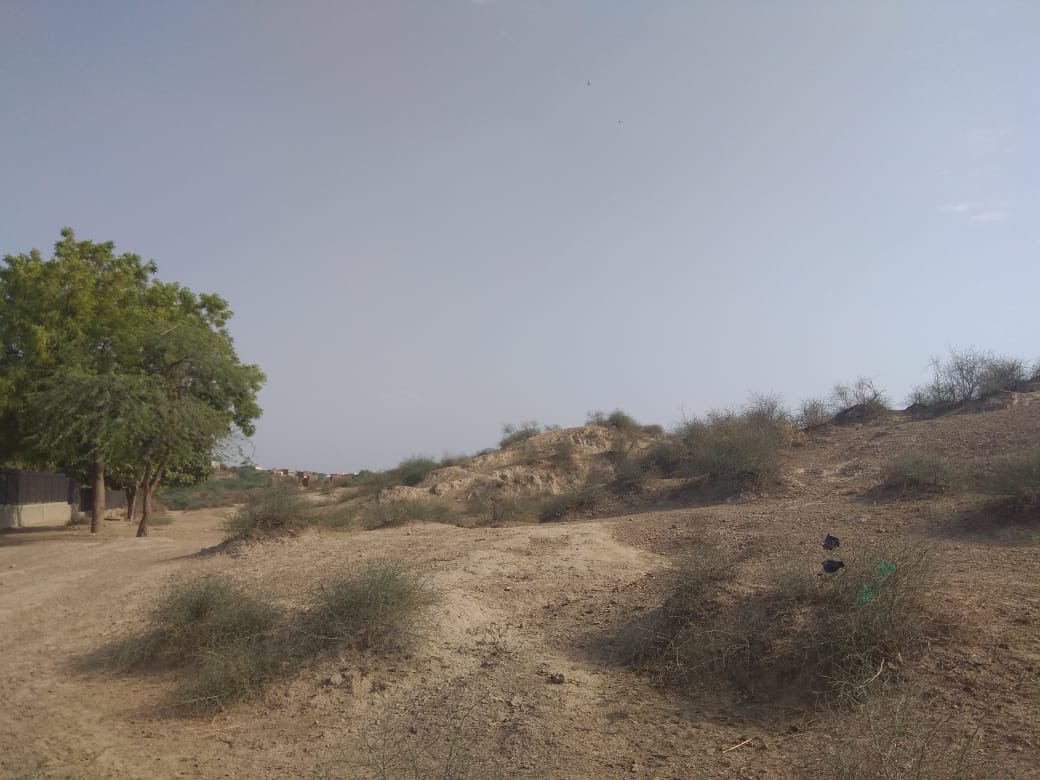
Photo: Durgeshkushvaha · CC BY-SA 4.0

Rakhigarhi, spread over eleven mounds beneath and around two living villages in Haryana's Hisar district, is now considered the largest city of the Indus (Harappan) civilisation — estimates run from 350 to over 500 hectares, exceeding Mohenjo-daro. Occupied from Early Harappan times, c. 4600 BC in its oldest levels, to about 1900 BC, it had planned streets, brick platforms, drains, granaries and cemetery burials. Excavations by Amarendra Nath (1997-2000) and Vasant Shinde (2011-2016) culminated in a scientific landmark: the first ancient genome from the Indus civilisation, sequenced from a woman's skeleton and published in Cell in 2019 — a result whose interpretation immediately split along one of India's deepest political fault lines.

See it on the globe →
The mainstream view

What archaeology says

Archaeologically, Rakhigarhi anchors the eastern, Ghaggar-basin domain of the Indus world and demonstrates that the civilisation had multiple great centres, not just the famous cities of Pakistan. Its early levels reach back before 4000 BC, showing regional roots for urbanism, and its mature-phase remains display the standard Harappan package: grid planning, standardised bricks, drainage, craft industries in shell, carnelian and copper, and formal burials studied for diet and health.

The 2019 Cell paper — lead authors Vasant Shinde, Vagheesh Narasimhan, Niraj Rai, Nick Patterson and David Reich — reported the genome of individual I6113. Her ancestry combined a lineage related to ancient Iranian populations, which had separated from actual Iranian-plateau farmers before 10,000 BC, with ancestry related to Southeast Asian hunter-gatherers. Crucially she carried no Steppe pastoralist ancestry, the component associated with Indo-European speakers, and no ancestry from Anatolian farmers. The companion Science paper by Narasimhan and colleagues showed that Steppe ancestry entered South Asia later, roughly 2000-1500 BC, after the Indus decline — consistent with the long-standing model of Indo-Aryan languages arriving through post-Harappan migrations. The genetics also showed Harappans are major ancestors of most modern South Asians, and that farming in the region did not require mass migration from the Iranian plateau.

For most historians and geneticists, then, Rakhigarhi's DNA refined rather than overturned the standard picture: the Indus civilisation was indigenous in development, and Indo-European languages arrived afterwards.

Key evidence cited
  • Occupation from c. 4600 BC with full Mature Harappan urbanism: planned streets, drains, platforms and craft quarters
  • Site-size estimates of 350-550 hectares across eleven mounds, likely exceeding Mohenjo-daro
  • The 2019 Cell genome of individual I6113 lacking Steppe and Anatolian farmer ancestry
  • The companion 2019 Science study dating Steppe ancestry's arrival in South Asia to c. 2000-1500 BC
  • Genetic continuity showing Harappans as primary ancestors of most modern South Asians
  • Independent evidence that regional farming developed locally rather than by mass migration from Iran
The alternative view

What the skeptics propose

The interpretation war began at the press conferences. Vasant Shinde, presenting the paper he co-authored, declared that the results demolished the Aryan invasion or migration theory, proved the Harappans were the indigenous Vedic people, and suggested Sanskrit and Vedic culture developed locally — claims aligned with the Hindutva historiography favoured by India's governing right, in which Indian civilisation is wholly autochthonous and the 'Saraswati' name should replace Indus. Co-author Niraj Rai made partly similar statements. Yet the papers themselves, as co-authors like David Reich and Vagheesh Narasimhan pointed out and journalists such as Tony Joseph (author of Early Indians) documented, said nearly the opposite about language: the absence of Steppe ancestry in the Harappan woman, combined with its presence in modern Indians, strengthens the case that Indo-Aryan speech arrived after the cities fell.

The episode became a case study in the politics of ancient DNA: identical data presented as refuting a migration in Indian press events while the publications described that migration's genetic trail. The Saraswati dimension runs in parallel — Rakhigarhi lies in the Ghaggar (claimed Saraswati) basin, and Haryana's government has invested heavily in the site as heritage of a 'Saraswati civilisation', including museum development, while critics see mythology steering archaeology.

There are also non-political controversies: sample contamination challenges in India's climate (only one skeleton of dozens yielded DNA), looting and village encroachment on the mounds, and genuine debate over the site-size estimates that crown Rakhigarhi the largest Indus city.

Key evidence cited
  • Shinde and Rai's public claims that the DNA disproves any Aryan migration and identifies Harappans as Vedic people
  • Rakhigarhi's position in the Ghaggar-Hakra basin, identified by Saraswati proponents with the Vedic river
  • Early local dates cited to argue an unbroken indigenous civilisation stretching back seven millennia
  • Absence of Steppe ancestry in the one sequenced Harappan individual, read by Out-of-India theorists as decisive
  • State investment in a Saraswati-framed museum and heritage narrative at the site
  • The undeciphered Indus script, leaving the inhabitants' language formally unknown and every identification alive

Genuinely open questions

  1. Will more Harappan genomes confirm or complicate the single Rakhigarhi sample?
  2. How large was Rakhigarhi really, and was it a capital in any political sense?
  3. What language did the Harappans of Rakhigarhi speak?
  4. Can the science be insulated from the identity politics now attached to the site?

Worth knowing

Of dozens of skeletons excavated at Rakhigarhi, exactly one yielded usable ancient DNA — and only after more than 100 attempts on its petrous bone — meaning India's fiercest debate about its origins currently rests on the genome of a single woman.