Myth & Memory · Traditional location: beyond the Pillars of Heracles, west of the Strait of Gibraltar (per Plato)

Atlantis (Plato's Account)

Every version of Atlantis on Earth traces back to a single source: two dialogues by one Athenian philosopher.

Mainstream: c. 360 BC (composition of Plato's Timaeus and Critias)Alternative: c. 9600 BC (Plato's dramatic date, read literally)36.00°, -7.50°

At a glance

Atlantis (Plato's Account)
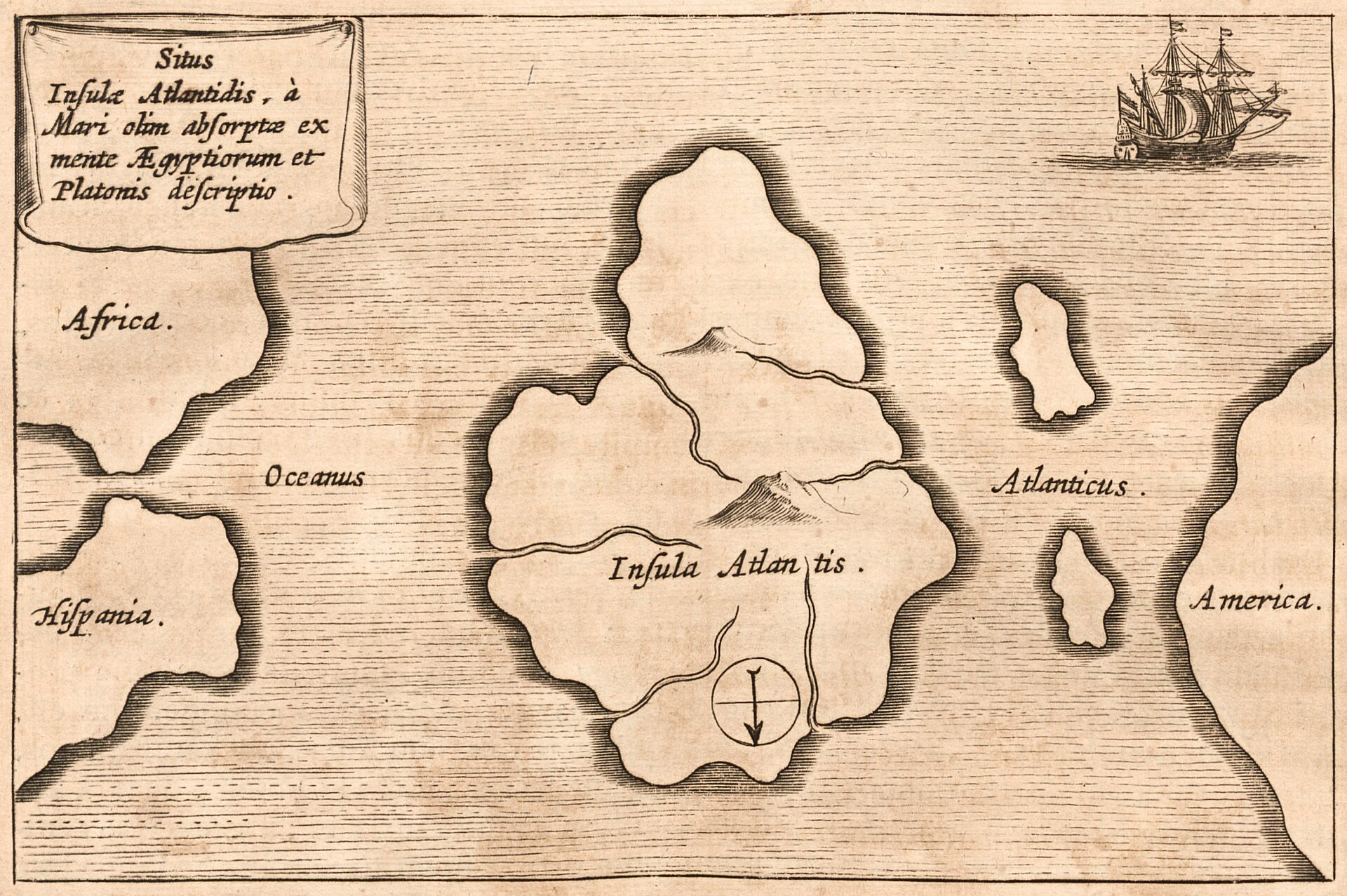
Photo: Athanasius Kircher (1678) · Public domain

Atlantis appears in exactly two ancient texts — Plato's Timaeus and its unfinished sequel the Critias, written around 360 BC. In them, the character Critias relates a story allegedly passed down from the Athenian statesman Solon, who heard it from Egyptian priests at Sais: nine thousand years earlier, a vast island power 'larger than Libya and Asia combined', lying beyond the Pillars of Heracles, attacked the Mediterranean world, was defeated by a virtuous primeval Athens, and then sank beneath the sea 'in a single dreadful day and night'. No earlier Greek, Egyptian or Near Eastern source mentions the place. From that slender textual seed has grown one of the most productive legends in history — hundreds of proposed locations, a nineteenth-century bestseller that founded 'Atlantology', and a modern industry of documentaries, YouTube channels and expeditions. This entry is the hub for the site's Atlantis coverage; the map also plots the leading candidate locations, from the Richat Structure to Doñana, Doggerland, Bimini, the Azores and Sundaland.

See it on the globe →
The mainstream view

What archaeology says

The overwhelming consensus among classicists is that Plato invented Atlantis as a philosophical device. Christopher Gill of the University of Exeter, whose commentary on the Atlantis texts remains standard, has argued the story is best understood as the earliest self-conscious fiction in Western literature — a deliberately 'plausible false narrative' built to illustrate ideas from the Republic. Julia Annas and other historians of Greek philosophy read it as a political parable: idealised early Athens embodies the well-ordered state, while wealthy, imperial, morally decaying Atlantis is a mirror held up to maritime powers of Plato's own day — most obviously Athens itself, whose Sicilian expedition had ended in catastrophe within living memory. The tell-tale signs of construction are noted often: the suspiciously Greek details of the supposedly Egyptian record, the numerology (multiples of the sacred numbers five and six), the fact that the Critias breaks off unfinished, and the silence of every independent ancient source. Even in antiquity the story was doubted; a tradition preserved by Strabo has Aristotle quipping that its inventor made Atlantis vanish just as Homer conveniently buried the Achaean wall.

That said, many scholars allow that Plato wove real materials into his fiction. The Bronze Age eruption of Thera (c. 1600 BC) and the sophisticated Minoan civilisation it damaged offer a striking template of an island culture humbled by sudden catastrophe — a link popularised by archaeologists such as Spyridon Marinatos after the Akrotiri excavations. Closer to Plato's lifetime, the Greek city of Helike sank into the Gulf of Corinth in a single night in 373 BC, while the dialogues were being written, and its rediscovery in 2001 showed such an event was entirely real. The silver-rich kingdom of Tartessos in southern Iberia, which faded from Greek knowledge around 500 BC, may have contributed the 'rich realm beyond the Pillars' motif. On this reading Atlantis is fiction assembled from genuine fragments — a moral fable wearing borrowed historical clothes.

Key evidence cited
  • Atlantis appears in no source earlier than or independent of Plato — no Egyptian, Near Eastern or earlier Greek text mentions it
  • The story's structure openly mirrors Plato's Republic, with Critias framing it as the ideal state set in motion
  • Ancient readers already doubted it; a tradition via Strabo credits Aristotle with dismissing it as invention
  • Real events available to Plato — the Thera eruption, Helike's sinking in 373 BC, the fading of Tartessos — plausibly supplied the raw material
  • The Critias breaks off mid-sentence, as expected of an abandoned literary project rather than a preserved historical record
The alternative view

What the skeptics propose

Literal Atlantis-hunting is essentially a modern movement, launched by Ignatius Donnelly's 1882 bestseller Atlantis: The Antediluvian World. Donnelly, a Minnesota congressman, argued Plato's account was sober history: a real mid-Atlantic continent whose survivors seeded the civilisations of Egypt and the Americas, explaining pyramids and flood myths on both sides of the ocean. Almost every element of the modern legend — the advanced mother-culture, the diffusion of its refugees, the technological golden age — comes from Donnelly rather than Plato. Theosophy and later esoteric writers layered on psychic 'records' of Atlantean crystal technology, and by the twentieth century proposed locations numbered in the hundreds.

The contemporary case is led by Graham Hancock, who reframes Atlantis as a garbled memory of a real lost civilisation destroyed at the end of the last Ice Age. Hancock points out that Plato's date of 9600 BC falls almost exactly at the close of the Younger Dryas, a period of genuine, dramatic sea-level rise that drowned millions of square kilometres of coastal land worldwide — Doggerland beneath the North Sea, the Sunda shelf of Southeast Asia, the Persian Gulf floor. In his telling, the flooded-land memory is global and Plato preserved one refracted version of it. Individual candidate sites each have their own champions: the Richat Structure in Mauritania (Jimmy Corsetti and the film-makers behind Visiting Atlantis), the Doñana marshes of Spain (Rainer Kühne, Richard Freund), the Bimini Road in the Bahamas (following Edgar Cayce's prophecy), the Azores as mountain-tops of a drowned Atlantic land, and Sundaland (Arysio Santos, Stephen Oppenheimer's related 'Eden in the East' thesis). Critics respond that the candidates refute one another — a story that fits everywhere fits nowhere — that Plato's nine thousand years is better read through the well-documented ancient habit of inflated Egyptian chronologies, and that no candidate has produced a single artefact of the described civilisation. Each major candidate is examined in its own entry on this site.

Key evidence cited
  • Plato insists three times in the dialogues that the story is 'true' and repeatedly cites a documentary chain to Egyptian temple records
  • Plato's 9600 BC date coincides with the end of the Younger Dryas and genuine catastrophic sea-level rise (Hancock's framing)
  • Vast inhabited lands really were drowned after the Ice Age — Doggerland, Sundaland and coastal shelves worldwide
  • Details such as elephants, a mixed red-white-black stone architecture and mud shoals beyond the strait strike literalists as oddly specific for pure fiction
  • Worldwide flood and lost-land traditions are read by Donnelly's heirs as convergent memories of one real cataclysm

Genuinely open questions

  1. Did Plato work from any genuine older tradition — Egyptian, Athenian or otherwise — or is every element his own invention?
  2. Why did Plato abandon the Critias mid-sentence, leaving the trilogy and the story unfinished?
  3. Which real places and events, if any, contributed to the composite — Thera, Helike, Tartessos, or something now lost?

Worth knowing

The Critias breaks off literally in mid-sentence — just as Zeus, about to punish the corrupted Atlanteans, opens his mouth to speak. The most famous lost civilisation in the world ends on an unfinished line.