What archaeology says
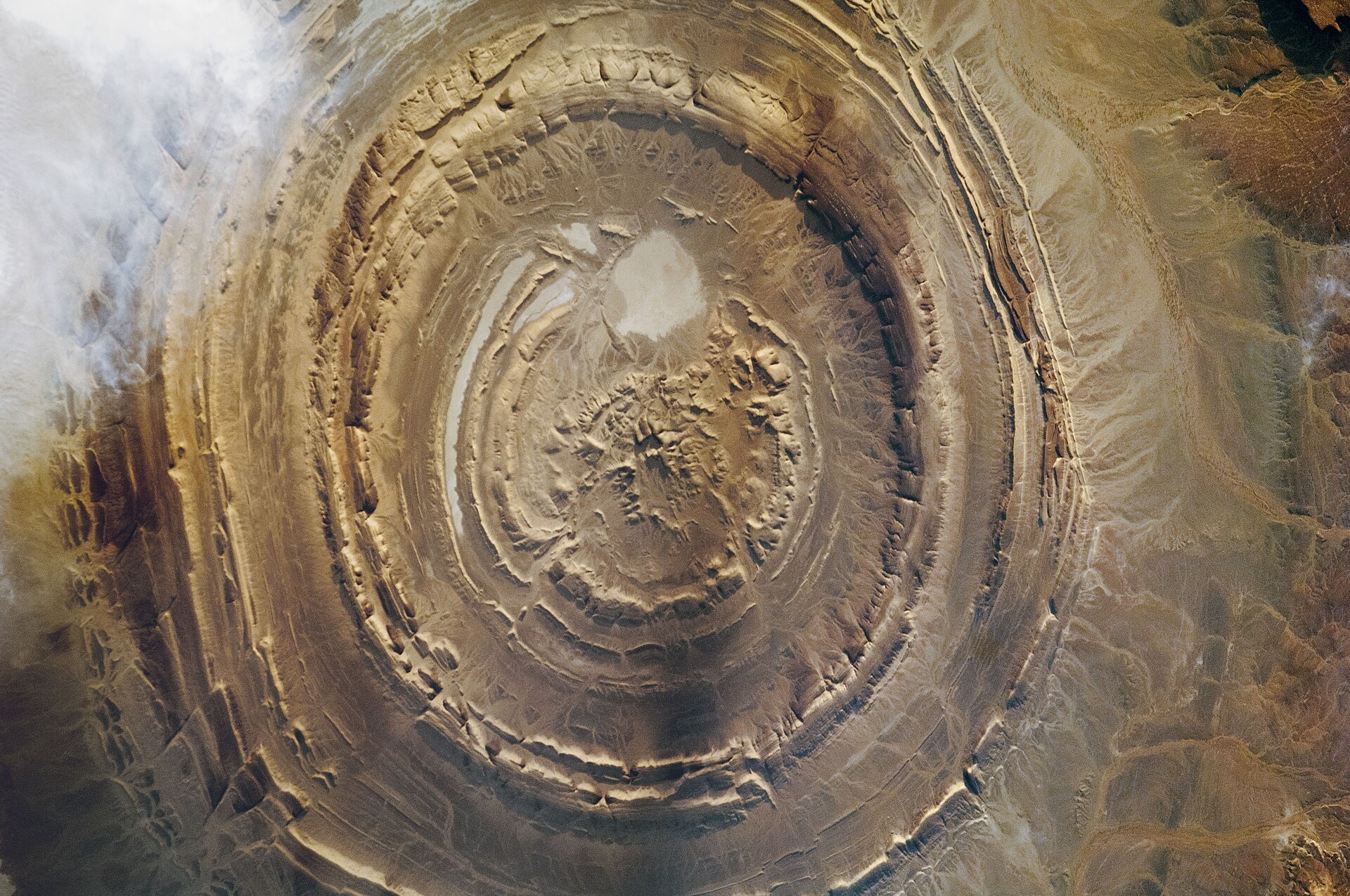
Geologically, the Richat Structure is among the better-studied features of the Sahara. Work by Guillaume Matton and Michel Jébrak, among others, identified it as a Cretaceous alkaline igneous complex roughly 100 million years old: magma welling up beneath the crust domed the overlying sedimentary layers, hydrothermal fluids altered and collapsed the centre, and tens of millions of years of erosion then planed the dome flat, exposing alternating hard and soft strata as concentric ridges and valleys — a natural bullseye. The rings are simply the stumps of different rock layers; there is no impact shock evidence and no buried architecture. Crucially for the Atlantis question, the structure sits more than 400 metres above sea level and roughly 500 kilometres from the Atlantic coast, in a region of crust that has been tectonically stable for on the order of 100 million years. There is no geological mechanism by which it could have been submerged by the sea and re-exposed within human history, and no marine sediments of Holocene age drape it.
Archaeologically, the area is genuinely rich — but in the wrong way for a lost city. Surveys have documented exceptional surface accumulations of Acheulean and even pre-Acheulean stone tools along the wadis of the outer ring, where quartzite outcrops supplied raw material for hundreds of thousands of years of Palaeolithic tool-making. Yet despite this intense ancient human presence and superb desert preservation, not one wall, foundation, sherd scatter, harbour work or burial of an urban civilisation has ever been recorded there. Archaeologists note that a Bronze Age-style capital of the size Plato describes could not vanish from a landscape that faithfully preserved hand-axes a hundred times older.
- Identified as a c. 100-million-year-old Cretaceous alkaline igneous dome (Matton and Jébrak), not an impact or artificial feature
- Sits over 400 metres above sea level and about 500 kilometres inland — irreconcilable with Plato's harbour city drowned by the sea
- The region's crust has been tectonically stable for roughly 100 million years, with no mechanism for recent submergence and re-emergence
- Dense, well-preserved Acheulean and pre-Acheulean stone-tool sites ring the structure, yet zero urban archaeology has ever been found
- The concentric rings are explained by differential erosion of alternating hard and soft rock strata around an eroded dome