Catastrophe & Climate · Cascade Range, southern Oregon, United States

Crater Lake and Mount Mazama

A mountain that blew its own summit off, remembered in a story told unbroken for over seven millennia.

Mainstream: c. 5700 BC (about 7700 years ago)Alternative: c. 5700 BC, held in Klamath oral tradition ever since42.94°, -122.11°

At a glance

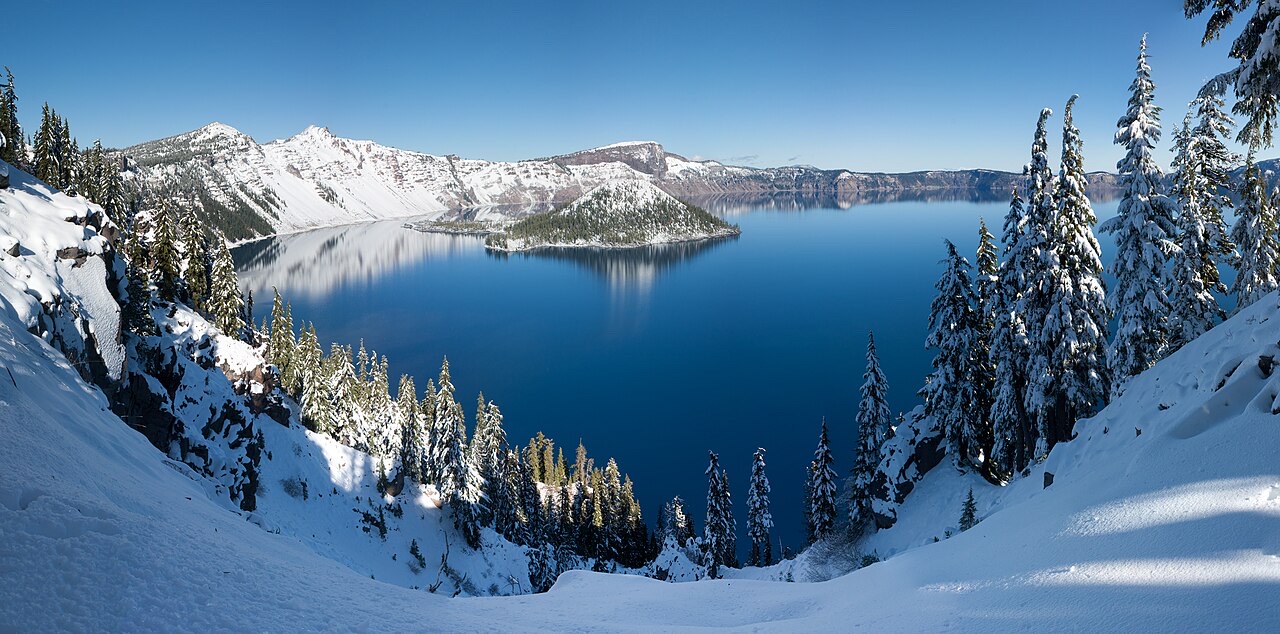
Crater Lake and Mount Mazama
Photo: WolfmanSF · CC BY-SA 3.0

Crater Lake fills the collapsed caldera of Mount Mazama, a Cascade volcano that erupted catastrophically and then fell in on itself. The deep blue lake that replaced the summit is beautiful, but the site's real marvel is that the Klamath people appear to have preserved an accurate account of the eruption in oral tradition for over 7,000 years, making it one of the best cases anywhere for extremely long-lived cultural memory of a natural catastrophe.

See it on the globe →
The mainstream view

What archaeology says

Mount Mazama's climactic eruption is one of the largest known in North America over the last ten thousand years. Around 7,700 years ago it discharged enormous volumes of pumice and ash, spreading a marker layer (Mazama ash) across much of the northwest, then collapsed to form a caldera roughly eight kilometres across. Rain and snow gradually filled it to create Crater Lake, the deepest lake in the United States.

The eruption is tightly dated by radiocarbon and by the ash layer's wide distribution, and recent volcanological work has reconstructed a complex sequence of precursory activity before the final collapse.

Crucially, people were present. Artefacts such as obsidian tools and sandals have been found sealed beneath Mazama ash. Klamath oral traditions describe a battle between the spirits of the sky and the underworld ending in the mountain's destruction and the filling of the basin, details, from red-hot rocks to the mountain's fall, that map onto the geological event. Scholars including Douglas Deur have examined how this tradition preserves a genuine eyewitness memory across some 7,600 years.

Key evidence cited
  • A caldera about eight kilometres wide, formed by summit collapse after the eruption emptied the magma chamber.
  • The widespread Mazama ash layer serves as a dated stratigraphic marker across the Pacific Northwest.
  • Radiocarbon and tephra studies place the climactic eruption near 7700 years ago (about 5700 BC).
  • Human artefacts, including sandals and tools, have been recovered buried beneath the ash.
  • Klamath oral tradition describes a sky-versus-underworld battle ending in the mountain's fall and the lake's forming.
  • Scholarly analyses (e.g. Douglas Deur) argue the tradition preserves a genuine eyewitness memory of the event.
The alternative view

What the skeptics propose

Here the alternative and mainstream views agree, and the alternative reading is actually vindicated. Long before geologists dated the eruption, sceptics doubted that any oral tradition could faithfully carry a memory for thousands of years. Crater Lake is the counter-example many now cite: the Klamath account of a mountain destroyed by fire from below and replaced by a deep lake matches the geology well enough that dismissing it as coincidence is hard.

This matters for the wider debate on this site. If the Klamath could preserve a catastrophe for 7,600 years, then in principle other cultures might carry accurate memories of ancient disasters, floods, darkened skies, falling fire, that mainstream scholars often treat as pure myth. Alternative writers, including Graham Hancock, use Crater Lake precisely this way: as proof of concept for deep oral memory of real events.

The honest limit is that Crater Lake works because the geology is unambiguous and local. It licenses taking oral traditions seriously; it does not prove that every flood legend records a literal event, and most such traditions cannot be cross-checked against a dated eruption.

Key evidence cited
  • The Klamath narrative matches the geology in specifics: violent fire from the mountain, its collapse, and the water-filled basin left behind.
  • The tradition is independently corroborated by a precisely dated eruption, unlike most myths.
  • It demonstrates oral memory can survive some 7,600 years, far longer than sceptics once allowed.
  • Artefacts sealed under the ash prove people witnessed the event first-hand.
  • It supports the general principle that catastrophe myths can encode real geological events.
  • It is cited as a model for taking indigenous and ancient testimony seriously as data.

Genuinely open questions

  1. How much detail in the Klamath tradition is original eyewitness memory versus later elaboration?
  2. How exceptional is Crater Lake, or do other long-lived oral memories of catastrophe await confirmation?
  3. How faithfully can any spoken tradition transmit specifics across hundreds of generations?
  4. Where is the line between a memory validated by geology and a myth merely reinterpreted after the fact?

Worth knowing

Sagebrush sandals found near the Oregon caldera were sealed beneath Mazama pumice, footwear literally buried by the eruption the Klamath still describe.