Ancient Engineering · Shravanabelagola, Karnataka, India

Bahubali Colossus, Shravanabelagola

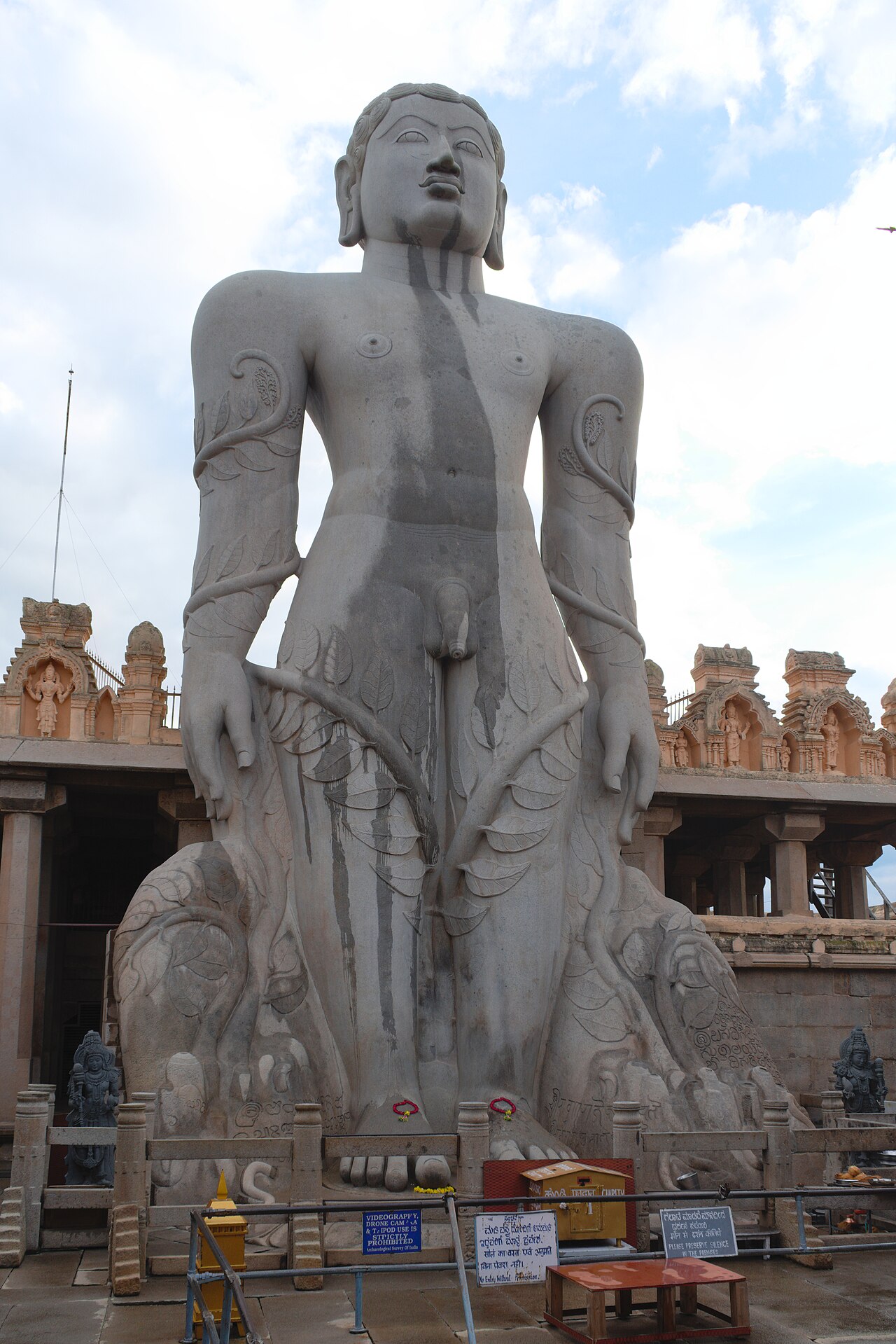
A 17-metre naked ascetic carved from a single granite tor on a bare hilltop — flawless after a thousand monsoons, with no record of who carved it or how.

Mainstream: Consecrated c. AD 981 (Western Ganga dynasty; some scholars prefer 983)Alternative: Undated by proponents — the arrow legend is read as a pre-existing image merely revealed in 981, and ancient-technology writers argue the finish exceeds 10th-century iron tools12.85°, 76.49°

At a glance

Bahubali Colossus, Shravanabelagola
Photo: Rohit14400 · CC BY-SA 4.0

On the summit of Vindhyagiri, a whale-back of bare granite rising some 140 metres above the small town of Shravanabelagola, stands one of the largest free-standing monolithic statues in the world: the 57-foot (17.4-metre) figure of Bahubali, known in Kannada as Gommateshwara. Carved in the round from a single upstanding tor of fine-grained granite, it depicts the Jain prince who, in the moment of winning a duel against his brother Bharata for their father's empire, renounced everything and stood motionless in kayotsarga meditation for a year — so long that madhavi creepers climbed his arms and anthills rose at his feet, all faithfully rendered in the stone. Pilgrims reach it by more than 600 steps cut into the naked rock, and on a clear day the statue is visible from up to 25 kilometres across the Deccan plain. Together with the older sacred hill of Chandragiri facing it, Shravanabelagola has been a centre of Digambara Jainism for well over two thousand years.

See it on the globe →
The mainstream view

What archaeology says

The colossus is one of the best-documented monuments in early medieval India, because it is dated by inscriptions carved on its own base. A three-line dedication in Kannada, Tamil and Marathi records that the image was made by Chavundaraya — minister and general to King Rachamalla IV of the Western Ganga dynasty — with tradition fixing the consecration on 13 March 981, a date most historians accept within a year or two. Later Jain texts add that Chavundaraya commissioned it to fulfil a vow made by his mother Kalala Devi. The site's extraordinary epigraphic record — more than 600 inscriptions across the two hills, spanning the 7th to 19th centuries — was documented by B. Lewis Rice in his Epigraphia Carnatica (1889), and it anchors not just the statue but the whole history of the site.

Art historians place the figure squarely within Western Ganga sculpture, and the feat itself within a southern Indian stone-working tradition with deep roots: the Mauryan chambers at Barabar had achieved mirror polish on hard granite twelve centuries earlier, and Pallava sculptors at Mamallapuram had long carved monoliths in situ. The sculptors worked an existing granite tor at the summit — which is why the statue could never have been 'transported' — trimming the mass down to the figure and finishing it with abrasives. That the tradition remained alive is shown by the explicit later copies it inspired: the 13-metre Bahubali at Karkala (1432) and the 11-metre image at Venur (1604), both raised by named patrons in imitation of Shravanabelagola.

The hill facing the statue carries an older sanctity still. Digambara tradition, supported by early inscriptions on Chandragiri, holds that the Mauryan emperor Chandragupta — Alexander's contemporary and founder of India's first great empire — abdicated around 300 BC, migrated south with the monk Bhadrabahu, and ended his life there in ritual fasting. Historians debate the tradition's reliability, but it is old, and it explains why Chavundaraya chose this hill of all hills. The living ritual record is equally continuous: roughly every twelve years the statue is anointed head-to-foot in the Mahamastakabhisheka festival — milk, sugarcane juice, saffron, turmeric and sandalwood poured from scaffolding — most recently in February 2018, when millions attended.

Key evidence cited
  • Dedicatory inscriptions in Kannada, Tamil and Marathi on the statue's own base naming Chavundaraya, minister of Ganga king Rachamalla
  • More than 600 dated inscriptions across Shravanabelagola's two hills, documented in B. Lewis Rice's Epigraphia Carnatica
  • The figure's clear stylistic place in 10th-century Western Ganga sculpture, with explicit later copies at Karkala (1432) and Venur (1604)
  • A mature Indian tradition of in-situ monolith carving and granite mirror polish reaching back to the Mauryan Barabar caves
  • A continuous ritual record — the Mahamastakabhisheka anointing held roughly every twelve years since the medieval period
The alternative view

What the skeptics propose

The alternative case begins with the consecration legend itself. In the story preserved by the Jain tradition, a goddess instructed Chavundaraya to climb the smaller hill of Chandragiri and loose a golden arrow towards Vindhyagiri — and before its sound died away, the image of Bahubali rose and appeared before his eyes. Legend-literalists read this as a memory that the image already existed, ancient beyond reckoning, and that Chavundaraya uncovered and consecrated rather than created it. They note that Digambara cosmology places Bahubali himself in a remote cosmic age, that no sculptor is named anywhere on the monument, and that older Bahubali images in the region show the cult was already ancient in 981.

A second camp argues from the stone. Ancient-technology researchers such as YouTuber Praveen Mohan — whose videos on southern Indian sites reach tens of millions of viewers — point to the statue's near-perfect bilateral symmetry, the mirror-smooth curvature of the shoulders and skull, and the crispness of details like the individually modelled creeper leaves, and ask how this was achieved on unforgiving granite, vertically, in situ, on an exposed summit where a single slip would have ruined the whole figure. They ask where the hundreds of tonnes of removed granite went, how scaffolding was anchored on bare rock, and why a project of this magnitude left no contemporary account of its methods, workforce or duration — silences they fill with lost tools and lost knowledge.

Mainstream researchers answer that the dedication inscriptions sit on the statue's own base in three dated languages; that the figure's style is unmistakably 10th-century Ganga work, not timeless; that Barabar's mirror polish shows Indian granite-finishing was mature over a millennium earlier; and that the arrow story is pious hagiography recorded centuries after the event, of a kind attached to temples across India. The spoil question dissolves once the statue is understood as a reduced tor — the 'missing' granite was chipped away in fragments and tipped down the hillside over decades of work. Yet the genuine gaps remain: no text describes the carving, no name survives for the master sculptor, and the logistics of the final polish remain a matter of inference rather than record.

Key evidence cited
  • The consecration legend in which the image 'rose and appeared' at Chavundaraya's arrow-shot, read as a pre-existing statue revealed
  • Near-perfect symmetry and mirror-smooth finish on granite, argued by Praveen Mohan and others to exceed iron-chisel work
  • The absence of any contemporary account of the carving — no named sculptor, method, workforce or duration
  • The puzzle of scaffolding, spoil removal and error-free vertical carving on an exposed bare-rock summit
  • Digambara tradition placing Bahubali in a remote cosmic age, with older images showing an already-ancient cult in 981

Genuinely open questions

  1. How did the sculptors keep a 17-metre vertical figure in flawless proportion while carving in situ — grids, models, or methods never recorded?
  2. Who was the master sculptor, and why is no artist named anywhere on early medieval India's greatest single carving?
  3. Did Chandragupta Maurya really end his life on the facing hill around 300 BC, as the site's early tradition holds?
  4. How much of the original tor survives inside the figure — and has the statue's interior ever been geophysically surveyed?

Worth knowing

The three-line dedication at the statue's foot — 'Chavundaraya had this made' — is repeated in Kannada, Tamil and Marathi, and the Marathi line is among the oldest known sentences ever written in that language, today spoken by more than 80 million people.