Belief & Society · Colorado Desert near Blythe, California, USA

Blythe Intaglios

Giant human figures scraped into the desert floor beside the Colorado River — invisible from the ground, sacred to the river tribes, and unknown to science until a pilot looked down in 1932.

Mainstream: c. 900 BC – AD 1200 (varnish and AMS radiocarbon dates), by ancestral Mojave and Quechan peopleAlternative: Claimed by some to be far older, or designed for viewers in the sky — claims the tribes and archaeologists both reject33.80°, -114.53°

At a glance

Blythe Intaglios
Photo: Rsfinlayson · CC BY-SA 4.0

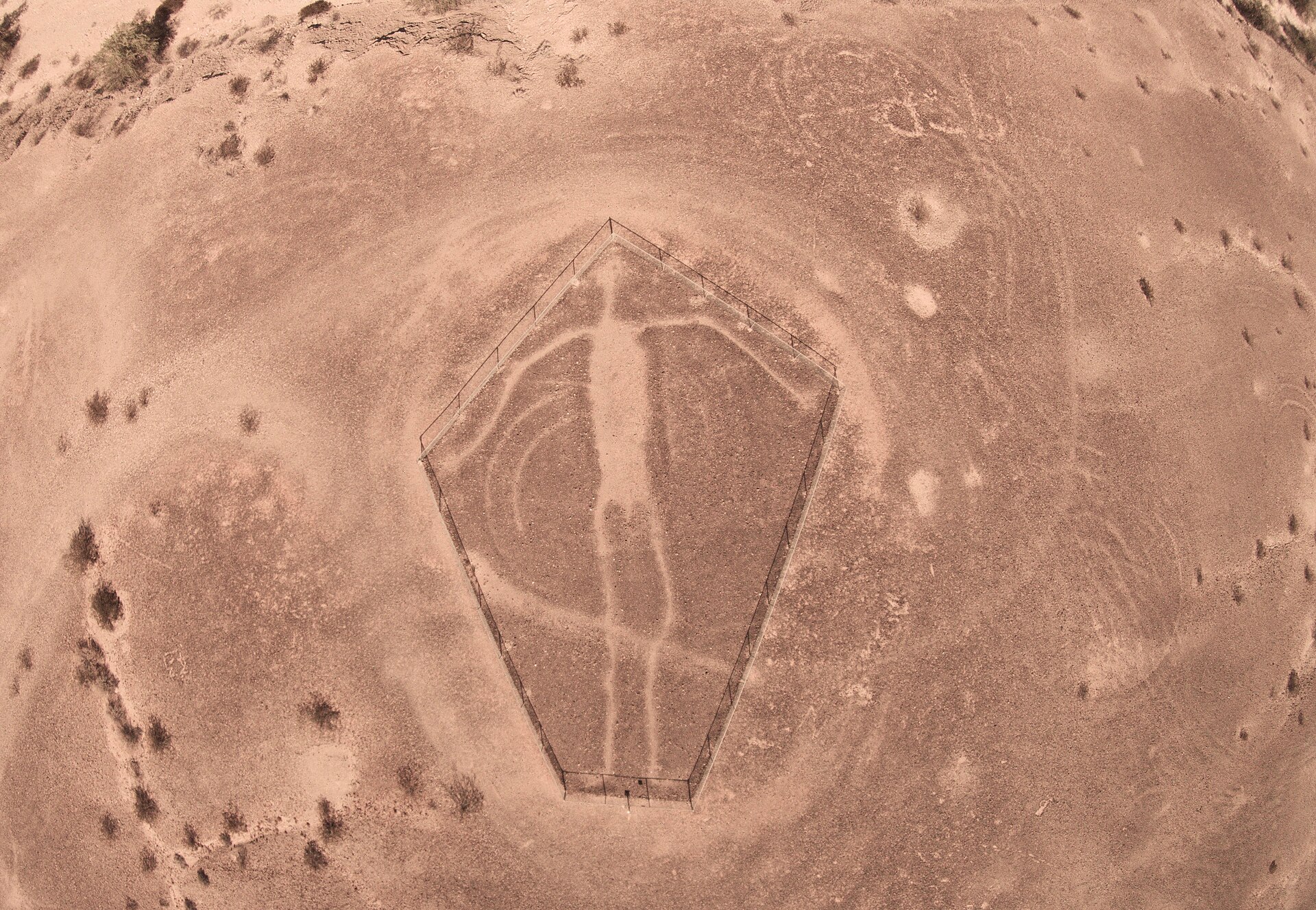
The Blythe Intaglios are a group of enormous figures created on the desert terraces above the Colorado River, about 24 kilometres north of Blythe, California. The main group comprises three human figures — the largest 52 metres from head to foot — along with two four-legged animals and a spiral, made by scraping away the dark, varnished desert pavement to expose the pale soil beneath, with the cleared gravel banked along the outlines. In the hyper-arid Colorado Desert such surfaces persist for centuries or millennia, so the figures survive essentially as drawn. They are the most famous members of a much larger phenomenon: several hundred geoglyphs are scattered along the lower Colorado River corridor, linked by ancient trail networks running toward Avikwaame, the sacred Spirit Mountain near present-day Laughlin, Nevada. Almost imperceptible at ground level, the Blythe figures went unrecorded by outsiders until 1932, when pilot George Palmer spotted them from the air while flying between Las Vegas and Blythe — a rediscovery that prompted a survey by the Natural History Museum of Los Angeles County and, after a 1952 National Geographic article, national fame. The figures were fenced in 1974 after decades of vehicle damage and are now managed by the Bureau of Land Management within a National Register historic site.

See it on the globe →
The mainstream view

What archaeology says

Archaeologists attribute the intaglios to the ancestral Yuman-speaking peoples of the lower Colorado — the Mojave (Aha Makhav) and Quechan — whose living traditions directly interpret them. In Mojave and Quechan teaching the great human figures represent Mastamho, the creator who made the river, the land and the people from Avikwaame, while the four-legged figures represent Hatakulya, one of the mountain lion-beings who assisted at creation. Ceremonies including sacred dances were held near the figures, and the tribes regard the whole geoglyph landscape as a living religious text rather than an archaeological curiosity. Ethnographic work from Malcolm Rogers in the 1930s to Bureau of Land Management archaeologist Boma Johnson in the 1980s and 1990s mapped the figures onto Yuman cosmology and the Xam Kwatcan trail system, along which people travelled for ceremony and, in dream-culture, retraced the events of creation.

Hard dating is genuinely difficult, since scraping gravel creates nothing organic to date. The key study, published in 1995 by Jay von Werlhof with Harry Casey, Ronald Dorn and Glen Jones, applied accelerator radiocarbon methods to organic matter trapped in rock varnish at the Blythe figures and related geoglyphs, yielding calibrated results spanning roughly 900 BC to AD 1200. Most specialists therefore bracket the figures between about 450 and 2,000 years old, likely made and remade over generations rather than in a single event, though everyone concedes the error bars are wide and varnish-based dating has had a contentious methodological history.

One figure, the so-called Fisherman intaglio nearby — a man spearing fish beneath a sun and serpent — is debated even within the mainstream, with some researchers suspecting it was cut in the 1930s, while others defend its antiquity. That such doubts can be tested figure-by-figure underlines the general point: the main Blythe anthropomorphs show revarnished, long-weathered surfaces consistent with genuine age.

Key evidence cited
  • Mojave and Quechan oral traditions identifying the figures as Mastamho and Hatakulya of the creation cycle
  • 1995 varnish and AMS radiocarbon dates (von Werlhof, Casey, Dorn, Jones) spanning c. 900 BC – AD 1200
  • The figures' placement on the Xam Kwatcan trail network converging on the sacred mountain Avikwaame
  • Hundreds of comparable geoglyphs along the lower Colorado, showing a coherent regional tradition
  • Ethnographic documentation from Malcolm Rogers (1930s) to Boma Johnson linking figures to Yuman ceremony
The alternative view

What the skeptics propose

The Blythe Intaglios attract the same family of arguments as Peru's Nazca Lines, and for the same reason: the figures read clearly only from altitude. Ancient-astronaut writers in the tradition of Erich von Däniken have long cited them as images meant for viewers in the sky, asking why a ground-dwelling people would labour over pictures they could never properly see. The steelman version of the puzzle is fair — the figures genuinely are near-invisible at ground level, and their rediscovery required an aeroplane. The standard rebuttal, endorsed by the tribes themselves, is that the intended audience was above but not extraterrestrial: the figures were made to be seen by Mastamho and the spirit world, and their power lay in the making and the ceremony, not in optical viewing. Ethnography records exactly this logic across many cultures, and simple ground-based methods — pacing out enlarged sketches with cords and stakes — reproduce such figures without difficulty.

A second strand points to the figures' scale as evidence of a tradition remembering giants, connecting the 52-metre man to widespread 'giants in the Americas' lore and to sensationalised newspaper archaeology of the 19th and early 20th centuries. Mainstream archaeology finds no skeletal or material support for any such population, and notes that monumental scale is a normal property of sacred art. A third, subtler challenge is chronological: because rock-varnish dating (particularly Ronald Dorn's cation-ratio and varnish radiocarbon methods) was fiercely disputed in the 1990s, some writers argue the figures could be far older than the accepted window — potentially many thousands of years — a possibility that cannot be strictly excluded but that finds no positive support in the region's archaeology.

It is worth stating the tribal position plainly, because it cuts across both camps: for the Mojave and Quechan the question 'who made them and why' is not open. The figures are part of their creation account, their trails and their continuing ceremonial life, and tribal members have been prominent in protecting the sites from vehicles, vandalism and — as they see it — appropriation by alien-visitation narratives that write their ancestors out of their own monuments.

Key evidence cited
  • The figures are effectively invisible from the ground and were only rediscovered from an aeroplane
  • Ancient-astronaut writers cite them, like Nazca, as art addressed to viewers in the sky
  • The 52-metre human figure is invoked in 'giants in ancient America' literature
  • Disputes over rock-varnish dating methods leave the true age window arguably much wider
  • The Fisherman intaglio controversy shows individual figures' antiquity can genuinely be questioned

Genuinely open questions

  1. How old are the figures really, given the wide and methodologically contested dating window?
  2. Were the Blythe figures made in one episode or maintained and re-scraped over many generations?
  3. How many geoglyphs along the lower Colorado have already been lost to vehicles and development?

Worth knowing

The intaglios sat unnoticed by the outside world until 1932, when pilot George Palmer happened to glance down on a flight from Las Vegas — yet Mojave and Quechan people had never lost them at all, and their elders could explain to the arriving archaeologists exactly what the figures meant.