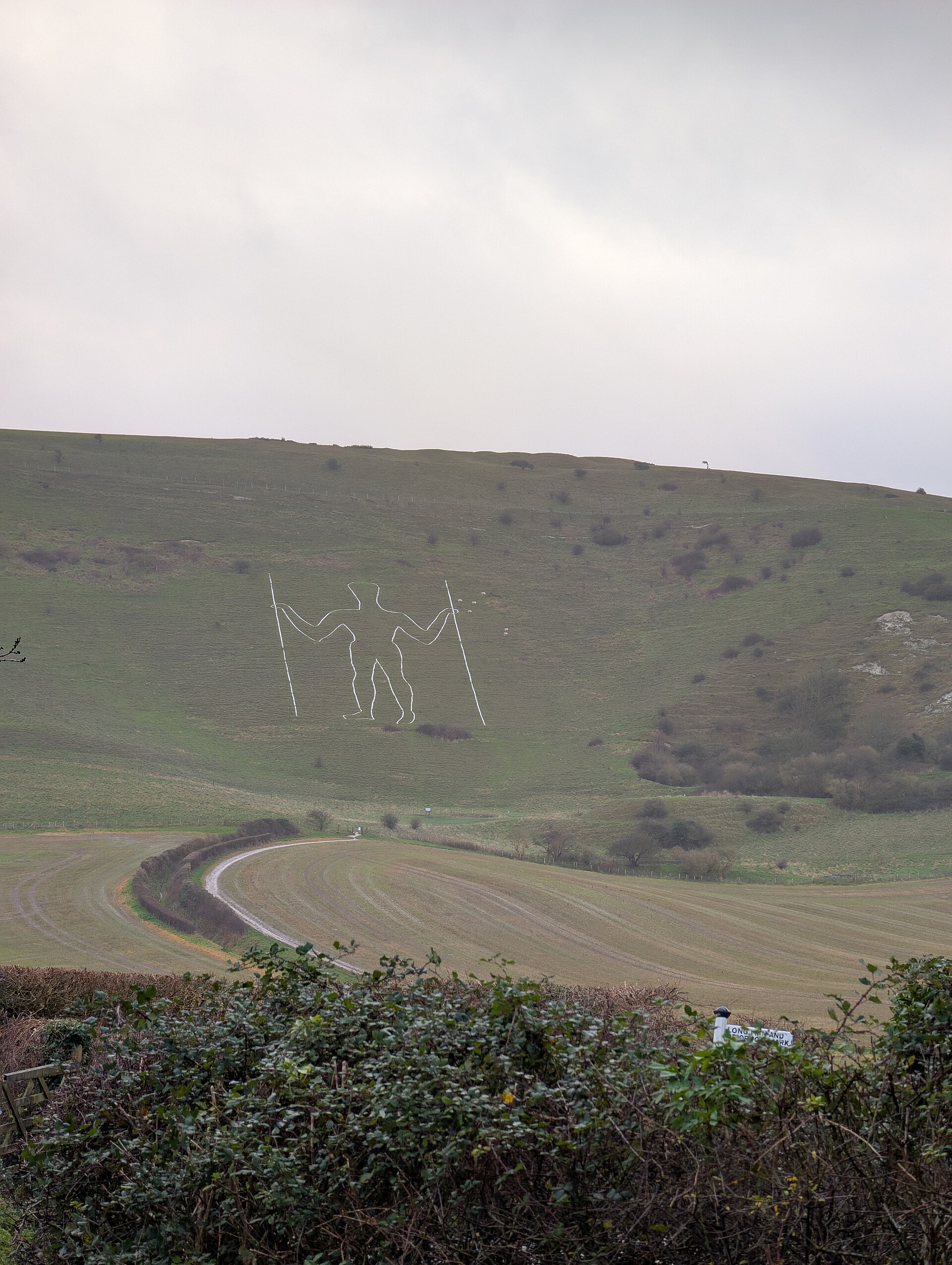
What archaeology says
The current scientific position rests on fieldwork carried out in 2003 by Martin Bell of the University of Reading, working with Aubrey Manning's Open University series Landscape Mysteries. Bell's team cut trenches around the figure and used optically stimulated luminescence to date slope deposits, finding that the hillside had been stable for millennia and then experienced a burst of disturbance centred on roughly AD 1545. The most economical reading is that the Long Man was first cut in the 16th or early 17th century — an Early Modern creation, perhaps connected with the nearby priory estate's later owners, a folly, or an image whose meaning was quickly forgotten. The documentary record is consistent with this: despite Wilmington Priory sitting directly below the hill, no medieval source mentions the figure, and nothing certain appears before Rowley's 1710 drawing.
Mainstream scholars nonetheless treat the case as genuinely open in a way the Cerne Abbas question no longer is. The 2003 dating is indirect — it dates soil movement on the slope, not the figure's fabric itself — and the excavators acknowledged that an older figure, maintained without major slope disturbance and perhaps re-cut in the Tudor period, cannot be absolutely ruled out. Rowley's drawing hints that the original design differed from today's tidied Victorian outline: the staves may once have carried a rake and a scythe, as an 18th-century drawing by William Burrell shows, and the modern feet were repositioned by the 1874 restorers.
If the figure is early modern, the leading question becomes why anyone in post-Reformation Sussex cut a giant on a hillside. Suggestions range from an estate boundary marker or surveyor's exercise to a satirical or commemorative image, but no candidate has documentary support — a rare case where the mainstream date makes the figure harder to explain, not easier.
- Martin Bell's 2003 OSL results showing slope disturbance beginning around AD 1545 after long stability
- Complete absence of the figure from medieval records, including those of Wilmington Priory below
- The earliest depiction being John Rowley's 1710 drawing, with nothing certain before it
- 18th-century drawings showing altered details (rake, scythe, face), proving the outline has been fluid
- Documented Victorian (1874) and 1969 restorations that fixed and shifted the modern outline