What archaeology says
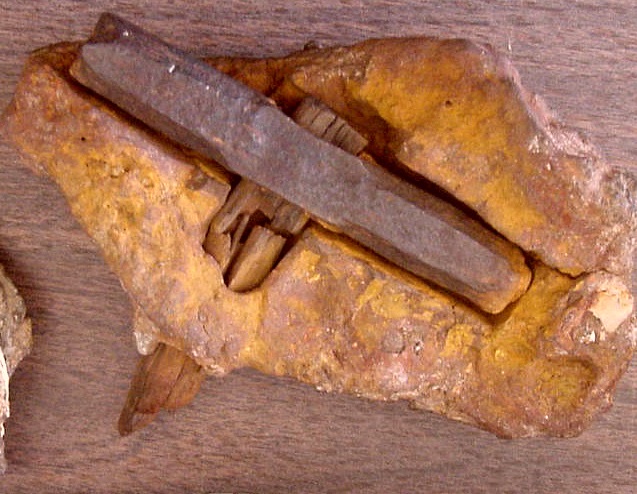
Geologists see no mystery. The hammer was found loose on a ledge, not embedded in bedrock; no geologist documented it in situ, and its stratigraphic connection to the local Lower Cretaceous Hensell Sand is pure assumption. The rock around the tool is a travertine-like concretion, and dissolved calcium carbonate from ancient limestone can cement gravel, shells and stray objects around a nucleus within years to decades — modern examples abound of concretions enclosing Second World War shrapnel, bottles and even a spark plug (the 'Coso artefact'). An old iron tool dropped by a nineteenth-century miner or farmer is exactly the sort of nucleus such deposits form around.
The hammer itself is diagnostic. Glen Kuban, the researcher best known for debunking the nearby Paluxy 'man tracks', published a detailed analysis in 1997 showing the tool matches a common nineteenth-century pattern consistent with mining, smithing or general utility hammers used in the region, where mining activity is documented from the 1800s.
Mainstream commentators also note that Baugh has declined to permit independent dating or destructive testing under neutral conditions, and that the claim has never been submitted to a peer-reviewed geological journal — the argument lives entirely in creationist media.
- The nodule was found loose, not embedded in any bedrock exposure, so it has no documented stratigraphic context
- Travertine concretions form around objects in years to decades; modern examples enclose twentieth-century artefacts
- Glen Kuban's 1997 analysis matches the tool to common nineteenth-century American hammer patterns
- Mining and settlement in the London, Texas area are documented from the 1800s, supplying an obvious source for a lost tool
- The famous Battelle metallurgical analysis has never been published or confirmed by Battelle
- The owner has not permitted independent radiocarbon dating of the wooden handle, the single test that could decide the question