What archaeology says
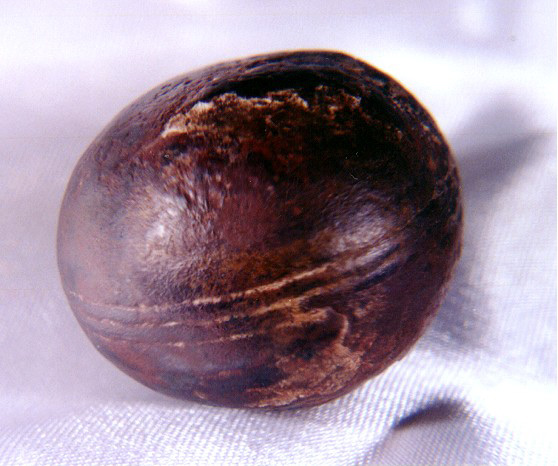
Geological studies, notably those publicised by researcher Paul V. Heinrich and South African geologists including Bruce Cairncross of the University of Johannesburg, identify the objects as concretions formed within volcanic ash and sediment roughly three billion years ago. They consist of pyrite or of hematite and wollastonite derived from original pyrite and gypsum during metamorphism — not of any machined metal; none is a true perfect sphere, and many are flattened, fused into groups, or irregular, exactly as concretions are.
The 'machined' grooves are the giveaway feature in reverse: they correspond to fine laminations in the surrounding sediment. A concretion growing outward through subtly layered ash builds ridges and furrows where layers of different composition intersect its surface — the same phenomenon seen in the famous Moqui marbles of Utah and in concretions worldwide. Latitudinal ridges therefore mark bedding planes, not lathework.
Claims that the spheres are harder than steel, perfectly balanced, or that NASA found they rotate by themselves in vacuum, trace to garbled retellings of remarks attributed to former Klerksdorp Museum curator Roelf Marx, who himself stated he was misquoted and considered the objects natural. Tested specimens have ordinary mineral hardness, and no laboratory rotation study exists.
- Petrographic analysis identifies the objects as pyrite and hematite-wollastonite concretions and nodules, not metal
- The equatorial grooves align with fine laminations in the host pyrophyllite, marking bedding planes the concretions grew across
- Specimens range from spherical to flattened, fused and irregular — a natural population, not manufactured uniformity
- Comparable grooved concretions occur worldwide, including Utah's Moqui marbles and Schoharie County, New York carbonate concretions
- Roelf Marx stated he was misquoted about rotating spheres and regarded the objects as natural limonite concretions
- Hardness and balance claims fail on testing; no laboratory has ever documented self-rotation or steel-exceeding hardness