What archaeology says
Everyone agrees the glass is impact-related in the broad sense; the argument is about the mechanism. The strongest recent evidence for a true crater-forming impact came in 2019, when Aaron Cavosie of Curtin University and Christian Koeberl of the University of Vienna published a study in Geology of zircon grains inside the glass. They found orientation relationships diagnostic of former reidite — a high-pressure polymorph of zircon that forms only under the shock pressures of a hypervelocity ground impact, not in the radiative heating of an airburst. On this reading, somewhere beneath the Great Sand Sea or long since eroded away lies (or lay) a genuine crater. Koeberl and colleagues have also reported shocked quartz in bedrock from the region, consistent with a deeply eroded impact structure, and candidate features such as the disputed Kebira structure identified by Farouk El-Baz in 2006 have been proposed, though none has been confirmed.
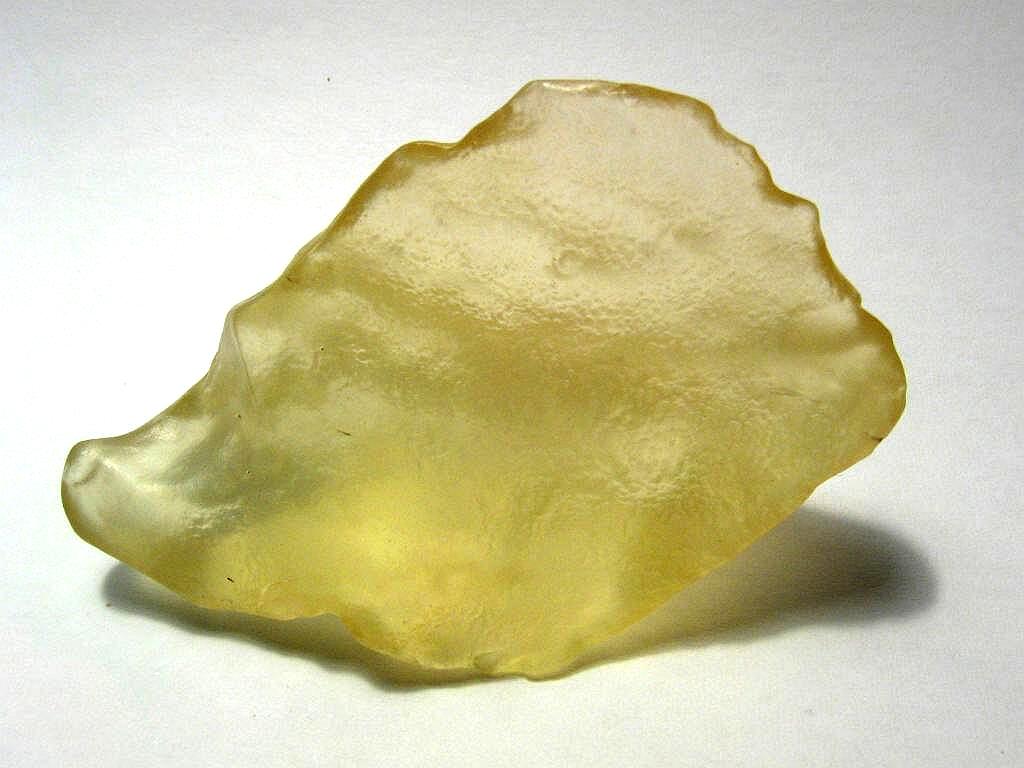
The human story is better settled. The glass field lay on the margins of habitable country during wetter phases of the Pleistocene and early Holocene, and thousands of knapped glass tools attest that prehistoric people prized it as a superb cutting material. By the New Kingdom the glass had travelled some 800 kilometres east: in 1998 the Italian mineralogist Vincenzo de Michele examined the yellow-green scarab in a pectoral from Tutankhamun's tomb and identified it as Libyan Desert Glass, not chalcedony as long catalogued. How the material reached the Nile — direct expedition, oasis trade networks, or chance nomad finds — remains unknown, but its use in royal regalia implies it was recognised as rare and potent, plausibly linked to the sun through its colour.
For mainstream Egyptology there is no mystery requiring lost civilisations: the glass is a natural impact product, collected and traded by people who valued beautiful, exotic stone.
- Zircon grains in the glass preserving evidence of former reidite, a mineral requiring ground-impact shock (Cavosie & Koeberl 2019)
- Argon and fission-track dating placing glass formation at c. 29 million years ago
- Near-pure silica composition with lechatelierite and vapour-phase phases demanding temperatures far above volcanic melting
- Shocked quartz reported in regional bedrock, consistent with a deeply eroded impact structure
- De Michele's 1998 identification of Tutankhamun's pectoral scarab as Libyan Desert Glass, proving pharaonic-era sourcing