Catastrophe & Climate · Chaco Province, Argentina

Campo del Cielo

A rain of iron 4,000 years ago, a 'Field of the Sky' named by its witnesses' descendants — and the heaviest meteorite haul on Earth.

Mainstream: c. 2200–2700 BC (fall of the meteorite, radiocarbon-dated charcoal from the craters)Alternative: The same event, remembered: Moqoit oral tradition arguably preserves the fall across four millennia-27.63°, -61.70°

At a glance

Campo del Cielo
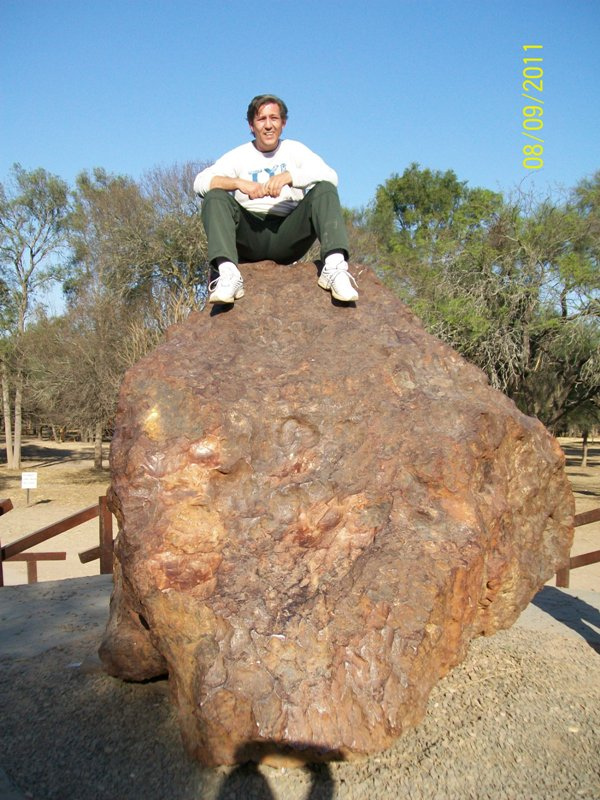
Photo: Scheihing Edgardo · CC BY 2.0

Scattered along a 3 by 18.5 kilometre corridor of the Gran Chaco plain in northern Argentina lie at least 26 craters and over 100 tonnes of iron meteorite — the greatest recovered mass of any fall on Earth. Around four thousand years ago an iron body of the IAB group broke apart on a shallow trajectory, ploughing a chain of explosion craters and penetration funnels into the soft sediment. The two giants of the field, the 28.8-tonne El Chaco and the 30.8-tonne Gancedo (raised in 2016), rank among the heaviest single meteorite masses ever weighed. The region's name is a direct translation of the indigenous term for the site — Piguem Nonralta, the Field of the Sky — and for the Moqoit people whose ancestors likely saw the fall, the irons remain sacred beings, not specimens.

See it on the globe →
The mainstream view

What archaeology says

Scientifically, Campo del Cielo is among the best-studied crater fields in the world, thanks largely to the American planetary scientist William Cassidy, whose expeditions from the 1960s mapped the strewn field, excavated buried masses and worked out the physics of the fall: a single iron meteoroid, perhaps 4 metres across, entering at a very shallow angle from the south-west and fragmenting progressively, so that the largest pieces travelled furthest along the ellipse. Radiocarbon dates on charred wood from within the craters cluster around 3,950 ± 90 and 5,800 ± 200 years before present, bracketing the fall at roughly four to five thousand years ago — unambiguously within the span of human occupation of the Chaco.

The documented history is equally rich. Spanish colonial authorities heard indigenous reports of a great iron in the bush, and in 1576 an expedition under Captain Hernan Mexia de Miraval reached a huge mass that became known as the Meson de Fierro, the 'great table of iron'. Rediscovered in 1774 and blasted at by Rubin de Celis's 1783 expedition — who concluded, wrongly, that it was not worth exploiting — the Meson de Fierro was then lost, and its location remains one of meteoritics' enduring mysteries, though a 2019 study identified a probable fragment of it in Vienna's Natural History Museum. Another mass, Otumpa, was hauled out in 1803; a piece reached the British Museum, where it helped convince early nineteenth-century scientists that iron really did fall from the sky.

For mainstream researchers the Moqoit connection is a striking case of scientific and ethnographic dating converging: the radiocarbon ages are consistent with the fall having been witnessed by ancestors of the region's indigenous peoples, whose place-name preserved the event's celestial origin centuries before European science accepted that meteorites existed.

Key evidence cited
  • Radiocarbon dates of c. 3,950 and 5,800 years BP on charred wood from inside the craters
  • At least 26 mapped craters and penetration funnels aligned along a single shallow-entry trajectory (Cassidy's fieldwork)
  • Over 100 tonnes of chemically matching IAB iron recovered, including El Chaco (28.8 t) and Gancedo (30.8 t)
  • Colonial records from 1576 onward documenting indigenous knowledge of the irons before European contact
  • 2019 identification of a probable Meson de Fierro fragment in Vienna, confirming the historical accounts
The alternative view

What the skeptics propose

The contested territory at Campo del Cielo is not the date but the meaning of memory — and who owns it. Ethnoastronomers, above all Alejandro Martin Lopez of the University of Buenos Aires working with Moqoit communities, have documented a living body of tradition in which the irons are pieces of the sky's own body that fell to earth in a time of fire, associated with the sun, with celestial beings and with places of power. On the strongest reading, this is a genuine oral memory of the c. 2000 BC fall transmitted across roughly 150 generations — which would make it one of the longest-lived eyewitness traditions ever proposed, alongside Australian Aboriginal accounts of sea-level rise and volcanic eruptions.

Sceptics of that reading, including cautious voices within cultural astronomy itself, point out an alternative pathway: the Chaco peoples lived among tonnes of anomalous iron for millennia, and stories explaining strange, unrustable, sky-coloured masses could have arisen long after the fall, inspired by the objects rather than the event. Distinguishing preserved memory from later aetiology is genuinely difficult, and Lopez himself frames Moqoit accounts as a living cosmology — 'signs, not phenomena' — rather than a fossilised news report.

There is also a political dimension that alternative and indigenous commentators press hard. The meteorites have been trafficked, blasted, carted to museums and nearly stolen outright — most notoriously in 1990, when American meteorite dealer Robert Haag attempted to truck the 37-tonne (as then estimated) El Chaco out of the country before being stopped. Moqoit leaders have opposed proposals to send masses abroad, including a plan to exhibit El Chaco at Documenta in Germany in 2012, arguing the irons are sacred relatives, not exhibits. In this view, the deepest catastrophe at Campo del Cielo was not the impact but the colonial appropriation of its remains.

Key evidence cited
  • The indigenous place-name Piguem Nonralta ('Field of the Sky'), recorded at first European contact
  • Moqoit oral traditions of fire falling from the sky and of the irons as fragments of the sky's body (Lopez's ethnography)
  • Radiocarbon ages consistent with the fall being witnessed by the ancestors of today's Chaco peoples
  • Comparative cases of verified multi-millennial oral memory, such as Aboriginal Australian coastline traditions
  • Continuing Moqoit ritual and political engagement with the masses, treated as sacred beings rather than specimens

Genuinely open questions

  1. Where is the lost Meson de Fierro — still buried somewhere in the Chaco, or long since broken up and dispersed?
  2. Does Moqoit tradition genuinely preserve a 4,000-year-old eyewitness memory, or did the stories grow up around the mysterious irons later?
  3. Should the great masses stay on the pampa where they fell, and what does just stewardship of a sacred strewn field look like?

Worth knowing

When the Gancedo mass was finally lifted and weighed in 2016, it tipped the scales at 30.8 tonnes — quietly dethroning its famous neighbour El Chaco as the largest meteorite in the Americas.